How To Train a Dachshund To Lay Down
How To Train a Dachshund To Lay Down
Struggling to teach your dachshund to lay down? Here's how we got Harvey to finally do it, plus tips if your doxie just stares at you. Game changer advice.
James
Posted on November 5, 2025.
Updated on July 22, 2026.
Table of Contents
- 1.Key Takeaways on Training a Dachshund to Lay Down
- 2.Step-by-Step: Teaching Your Dachshund to Lay Down
- -1. Set the Scene
- -2. Use a High-Value Reward
- -3. Lure into Position
- -4. Mark and Reward
- -5. Add the Cue
- -6. Practice in Short Bursts
- -7. Generalise the Command
- -8. Troubleshoot Common Issues
- 3.Why ‘Lay Down’ is a Foundational Command for Dachshunds
- 4.Common Mistakes to Avoid When Teaching ‘Lay Down’
- •Rushing the process
- •Poor timing with rewards
- •Using too much physical pressure
- •Training in a high-distraction environment too soon
- •Not pairing it with a release cue
- •Expecting the same result from every dachshund
- 5.Troubleshooting & Advanced Tips for Teaching ‘Lay Down’
- •Problem 1 — Your Dachshund Won’t Follow the Lure
- •Problem 2 — They Keep Standing Up
- •Problem 3 — They Pop Up Too Early
- •Problem 4 — They Resist on Certain Surfaces
- 6.Advanced Training: Beyond the Basic ‘Lay Down’
- •1. The “Settle” Command
- •2. Adding Distance
- •3. Combining Cues for Mental Stimulation
- •4. Using Lay Down for Impulse Control
- 7.The Emotional Side of Training ‘Lay Down’
- 8.When to Seek Professional Help
- -More from This Series
- -Disclaimer
Share

The first time I tried to teach Harvey to lay down, he looked at me like I’d suggested we cancel dinner. We were in our backyard in Cronulla, late afternoon sun on the grass, and I had a pocket full of his favourite treats. “Sit” was easy — he’d already worked out that sitting got him snacks. But “lay down”? That was different. To Harvey, it seemed like an unnecessary step between sitting and doing something far more exciting, like chasing a bird or inspecting the fence.
Teaching a dachshund to lay down isn’t just about adding another trick to the list. It’s a practical command that can help calm an excitable dog, manage behaviour in busy environments, and even prevent injuries. For a breed as lively and independent as the dachshund, the “lay down” cue gives them a moment to reset — and you, a way to get their attention without a tug-of-war on the lead.
Dachshunds learn best when you work with their instincts, not against them. They respond to clear, consistent cues and positive reinforcement, especially when training is framed as a game rather than a chore. According to the American Kennel Club, the key to this command is patience and timing — rewarding the exact moment your dog’s elbows touch the ground so they connect the action with the word.
In this guide, I’ll walk through the step-by-step process I’ve used with Harvey, how to adapt the training for stubborn or distracted dachshunds, and ways to reinforce the behaviour so it sticks whether you’re at home, in the park, or waiting outside your local café.
Key Takeaways on Training a Dachshund to Lay Down
Fact | Why It Matters |
|---|---|
“Lay down” is more than a trick — it’s a tool for managing energy and focus. | Useful for calming your dachshund in busy environments or during training sessions. |
Timing your reward is essential. | Dachshunds learn faster when the treat is given the moment their elbows touch the ground. |
Some dachshunds resist laying down on hard or cold surfaces. | Using a mat or soft spot during training can reduce hesitation. |
Short, positive sessions work best. | Training for 5–10 minutes keeps them engaged without frustration. |
Consistency in cue words and hand signals is key. | Mixed signals slow progress and cause confusion. |
Training at different times and places builds reliability. | Helps your dachshund respond in parks, cafés, or vet clinics — not just at home. |
Patience pays off. | Independent breeds like dachshunds may take longer to learn new commands, but the result is worth it. |
Step-by-Step: Teaching Your Dachshund to Lay Down
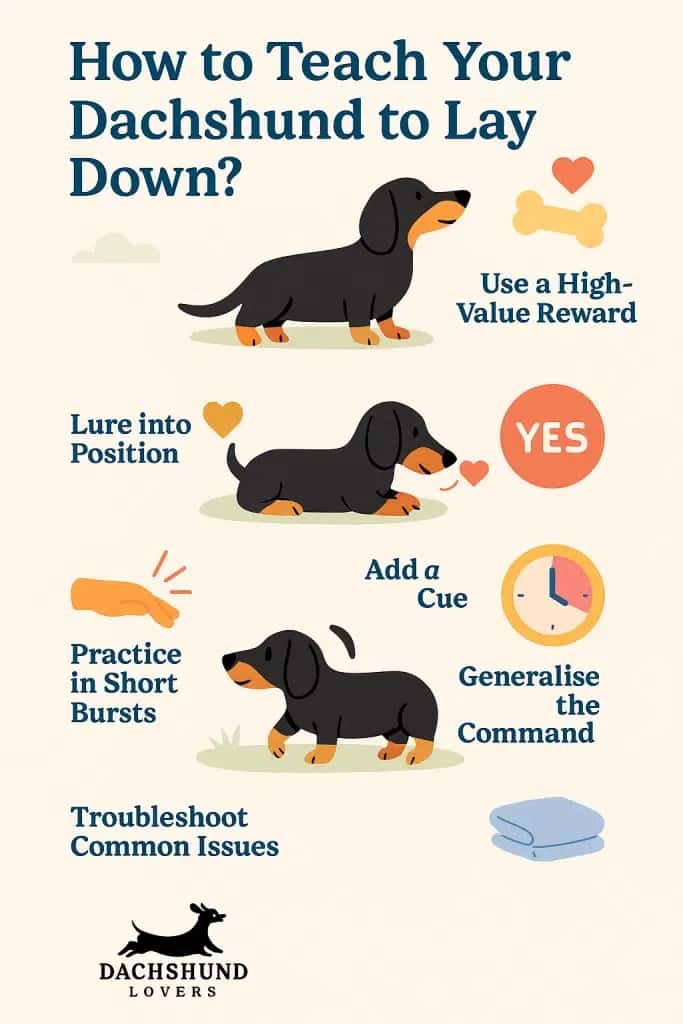
When I first started teaching Harvey to lay down, I thought it would be as simple as pointing to the floor. He had other ideas — mostly involving staying upright so he could keep an eye on the fridge. With dachshunds, you quickly realise that “lay down” is as much about trust and comfort as it is about following a cue.
1. Set the Scene
Choose a quiet, distraction-free environment for your first sessions. A familiar spot in the living room or a shaded area in the backyard works well. If your dachshund is still young or you’ve just begun house training, be prepared for shorter attention spans.
2. Use a High-Value Reward
Dachshunds are famously selective about when they’ll follow instructions. According to the American Kennel Club, using a reward they truly value — whether that’s a piece of chicken, a soft training treat, or a favourite toy — can make the difference between an uninterested stare and quick progress.
3. Lure into Position
Start with your dachshund in a sitting position. Hold the treat close to their nose, then slowly move it down toward the ground and slightly forward. As their head follows, their front legs should lower, eventually bringing them into a lying position.
Pro tip: If they back up instead of lowering down, try practicing against a wall so there’s no room to reverse.
4. Mark and Reward
The moment both elbows touch the ground, mark the behaviour with a word like “yes” or a clicker, and immediately give the treat. Timing here is critical — too late, and they won’t connect the reward with the action.
5. Add the Cue
Once your dachshund is consistently following the lure, introduce your chosen verbal cue — “down” or “lay down” — said clearly and once. Pair it with a hand signal, such as a palm facing down and moving toward the floor.
6. Practice in Short Bursts
Limit sessions to five or ten minutes, ideally ending on a successful repetition. Dachshunds tend to disengage when bored, so keeping it short maintains enthusiasm.
7. Generalise the Command
Many dachshunds will perform perfectly in the living room but forget the command in the park. Gradually add new environments — the front porch, a friend’s backyard, or even a quiet café — to help them understand that “lay down” applies everywhere.
8. Troubleshoot Common Issues
- Reluctance on hard floors — Use a training mat or towel.
- Overexcitement — Start the session after a short walk when they’re calmer.
- Partial compliance — Reward only when they fully lower their body.
With Harvey, it took about two weeks of consistent, short training sessions before “lay down” became a reliable command. Even now, years later, I keep reinforcing it in different contexts — partly for his safety, and partly because I’ve learned that with dachshunds, ongoing practice is the key to keeping skills sharp.
Why ‘Lay Down’ is a Foundational Command for Dachshunds

When people ask me which commands I consider “must-haves” for a dachshund, lay down is always in the top three. It might not seem as urgent as come or leave it, but once you live with a dachshund — especially one as full of opinions as Harvey — you start to see how much power there is in this simple position.
The first reason is safety. Imagine you’re sitting at an outdoor café and a cyclist zooms past, or a car backfires a little too close to the curb. A dachshund trained to drop into a calm, steady lay can avoid darting into trouble. I can’t count the number of times Harvey’s lay down has kept him steady while a loud bus pulled up or a dog he didn’t know came a bit too close.
It’s also invaluable during vet visits or grooming. Many dachshunds dislike being restrained, and some will wriggle and twist their way out of almost any hold. A dachshund that understands lay down sees it as a familiar, predictable position — one that gives you access to trim nails, check paws, or even inspect their ears without wrestling. The RSPCA Australia’s training guidelines highlight this cooperative handling as a major stress-reducer for both pets and owners.
Then there’s the behavioural side. A reactive dachshund can be all twitching muscles and forward momentum when something catches their attention. Teaching them to lay down is like giving them a pause button — a chance to disengage, reset, and listen. It’s not about suppressing their instincts, but about giving them another option in the moment. If your dachshund has a habit of barking or lunging, pairing lay down with positive reinforcement can be a bridge to calmer responses. You can explore this further in our guide on Reactive Dachshund Training.
It’s also a gateway command. Once a dachshund understands lay down, you can build from there — stay, wait, or even fun tricks like roll over. I often think of it as a foundation stone: everything else you build will be more stable if this piece is solid.
Finally, there’s something quietly rewarding about watching a dachshund choose to relax on cue. When Harvey stretches out beside me on the floor after hearing lay down, it’s not just obedience — it’s trust. And that trust, more than any clicker or treat, is what keeps training moving forward.
Common Mistakes to Avoid When Teaching ‘Lay Down’
If there’s one thing I’ve learned with Harvey, it’s that dachshund training can quickly go sideways if you’re not paying attention to your own cues. Teaching lay down sounds straightforward, but there are a few traps that can slow your progress or even undo it.
Rushing the process
A lot of owners try to get their dachshund to drop into a perfect down position in one go. The problem is, most dogs — especially independent thinkers like dachshunds — learn best in stages. Expecting a full lay-down straight away can frustrate both you and your dog. Start by rewarding any lowering of the body, then gradually work toward the complete position.
Poor timing with rewards
Dachshunds are fast — they can pop into and out of a lay-down in seconds. If you’re slow with your marker word or treat, you might accidentally reward them for getting up instead of staying down. I learned this the hard way with Harvey when he’d bounce straight into a sit after a lay-down, thinking that’s what earned him the reward. The American Kennel Club stresses timing as one of the key factors in command training success.
Using too much physical pressure
Some people try to push their dog’s shoulders or back to force them down. Not only can this be uncomfortable — especially for a breed prone to spinal issues like Intervertebral Disc Disease (IVDD) — it also risks creating negative associations with the command. A dachshund that thinks lay down means “someone’s going to manhandle me” will be less likely to respond happily in the future.
Training in a high-distraction environment too soon
If your dachshund is still working out what lay down means, throwing in the chaos of a dog park or a busy street is like asking someone to solve a puzzle while a marching band plays in their ear. Start in a quiet, familiar space and gradually layer in more distractions as their confidence grows.
Not pairing it with a release cue
This is a common oversight. If you don’t teach your dachshund when they’re allowed to get up, they’ll decide that for themselves — often in the middle of a stay. Pair lay down with a clear release word like “okay” or “free” so they know the difference between waiting and being done.
Expecting the same result from every dachshund
Some dachshunds will nail lay down in a couple of sessions. Others will look at you like you’ve asked them to write an essay. The speed of learning isn’t a reflection of your skill as an owner — it’s a mix of your dog’s personality, motivation, and prior training history.
If you’re finding progress slow, it can help to revisit your basics. Check your timing, rewards, and environment. Sometimes the smallest tweak — like using a softer surface or training before mealtime when they’re a little hungrier — can make all the difference.
Troubleshooting & Advanced Tips for Teaching ‘Lay Down’
Training a dachshund to lay down can sometimes feel like a test of patience rather than a simple obedience command. If your dog is resisting or taking longer than expected, you’re not alone — Harvey certainly wasn’t a “learn it in three tries” kind of student.
Here’s a breakdown of common challenges, why they happen, and what to do about them — plus some advanced training variations for when you’re ready to take it to the next level.
Problem 1 — Your Dachshund Won’t Follow the Lure
If your dachshund ignores the treat in your hand, it could be one of two things:
- The treat isn’t high enough value — swap kibble for something more enticing like tiny pieces of chicken, cheese, or freeze-dried liver.
- They’re not hungry or motivated — schedule training before meals so they’re more engaged.
If they’re still uninterested, try using a toy instead of food. Harvey has a small squeaky ball he’ll follow with laser focus — and sometimes, that was more effective than any snack.
Problem 2 — They Keep Standing Up
Some dachshunds, especially younger ones, have trouble holding the sit position before moving into the lay down. This usually happens when the lure is moved too quickly or too far forward.
Solution:
- Slow down your lure movement.
- Keep your hand close to their chest so they naturally fold into the position rather than stepping forward.
You can also practice “sit-to-down” transitions as a mini-exercise — rewarding each small improvement until the motion becomes smooth.
Problem 3 — They Pop Up Too Early
Your dachshund may lay down but immediately get back up, especially if they think the reward is “spent” once they’ve eaten it.
Solution:
- Use rapid-fire rewards — deliver several small treats while they’re still in position.
- Introduce a release cue so they learn they’re not finished until you say so.
This step was a game-changer with Harvey. Once he understood that “okay” meant the session was over, he stopped trying to end it himself.
Problem 4 — They Resist on Certain Surfaces
Some dachshunds refuse to lay down on cold tiles, wet grass, or rough concrete. This is more about comfort than defiance.
Solution:
- Start training on a comfortable mat or carpet.
- Gradually introduce different surfaces once they’re confident with the command.
- Pair new surfaces with high-value rewards so they form a positive association.
Advanced Training: Beyond the Basic ‘Lay Down’
Once your dachshund is reliably responding to the lay down cue at home and in low-distraction environments, you can use it in more functional ways.
1. The “Settle” Command
The settle is an extended version of lay down where your dachshund remains in position for several minutes, even with distractions.
How to teach it:
- Start by extending the time they stay down before receiving a treat.
- Reward intermittently rather than every few seconds, so they learn patience.
- Practice in real-world settings like at a café, during vet visits, or when guests arrive.
This is especially useful for reactive dachshunds — our Reactive Dachshund Training guide dives deeper into using commands like settle to prevent over-arousal.
2. Adding Distance
Once your dachshund will lay down on cue close to you, increase the challenge by giving the command from a step or two away.
- Begin with small distances and reward heavily when they succeed.
- If they get up and walk toward you, reset calmly and try again.
This is a handy skill for safety — imagine needing your dog to lay down across the room instead of rushing toward the door.
3. Combining Cues for Mental Stimulation
For intelligent breeds like dachshunds, chaining commands together keeps training interesting.
Example: sit → lay down → roll over → touch
Harvey thrives on this “mini routine” because it feels like a game. It also builds better communication and responsiveness.
4. Using Lay Down for Impulse Control
Impulse control is one of the hardest things for many dachshunds, especially around food, other dogs, or exciting noises.
- Ask for a lay down before putting their dinner bowl down.
- Require a lay down before opening the front door.
- Use it before tossing a toy so they learn patience is part of the game
The Emotional Side of Training ‘Lay Down’
One thing that often gets overlooked in obedience training is the bond it creates. When I first taught Harvey to lay down, I saw it as just another command. But over time, it became a signal of trust — he’d willingly go into a vulnerable position because he knew I wouldn’t put him in harm’s way.
For dachshunds, who can be naturally cautious and self-reliant, building this kind of trust is invaluable. It carries over into every other aspect of training, from leash manners to recall.
When to Seek Professional Help
If your dachshund is struggling despite your best efforts, it might be worth booking a session with a qualified positive-reinforcement trainer.
- Look for someone with experience in small, long-backed breeds.
- Avoid trainers who rely on punishment or dominance-based methods — these often backfire with independent dogs like dachshunds.
You can find a reputable trainer through the Delta Institute Australia or by asking your vet for recommendations.
FAQs — How to Train a Dachshund to Lay Down
More from This Series
Explore more breed-specific training tips and step-by-step guides from our Dachshund Obedience & Training collection:
- Dachshund Training — Understanding the dachshund mindset, from leash manners to managing their signature “doxie jump.”
- House Training a Dachshund — Practical, realistic steps for toilet training without frustration.
- Reactive Dachshund Training — Strategies for reducing reactivity to dogs, people, and distractions on walks.
Authored by
James
James is the founder of Dachshund Lovers and the proud human of Harvey, a mini dapple with a big personality. He writes to empower and connect the dachshund community, blending founder insights with honest, experience-based stories about life with this incredible and special breed. James brings candid, experience-backed opinions to the community and always focused on fewer, better products and ideas that genuinely improve life for dachshunds and their people.
Read moreJames is the founder of Dachshund Lovers and the proud human of Harvey, a mini dapple with a big personality. He writes to empower and connect the dachshund community, blending founder insights with honest, experience-based stories about life with this incredible and special breed. James brings candid, experience-backed opinions to the community and always focused on fewer, better products and ideas that genuinely improve life for dachshunds and their people.
Read more
Disclaimer
This content is for informational purposes only and should not be considered veterinary advice. Always consult with a licensed veterinarian regarding your dog’s health and wellbeing.
There are no comments yet
Leave a comment