Dachshund Travel Carrier Guide
Dachshund Travel Carrier Guide
From back seat to cabin-approved, I’ve narrowed it down to 3 dachshund-friendly carriers that balance safety, comfort, and style wherever you need to go.
James
Posted on November 5, 2025.
Updated on July 12, 2026.
Table of Contents
- 1.Key Takeaways on Dachshund Travel Carrier Guide
- 2.Types of Carriers for Dachshunds
- •1. Soft-Sided Carriers
- •2. Hard-Shell Carriers
- •3. Backpacks & Slings
- •4. Expandable Carriers
- •5. Airline-Approved vs Everyday Carriers
- 3.Carrier Comparison Table
- 4.How to Choose the Right Carrier for Your Dachshund
- •1. Sizing a Carrier
- •2. Safety Features
- •3. Comfort Considerations
- •4. Carrier Type vs Purpose
- •5. Dachshund-Specific Concerns
- 5.Carrier Feature Checklist Table
- 6.Carrier Training & Travel Preparation
- •Step 1: Introduce the Carrier at Home
- •Step 2: Build Positive Associations
- •Step 3: Short Practice Sessions
- •Step 4: Add Movement
- •Step 5: Real-World Travel
- 7.Step-by-Step Carrier Training Table
- •Additional Preparation Tips
- 8.Dachshund Carrier Needs Across Life Stages
- -More from This Series
- -Disclaimer
Share

If there’s one piece of gear that makes or breaks dachshund travel, it’s the carrier. I learned this the hard way on Harvey’s first longer trip to the Southern Highlands. We used a carrier that was too small, and by the time we arrived, he was restless, stiff, and decidedly unimpressed. Since then, we’ve tested carriers on weekend getaways to Mudgee and Newcastle, and the difference between a good fit and a bad one couldn’t be clearer.
Dachshunds aren’t built like other small breeds. Their long spines, deep chests, and short legs mean that carriers need to provide not just comfort, but also back support and security. According to the American Kennel Club, carriers are one of the safest ways for small dogs to travel, but choosing the wrong size or type can actually increase risks for dachshunds.
This guide will walk you through everything you need to know about dachshund carriers — from types and features to training tips and when to use them for road trips versus flights.
Key Takeaways on Dachshund Travel Carrier Guide
Question | Quick Answer | Why It Matters for Dachshunds |
|---|---|---|
Do dachshunds need special carriers? | Yes, ideally designed with back support and space to stretch | Their long spines make improper carriers risky |
What’s the best carrier for cars vs flights? | Hard-sided crates for cars, soft-sided for in-cabin flights | Different settings require different safety features |
How do I size a carrier for my dachshund? | They should be able to stand, turn, and lie flat | Prevents back strain and ensures comfort |
Can dachshunds travel in backpacks/slings? | For short trips only | These aren’t supportive enough for longer journeys |
How do I train my dachshund to use a carrier? | Start at home, build positive associations, reward calm behaviour | Reduces anxiety on travel day |
Are carriers safer than harnesses in cars? | Often, yes — especially for nervous dachshunds | Limits sudden movement and protects the spine |
Types of Carriers for Dachshunds
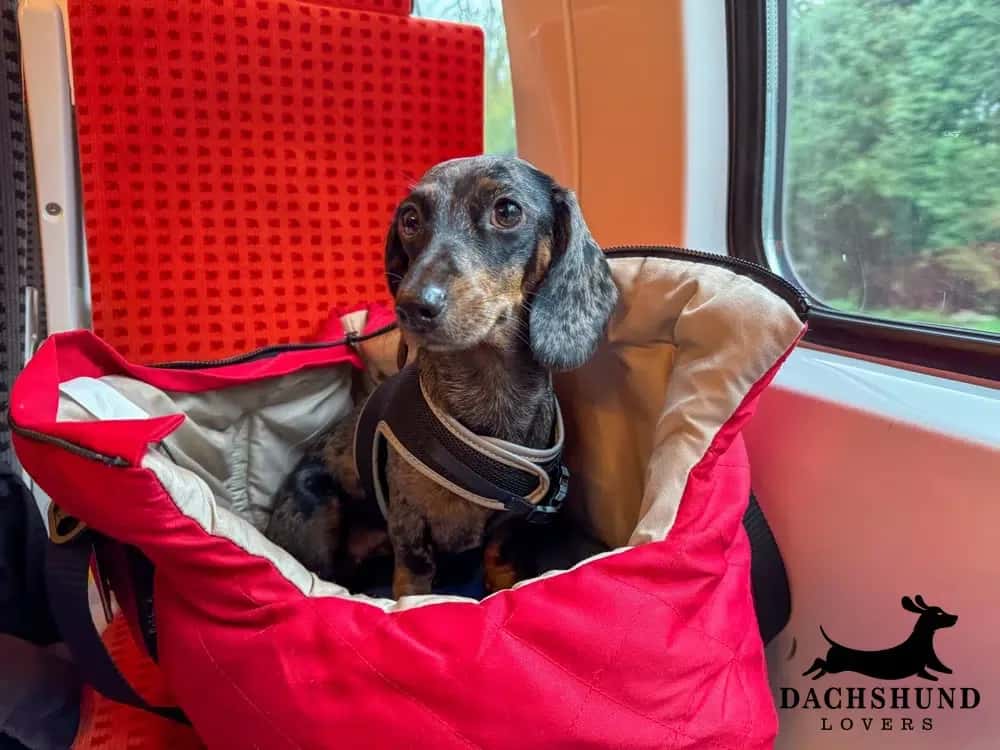
Choosing a carrier for a dachshund isn’t about picking the cutest one on the shelf — it’s about finding something that balances safety, support, and practicality. Dachshunds’ long spines mean that a poorly designed or ill-fitted carrier can actually do more harm than good. On our yearly trips to Mudgee and Newcastle, I learned firsthand that Harvey needs room to stretch, a base that won’t sag, and ventilation so he doesn’t overheat. Below are the main carrier types dachshund owners can consider, each with its own strengths and drawbacks.
1. Soft-Sided Carriers
Soft-sided carriers are the most common choice for small dogs because they’re lightweight, portable, and airline-approved. For dachshunds, they work well on short trips or for in-cabin flights (see Flying with a Dachshund), provided the base is reinforced.
The key here is support. Many soft carriers collapse slightly under the dog’s weight, which can cause a dachshund’s spine to curve unnaturally. Look for carriers with a solid base insert and padded sides to help distribute weight evenly.
2. Hard-Shell Carriers
Hard-shell crates are more robust and protective than soft carriers. They’re an excellent option for car travel (see Dachshund Road Trip Guide), particularly for nervous dachshunds who feel calmer in a secure den-like space. These crates are also easier to clean, which is handy for long journeys where accidents might happen.
The trade-off is weight and bulk. Hard-shell carriers are heavier, harder to carry through airports, and often too large to fit under airplane seats. But for safety in cars or longer trips, they’re often the most reliable option.
3. Backpacks & Slings
Pet backpacks and slings are increasingly popular for urban travel and short walks, but they’re not ideal for long-haul use. A sling may be fine for carrying your dachshund through a busy train station or hotel lobby, but it doesn’t provide the structured support their spines need.
I tried a sling for Harvey once when exploring the markets in the Southern Highlands it worked for about 15 minutes, but he wriggled uncomfortably, and I quickly realised it wasn’t a sustainable option. These should be treated as short-term convenience tools, not full travel solutions.
4. Expandable Carriers
Some modern carriers have expandable sides that zip open, creating extra room when you’re stationary. These are particularly useful for flights or hotel stays, as they allow dachshunds to stretch out more without leaving the carrier.
For Harvey, this type has been a game changer — during a winery stop in Mudgee, I was able to unzip the sides of his carrier, giving him space to stretch while still staying contained.
5. Airline-Approved vs Everyday Carriers
It’s worth noting that not all carriers are airline-approved. If you plan on flying, you’ll need to ensure your carrier meets the airline’s size and ventilation requirements. Everyday carriers may be fine for car trips or day-to-day use, but airlines are strict on measurements. Always check in advance with your carrier of choice (see Flying with a Dachshund).
Carrier Comparison Table
Carrier Type | Best For | Pros | Cons | Dachshund Notes |
|---|---|---|---|---|
Soft-Sided | In-cabin flights, short trips | Lightweight, portable, airline-approved | Less structure, can sag | Needs reinforced base for spine support |
Hard-Shell | Car travel, longer journeys | Durable, easy to clean, protective | Heavy, bulky, not cabin-friendl | Best for nervous dachshunds or long car rides |
Best for nervous dachshunds or long car rides | Short walks, urban travel | Hands-free, convenient | Poor back support, short-term use only | Use for 10–15 mins, not full trips |
Expandable | Flights, hotel stays | Extra space when stationary, versatile | Can be heavy, bulkier design | Great for stretching safely mid-journey |
Airline-Approved | Flights | Meets airline standards, safe | Smaller interior space | Always confirm size with airline in advance |
For Harvey, we actually keep two carriers a soft-sided one for cafes and shorter trips, and a hard-shell crate for the car. It sounds like overkill, but it works: the soft-sided gives us flexibility, while the hard-shell keeps him safe and calm on the road. The biggest lesson I’ve learned? Carriers aren’t one-size-fits-all. They’re tools for different scenarios, and the right one depends entirely on where and how you’re traveling.
How to Choose the Right Carrier for Your Dachshund
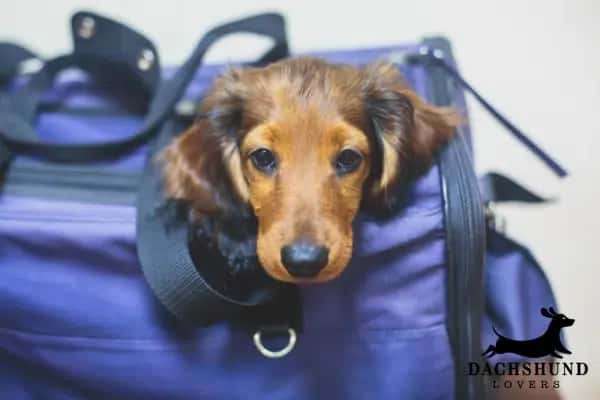
Not all carriers are created equal, and what works for a Yorkie or a Pug won’t always work for a dachshund. Their long backs, deep chests, and tendency toward back problems mean that every carrier decision should prioritise support, comfort, and safety. The wrong size or design can cause strain, while the right one can transform travel into a calm, secure experience.
When Harvey was younger, I made the mistake of buying a “small dog” carrier without measuring him properly. It was technically the right size for his weight, but too short in length, forcing him to hunch. By the time we reached the Southern Highlands, he was stiff and reluctant to get out. That experience taught me to never rely on weight limits alone. Here’s what really matters when choosing a carrier.
1. Sizing a Carrier
Sizing is the single most important factor. A dachshund carrier should allow your dog to:
- Stand up fully without hitting the top.
- Turn around easily without curling awkwardly.
- Lie flat on their side with their spine supported.
A good rule of thumb: measure your dachshund from nose to tail base, then add at least 5–8 cm to find the right carrier length. For height, measure from floor to top of head or ears (whichever is taller).
Harvey, for example, is 43 cm long from nose to tail base. His carrier needs to be at least 50 cm long to give him proper room to stretch.
2. Safety Features
A dachshund carrier should feel as safe as a child’s car seat. Key safety features include:
- Reinforced base – Prevents sagging that can stress the spine.
- Strong zippers or locks – Keeps determined dachshunds from wriggling out.
- Ventilation panels – Mesh sides or windows to keep airflow constant.
- Seatbelt loops (for cars) – Allow secure attachment to prevent sliding.
- Escape-proof design – No loose seams or weak velcro closures.
Harvey once chewed through a flimsy zipper on a cheap carrier while we were in Newcastle. Since then, durability has been at the top of my list.
3. Comfort Considerations
Dachshunds love being close to their families, but they also need to feel secure. Look for:
- Padding – Both in the base and on shoulder straps (if carried).
- Removable bedding – A washable mat inside the carrier keeps things hygienic.
- Expandable space – Useful for flights or longer stays, allowing stretching at rest stops.
- Visibility options – Some dachshunds prefer seeing out, while others feel safer in darker, den-like spaces.
When we stayed in Mudgee, Harvey settled faster in a carrier with a fleece mat that smelled like home. Familiar textures made all the difference.
4. Carrier Type vs Purpose
Not every carrier works in every situation. Match the carrier to your travel needs:
- Road trips – Hard-shell carriers with seatbelt loops offer maximum safety.
- Flights – Soft-sided, airline-approved carriers that fit under the seat.
- Short urban trips – Backpacks or slings for convenience (10–15 minutes max).
- Hotels/Airbnbs – Expandable carriers that double as a den.
This is why many dachshund owners end up with more than one carrier. It’s not excess — it’s practicality.
5. Dachshund-Specific Concerns
Unlike other small dogs, dachshunds face extra risks:
- IVDD (Intervertebral Disc Disease) – Carriers without spine support increase risk of flare-ups.
- Overheating – Dachshunds overheat easily; ventilation and cooling pads are essential for summer travel.
- Chewing – Some dachshunds will chew at zippers, seams, or mesh panels if anxious. Choose durable designs.
Checking these details ensures the carrier is genuinely dachshund-friendly, not just marketed as “small dog” safe.
Carrier Feature Checklist Table
Feature | Why It Matters | Dachshund-Specific Note |
|---|---|---|
Correct Length & Height | Allows standing, turning, lying flat | Prevents hunching and back strain |
Reinforced Base | Stops sagging under body weight | Critical for spine support |
Strong Zippers/Locks | Prevents escapes | Dachshunds are stubborn wrigglers |
Ventilation Panels | Maintains airflow | Prevents overheating in cars/flights |
Seatbelt Loops | Keeps carrier secure in car | Protects against sudden stops |
Padded Interior/Mat | Adds comfort, reduces stress | Can be swapped with familiar blanket |
Expandable Design | Extra space when resting | Great for long trips and hotels |
Durable Material | Resists chewing and scratching | Dachshunds test weak seams |
Carrier Training & Travel Preparation
Even the best carrier in the world won’t work if your dachshund refuses to go inside it. Many owners make the mistake of introducing the carrier only on travel day which almost guarantees stress, whining, and resistance. Dachshunds are creatures of habit, and building positive associations with a carrier takes time. The good news? With patience, even the most stubborn doxie can learn to see their carrier as a safe, comfortable den.
When Harvey was a pup, we rushed his first trip to the Southern Highlands. We pulled out the carrier on the morning of the trip, expecting him to trot right in. Instead, he panicked clawing at the zipper and whining the whole way. Since then, we’ve taken a completely different approach, slowly introducing his carrier at home so it feels as familiar as his bed.
Step 1: Introduce the Carrier at Home
Start by placing the carrier in a familiar space, like the living room. Leave the door open and line it with a blanket that smells like home. Let your dachshund explore it at their own pace without pressure.
Harvey ignored his at first, but once I tossed in a few of his favourite treats, curiosity won out.
Step 2: Build Positive Associations
Make the carrier part of your dog’s daily routine. Feed meals inside it, hide toys within, and reward calm behaviour when they sit or lie down inside. The goal is for the carrier to become a place of comfort, not confinement.
Some owners even replace the regular dog bed with the carrier during training.
Step 3: Short Practice Sessions
Once your dachshund is comfortable being inside, start closing the door for short periods while staying nearby. Keep sessions to a few minutes at first, gradually extending the time.
During one training run, Harvey dozed off inside his carrier after just ten minutes — proof that patience pays off.
Step 4: Add Movement
Before real travel, simulate the feeling of being carried. Pick up the carrier, walk around the house, and then set it down calmly. Later, bring it into the car and go for very short drives, gradually building to longer trips.
This step is crucial, carriers feel different in motion than when they’re stationary.
Step 5: Real-World Travel
By the time travel day comes, your dachshund should see the carrier as familiar and safe. Place a toy, chew, or blanket inside for comfort. Stick to your normal feeding schedule, and take bathroom breaks before departure.
For Harvey, this approach transformed travel from stressful to manageable. Now, when he sees his carrier, he hops in without hesitation, knowing it means adventure is ahead.
Step-by-Step Carrier Training Table
Training Stage | What to Do | Goal | Harvey’s Experience |
|---|---|---|---|
1. Introduction | Leave carrier open in familiar room with blanket | Encourage curiosity | Ignored at first, but drawn in with treats |
2. Positive Association | Feed meals/treats in carrier | Build comfort and routine | Began napping inside by week two |
3. Short Sessions | Close door for minutes at a time | Normalise confinement | Dozed off after 10 minutes |
4. Add Movement | Carry around house, short car rides | Reduce fear of motion | Nervous at first, then calm with practice |
5. Real Trave | Use for trips/flights with comfort items | Confidence on travel day | Now hops in knowing it’s “adventure time” |
Additional Preparation Tips
- Pack Familiar Scents – A blanket or toy from home helps reduce anxiety.
- Hydration – Offer water before travel but avoid overfilling to prevent accidents.
- Timing – Schedule breaks for long journeys; dachshunds do best with regular toilet stops.
- Trial Runs – Before big trips, take your dachshund on smaller ones to build confidence.
For Harvey, the biggest change came when we stopped treating the carrier as just “travel equipment” and started treating it as part of his everyday environment. Once he understood that the carrier meant security, not separation, his stress levels dropped dramatically. Now, he happily settles in whether we’re heading to Newcastle for the weekend or just popping out on a short car trip.
Dachshund Carrier Needs Across Life Stages
Life Stage | What to Expect | Risks | Carrier Tips |
|---|---|---|---|
Puppy (0–12 months) | First exposure to carriers; often restless and curiou | Fear of confinement, chewing on zippers | Use crate training early, keep sessions short, line with familiar bedding |
Adult (1–7 years) | Prime travel years; most adaptable if trained well | Overexcitement, stubborn toileting, motion sickness | Match carrier type to journey (soft-sided for flights, hard-shell for road trips) |
Senior (8+ years | Mobility and comfort matter most | Arthritis, reduced stamina, anxiety | Choose carriers with reinforced padding, easy access, and space to stretch |
Harvey’s puppy months taught us patience with training; as an adult, his carrier is simply part of the routine. Looking ahead, I know his senior years will shift our focus to comfort over distance, ensuring every trip feels like a cosy, secure experience rather than a chore.
FAQs on Dachshund Travel Carriers
More from This Series
Explore more guides in our Dachshund Travel Series:
- Traveling with a Dachshund
- Dachshund Travel Carrier Guide
- Flying with a Dachshund
- Dachshund Road Trip Guide
- Dachshund Travel Packing List
Authored by
James
James is the founder of Dachshund Lovers and the proud human of Harvey, a mini dapple with a big personality. He writes to empower and connect the dachshund community, blending founder insights with honest, experience-based stories about life with this incredible and special breed. James brings candid, experience-backed opinions to the community and always focused on fewer, better products and ideas that genuinely improve life for dachshunds and their people.
Read moreJames is the founder of Dachshund Lovers and the proud human of Harvey, a mini dapple with a big personality. He writes to empower and connect the dachshund community, blending founder insights with honest, experience-based stories about life with this incredible and special breed. James brings candid, experience-backed opinions to the community and always focused on fewer, better products and ideas that genuinely improve life for dachshunds and their people.
Read moreDisclaimer
This content is for informational purposes only and should not be considered veterinary advice. Always consult with a licensed veterinarian regarding your dog’s health and wellbeing.
There are no comments yet
Leave a comment