Dachshund Dalmatian Mix for Sale & Adoption Guide
Dachshund Dalmatian Mix for Sale & Adoption Guide
Before buying a Dachshund Dalmatian mix, here's what I’d recommend checking—price, ethical breeders, red flags, and why adoption might be a better route.
James
Posted on October 19, 2025.
Updated on July 21, 2026.
Table of Contents
- •Finding a Rare Hybrid
- -Average Prices in the US, UK, and Australia
- 1.Key Takeaways on Dachshund Dalmatian Mix For Sale
- 2.Where to Find Reputable Dachshund Dalmatian Mix Breeders
- -United States: Trusted Breeder Directories & Clubs
- -United Kingdom: Ethical Breeder Options
- -Australia: Breeder Networks & Directories
- -Tips for Approaching Breeders
- -Understanding Breeder Pricing
- -How to Identify Ethical Breeders
- -Networking Through Breed Clubs
- •Steps for Using These Breeder Networks
- -James’ Note
- 3.Adoption vs Buying: Pros & Cons
- -Why Adoption Appeals to Many Owners
- -Challenges of Adoption
- -Why Buying from Breeders Works for Some Families
- -Challenges of Buying
- -Cost Comparison: Adoption vs Buying
- -Finding the Balance
- •Top Rescues to Monitor
- -James’ Note
- 4.What Affects the Price of This Rare Mix?
- -1. Breeder Reputation and Ethics
- -2. Health Screenings and Vet Care
- -3. Rarity and Demand
- -4. Pedigree of Parent Dogs
- -5. Miniature vs. Standard Cross
- -6. Color and Coat Patterns
- -7. Location and Transport Costs
- -8. Time of Year
- •Price Ranges Recap
- -James’ Advice
- 5.Questions to Ask Breeders
- -1. What Health Tests Have Been Done on the Parents?
- -2. Can I Meet the Puppy’s Parents?
- -3. What Kind of Early Socialization Has the Puppy Had?
- -4. Are the Puppies Vaccinated, Microchipped, and Vet-Checked?
- -5. What Diet Are the Puppies Currently On?
- -6. Do You Offer a Health Guarantee or Return Policy?
- •Sample Questions for First Contact
- •Red Flags When Dealing with Breeders
- •Checklist for Meeting a Breeder
- 6.Rescue & Adoption Stories
- -Why Consider Adoption?
- -Real-Life Rescue Stories
- -Where to Find Rescues
- -Adoption Tips for First-Timers
- -Why Adoption Can Be Easier Than Raising a Puppy
- -James’ Note
- -More From This Series:
- -Disclaimer
Share

Finding a Rare Hybrid
The dachshund Dalmatian mix is a rare and unique hybrid, combining the playful independence of a dachshund with the loyal, athletic nature of a Dalmatian. Because this cross isn’t commonly bred on a large scale, finding one — whether through breeders or adoption — requires patience, research, and a clear understanding of what to look for.
Unlike popular hybrids such as labradoodles or poodle mixes, the Dalmatian Doxie isn’t widely available. This means:
- Prices can vary significantly depending on breeder reputation and location.
- Many owners find their Dalmatian Doxie through smaller breeders, accidental litters, or rescues rather than large-scale operations.
- Ethical breeding and early health checks are vital, as this hybrid combines two breeds with specific needs, including spinal care (from the dachshund) and hearing and urinary health (from the Dalmatian).
This guide will help you navigate the process of finding a healthy, well-bred dachshund Dalmatian mix, while also exploring the option of adopting through rescue organizations — which can be just as rewarding and often more affordable.
Average Prices in the US, UK, and Australia
Because of their rarity, pricing can fluctuate widely:
- United States: $800 – $2,000 USD for puppies from reputable breeders.
- United Kingdom: £700 – £1,200 GBP.
- Australia: $1,200 – $2,500 AUD.
Adoption fees are usually lower, ranging from $200–$500 USD, £150–£300 GBP, or $250–$500 AUD, and often include spaying/neutering and vaccinations.
The American Kennel Club (AKC) advises that price should reflect not just rarity but the quality of care, health testing, and early socialization a puppy has received (AKC Puppy Buyer’s Guide).
Key Takeaways on Dachshund Dalmatian Mix For Sale
Topic | Summary |
|---|---|
Rarity | This hybrid is not commonly bred, making research and patience key when looking to buy or adopt. |
Price Range | Expect $800–$2,000 USD, £700–£1,200 GBP, or $1,200–$2,500 AUD for puppies from ethical breeders. Adoption is more affordable. |
Ethical Breeding | Reputable breeders provide health checks, early vaccinations, and socialization. Always ask to see the puppy’s parents. |
Rescue Options | Adoption through organizations like Petfinder (US), Dogs Trust (UK), or PetRescue (AUS) can be rewarding and cost-effective. |
What To Avoid | Avoid puppy farms, unverified online ads, or breeders who cannot provide health records. |
Health Considerations | Look for testing related to IVDD (dachshund) and hearing issues (Dalmatian). |
Family Suitability | Choose puppies or adult dogs with the right temperament — confident, curious, and well-socialized. |
Ongoing Costs | Beyond the purchase price, budget for vet care, grooming, food, and insurance — typically $800–$1,200 USD/year. |
Finding this hybrid is like discovering a one-of-a-kind design piece. The key is not to rush. A good breeder or rescue organization will feel transparent, reassuring, and supportive from the start. I always recommend meeting the puppy’s mother if possible — it tells you a lot about the temperament your dog might inherit.
Where to Find Reputable Dachshund Dalmatian Mix Breeders

Because the Dachshund Dalmatian mix is a rare hybrid, most reputable breeders are not running large-scale operations. Instead, you’ll often find small, home-based breeders who specialize in one or both parent breeds (dachshunds or Dalmatians) and occasionally produce mixes. Your search will involve checking breed clubs, vetted directories, and word-of-mouth recommendations.
United States: Trusted Breeder Directories & Clubs
- AKC Marketplace
While the Dachshund Dalmatian mix won’t have a dedicated listing, the AKC Marketplace is an excellent place to find breeders of purebred dachshunds and Dalmatians. These breeders often have the highest health and ethical standards, and some may occasionally produce cross litters. - Dachshund Club of America (DCA)
Website: https://dachshundclubofamerica.org/
The DCA has a list of recognized dachshund breeders across the US. Reaching out directly can help you find breeders who may also breed hybrids or know trusted contacts. - Dalmatian Club of America (DCA)
Website: https://thedca.org/
The Dalmatian Club provides a network of breeders that adhere to strict ethical standards. While they focus on purebred Dalmatians, they can often refer you to mixed-breed litters through their community. - Good Dog
Website: https://www.gooddog.com/
Good Dog screens breeders for health testing and breeding ethics. Searching for dachshunds or Dalmatians here can connect you to small breeders who also offer hybrid litters.
United Kingdom: Ethical Breeder Options
- The Kennel Club Assured Breeder Scheme
Website: https://www.thekennelclub.org.uk/dog-owners/buying-a-dog/
While hybrids like the Dalmatian Doxie aren’t KC-recognized, breeders under this scheme often focus on health and temperament. You can contact KC-recognized dachshund or Dalmatian breeders for hybrid recommendations. - British Dalmatian Club
Website: https://www.britishdalmatianclub.org.uk/
This club provides contact information for reputable Dalmatian breeders who may have cross litters. - The Dachshund Club UK
Website: http://www.dachshundclub.co.uk/
A reliable hub for reputable dachshund breeders — some members collaborate with other breeds to create hybrids. - Pets4Homes (With Caution)
Website: https://www.pets4homes.co.uk/
Pets4Homes lists many hybrids, but use it carefully. Look only for sellers with verified breeder badges and ask for health documents before committing.
Australia: Breeder Networks & Directories
- Dogzonline
Website: https://www.dogzonline.com.au/
This is Australia’s most trusted platform for ethical breeders, including dachshunds and Dalmatians. Many breeders here are registered with Dogs NSW or Dogs Victoria. - Master Dog Breeders Association (MDBA)
Website: https://www.mdba.net.au/
MDBA lists reputable breeders who meet strict standards. You can filter by breed and enquire about hybrids. - Dachshund Club of NSW
Website: https://www.dachshundclubnsw.com/
They offer resources and breeder contacts for dachshund lovers across Australia. - Dalmatian Club of Victoria (AUS)
Website: http://dalmatianclubvictoria.org.au/
This club is a key point of contact for finding Dalmatian breeders who focus on health and temperament.
Tips for Approaching Breeders
- Be patient: Many reputable breeders have waitlists, especially for rare hybrids.
- Ask for referrals: Even if a breeder doesn’t have a Dalmatian Doxie, they might know someone who does.
- Visit in person: A reputable breeder will encourage visits or video calls to see the puppies and parents.
- Look for transparency: Good breeders share veterinary records, health screenings, and details about the puppy’s environment.
Online Classifieds — With Extreme Caution
Websites like Gumtree (UK and AUS), Craigslist (US), or PuppyFind may list dachshund Dalmatian mixes, but this is where due diligence is crucial. Always:
- Request detailed photos and videos of the puppy and parents.
- Ask for proof of veterinary checks, microchipping, and vaccinations.
- Meet in person or via video call before committing.
Scammers often use stock images or request deposits upfront without showing the puppies in a real environment.
Personal Networks and Social Media
Sometimes the best leads come from dog communities, vet offices, or social platforms like Facebook breeder groups (be mindful of legitimacy). Instagram accounts of dachshund or Dalmatian enthusiasts occasionally showcase litters or collaborations between trusted breeders.
Questions to Ask Breeders
The AKC recommends asking a series of essential questions before making a purchase (AKC Puppy Buyer’s Guide):
- Can I meet the puppy’s mother and see where the litter is raised?
- What health tests have been done on the parents? (IVDD screening for dachshunds, hearing and hip evaluations for Dalmatians.)
- Are the puppies vet-checked, microchipped, and vaccinated?
- What socialization methods have you used? Puppies raised in home environments tend to adapt better to family life.
- Do you offer a health guarantee or support for new owners?
A responsible breeder will happily answer these questions and often ask you just as many — they’ll want to know that their puppy is going to a stable, loving home.
Understanding Breeder Pricing
Pricing reflects the level of care and investment in breeding healthy dogs:
- United States: $800 – $2,000 USD.
- United Kingdom: £700 – £1,200 GBP.
- Australia: $1,200 – $2,500 AUD.
These prices often include:
- Initial vaccinations and microchipping.
- Early socialization and basic training.
- Health certifications and documentation.
If you encounter pricing significantly below these ranges, proceed with caution — it could signal poor breeding conditions or a lack of proper vet care.
How to Identify Ethical Breeders
Signs of a reputable breeder include:
- Puppies are raised in a clean, family environment, not in overcrowded kennels.
- They limit the number of litters per year to prioritize health and quality.
- They are open to home visits and provide detailed paperwork on vaccinations, deworming, and parental health history.
- They encourage you to stay in touch and are available for post-adoption support.
Red Flags:
- Refusal to show the puppy’s living conditions.
- Lack of interest in your home or lifestyle.
- No vaccination records or vague health claims.
- High-pressure tactics to pay deposits quickly.
The RSPCA warns that puppy farms often hide behind slick websites or fake home photos, so always verify details (RSPCA Puppy Advice).
Networking Through Breed Clubs
Local and national dachshund or Dalmatian clubs can be excellent resources. Even if they don’t directly breed hybrids, club members often have trusted connections or referrals. Attending breed-specific events, meetups, or dog shows can also give you a sense of the community and lead you to responsible breeders.
Steps for Using These Breeder Networks
- Reach Out Directly: Even if breeders don’t have a hybrid litter, ask if they can refer you to someone in their network.
- Get on a Waitlist: Ethical breeders often plan litters months in advance, especially for rare mixes.
- Check Credentials: Confirm they’re registered with relevant clubs (AKC, Kennel Club UK, Dogs NSW, MDBA) and ask for health certificates.
- Visit or Video Call: Reputable breeders will welcome virtual tours or visits to meet the puppies and parents.
James’ Note
I always say: a good breeder feels like a partner, not a seller. They’ll ask as many questions about you as you do about them — they want to ensure their puppy is going to a safe, caring home. If something feels rushed or transactional, it’s worth walking away and waiting for the right match.
Adoption vs Buying: Pros & Cons

When deciding between adopting or buying a dachshund Dalmatian mix, the choice often comes down to lifestyle, timing, and personal values. Both paths offer rewards — but they come with different responsibilities and expectations. With this hybrid’s rarity, the right approach might even be a blend of patience and flexibility, keeping both adoption and breeder options open.
Why Adoption Appeals to Many Owners
Adopting a dog from a shelter or rescue isn’t just about saving money — it’s about giving a second chance to a dog who needs a loving home. Many dachshund Dalmatian mixes, especially those from accidental litters or surrendered homes, end up in rescue organizations rather than with breeders.
Benefits of Adoption:
- Lower Cost:
- Adoption fees usually range between $200–$500 USD, £150–£300 GBP, or $250–$500 AUD.
- This often includes spaying/neutering, vaccinations, microchipping, and initial health checks, saving you hundreds on upfront medical care.
- Adoption fees usually range between $200–$500 USD, £150–£300 GBP, or $250–$500 AUD.
- Ethical Choice:
- You’re reducing demand for puppy farms or backyard breeders.
- Many rescue dogs are already socialized and house-trained, making them easier to integrate into family life.
- You’re reducing demand for puppy farms or backyard breeders.
- Older Dogs, Less Work:
- Adopting a dog that’s past the puppy stage can mean less destructive behavior, no teething, and fewer training challenges.
- Adult dogs are often overlooked in shelters, yet they can form deep, immediate bonds with their new families.
- Adopting a dog that’s past the puppy stage can mean less destructive behavior, no teething, and fewer training challenges.
- Support from Rescue Teams:
- Rescues often provide detailed behavior assessments of each dog and will guide you on how to manage their needs.
- Some organizations even offer trial periods before final adoption.
- Rescues often provide detailed behavior assessments of each dog and will guide you on how to manage their needs.
Challenges of Adoption
While adoption is rewarding, it’s not always simple.
- Limited Availability:
Dachshund Dalmatian mixes are rare, so finding one in a shelter may require time, regular monitoring of rescue listings, or being flexible with age and coat pattern. - Unknown History:
Rescue dogs may come with limited health or behavioral records, meaning you could face surprise vet bills or training challenges. - Possible Adjustment Period:
Some rescue dogs need patience, reassurance, and re-socialization if they’ve had a difficult start.
Why Buying from Breeders Works for Some Families
For families looking for a puppy from the very start, buying from an ethical breeder offers predictability and guidance.
Benefits of Buying:
- Health Transparency:
- Responsible breeders provide health clearances for both parent dogs, reducing the risk of genetic conditions like IVDD (from dachshunds) or deafness (from Dalmatians).
- Responsible breeders provide health clearances for both parent dogs, reducing the risk of genetic conditions like IVDD (from dachshunds) or deafness (from Dalmatians).
- Early Socialization:
- Puppies are raised in structured environments, exposed to people, household noises, and sometimes even early crate training.
- Puppies are raised in structured environments, exposed to people, household noises, and sometimes even early crate training.
- Tailored Puppy Experience:
- You can choose based on coat patterns, temperament assessments, and even size (miniature vs. standard-cross).
- You can choose based on coat patterns, temperament assessments, and even size (miniature vs. standard-cross).
- Ongoing Support:
- A reputable breeder will remain a resource for training advice, diet tips, and long-term health guidance.
- A reputable breeder will remain a resource for training advice, diet tips, and long-term health guidance.
Challenges of Buying
- Cost:
Buying from an ethical breeder is expensive: - US: $800–$2,000 USD.
- UK: £700–£1,200 GBP.
- Australia: $1,200–$2,500 AUD.
- US: $800–$2,000 USD.
- Waitlists:
Ethical breeders often have waitlists, especially for unique hybrids like this one. It can take 6–12 months (or longer) to secure a puppy. - Scams and Puppy Farms:
The popularity of designer dogs has created a market for unethical breeders who prioritize profit over health. Vetting breeders is essential to avoid heartbreak and medical complications.
Cost Comparison: Adoption vs Buying
Expense | Adoption (Rescue) | Buying (Breeder) |
|---|---|---|
Upfront Cost | $200–$500 USD / £150–£300 GBP / $250–$500 AUD | $800–$2,000 USD / £700–£1,200 GBP / $1,200–$2,500 AUD |
Vaccinations | Included | $100–$300 USD |
Spay/Neuter | Included | $200–$500 USD |
Microchipping | Included | $40–$60 USD |
Total Initial Cost | $200–$500 USD | $1,200–$3,000+ USD |
Finding the Balance
For some owners, the perfect fit comes from a mix of both worlds. They may get on a breeder waitlist but also monitor rescues regularly. With rare hybrids like the dachshund Dalmatian mix, this strategy often increases your chances of success.
Top Rescues to Monitor
US:
- Dalmatian Rescue of South Florida: https://dalmatianrescue.com/
- Coast to Coast Dachshund Rescue: https://www.c2cdr.org/
- Petfinder: https://www.petfinder.com/
UK:
- British Dalmatian Welfare: https://www.dalmatianwelfare.co.uk/
- Dachshund Rescue UK: https://dachshundrescue.org.uk/
- Dogs Trust: https://www.dogstrust.org.uk/
AUS:
- PetRescue: https://www.petrescue.com.au/
- Dachshund Rescue Australia: https://dachshundrescue.com.au/
- RSPCA Australia: https://www.rspca.org.au/adopt
James’ Note
Adoption and buying aren’t about better or worse — they’re about what works for your family and lifestyle. Some people love the hands-on experience of raising a puppy, while others find deep joy in giving a second chance to a rescue dog who is already past the early chaos. There’s no wrong choice if the dog ends up in a home where it’s truly cherished.
What Affects the Price of This Rare Mix?
The dachshund Dalmatian mix is far from a mass-produced hybrid. Unlike more common designer breeds such as labradoodles or cavapoos, this mix is relatively rare, and that uniqueness drives up the price. But price is not only about rarity — it reflects a variety of factors, including breeder reputation, parental health, and demand. Here’s a breakdown of what determines the cost of this hybrid across the US, UK, and Australia.
1. Breeder Reputation and Ethics
The reputation of the breeder is one of the biggest factors affecting price. Ethical breeders invest significant time and resources into:
- Health testing for common genetic conditions (IVDD for dachshunds, deafness or urinary issues for Dalmatians).
- Early socialization (introducing puppies to people, sounds, and environments).
- High-quality nutrition and veterinary care for the litter.
Well-established breeders often charge higher prices (closer to $2,000 USD or $2,500 AUD) because they follow strict guidelines and offer additional benefits like:
- Puppy starter kits with food and toys.
- Health guarantees covering hereditary conditions.
- Ongoing support for training or health advice.
Conversely, backyard breeders or puppy farms may sell puppies for less, but often skip health checks and early socialization — which can result in higher long-term costs for the owner due to vet bills or behavioral issues.
2. Health Screenings and Vet Care
Puppies that undergo thorough health screening (hearing tests, joint checks, vaccinations, microchipping, and deworming) command a higher price because of the breeder’s upfront costs.
- US: Ethical breeders typically factor in $200–$500 USD per puppy in early veterinary expenses.
- UK: Vaccinations and microchipping can add £100–£200 to the cost of rearing each puppy.
- Australia: Similar costs of $250–$400 AUD per puppy are standard for high-quality breeders.
If a breeder provides health certifications for both parents, especially for conditions like hip dysplasia, this adds value and reassurance.
3. Rarity and Demand
Because the dachshund Dalmatian mix is not a common hybrid, demand can outweigh availability. This mix appeals to people who want something distinctive, stylish, and full of character — and with fewer breeders producing them, prices naturally rise.
For example:
- In major US cities (e.g., Los Angeles or New York), demand for unique hybrids can push prices above $2,000 USD.
- In the UK, southern regions like London and Kent see higher prices due to limited local breeders.
- In Australia, availability is often concentrated in New South Wales and Victoria, meaning interstate transport can add another $200–$500 AUD.
4. Pedigree of Parent Dogs
If the dachshund or Dalmatian parent is from a champion bloodline, prices can rise significantly. Breeders who compete in AKC or Kennel Club shows often produce puppies that meet higher standards for appearance, temperament, and health.
- Puppies from champion lines can range from $1,500–$2,500 USD in the US or $2,000–$3,000 AUD in Australia.
- Standard parent dogs (without show pedigrees) are typically in the $800–$1,200 USD range.
5. Miniature vs. Standard Cross
The size of the dachshund parent also impacts price. Miniature dachshunds are in high demand globally, making miniature Dalmatian Doxie mixes slightly more expensive than standard-sized ones.
- Expect to pay 10–15% more for miniature-cross hybrids due to their popularity as apartment-friendly dogs.
6. Color and Coat Patterns
Dalmatians are famous for their black or liver spots, and when crossed with dachshunds, puppies with striking, symmetrical markings often command a premium. Rare coat variations like brindle or dapple patterns (inherited from dachshunds) can also increase prices by $200–$500 USD or equivalent.
7. Location and Transport Costs
Where you live affects pricing:
- Urban areas with high demand and fewer breeders (e.g., Sydney or London) tend to have higher prices.
- Rural breeders might offer slightly lower prices but often require transport arrangements — adding $150–$300 USD or $200–$400 AUD to the total cost.
8. Time of Year
Interestingly, seasonal demand affects puppy pricing.
- Spring and summer: Prices peak due to higher demand, as families look for puppies during school breaks.
- Autumn and winter: Prices may dip slightly, with fewer buyers actively searching.
Price Ranges Recap
- US: $800 – $2,000 USD.
- UK: £700 – £1,200 GBP.
- Australia: $1,200 – $2,500 AUD.
Adoption Fees:
Rescue organizations usually charge $200–$500 USD, £150–£300 GBP, or $250–$500 AUD. These fees often include spaying/neutering and vaccines — making adoption a highly cost-effective alternative.
James’ Advice
Price doesn’t always equal quality, but it’s often a reflection of care, health, and ethics. I always encourage buyers to look beyond the number. Ask yourself:
- Does this breeder show genuine concern for the puppy’s welfare?
- Are they transparent about vet care, parental health, and living conditions?
- Do they provide support after the sale?
If the answer is yes, the price is likely worth it.
Questions to Ask Breeders
When searching for a dachshund Dalmatian mix, the most important step is not just finding a puppy — it’s ensuring that the breeder prioritizes health, ethics, and long-term well-being over profit. Asking the right questions will help you identify responsible breeders and avoid unethical practices like puppy mills.
1. What Health Tests Have Been Done on the Parents?
Both dachshunds and Dalmatians are prone to specific health conditions:
- Dachshunds: Intervertebral Disc Disease (IVDD), dental issues, and obesity-related spinal strain.
- Dalmatians: Hearing loss (congenital deafness), hip dysplasia, and urinary problems.
A responsible breeder will have health certifications for both parent dogs.
Ask for proof of:
- BAER (Brainstem Auditory Evoked Response) testing for hearing (especially for Dalmatian parents).
- Hip and elbow evaluations (certified by OFA or BVA).
- Screening for IVDD and genetic markers for spinal issues.
If a breeder hesitates or cannot provide this documentation, it’s a red flag.
2. Can I Meet the Puppy’s Parents?
Meeting the mother (and father, if possible) provides insight into:
- Temperament: A calm, friendly mother often produces well-adjusted puppies.
- Size and appearance: You can better predict how your puppy will look and behave.
- Living environment: Ethical breeders raise puppies in clean, safe, home-like conditions, not cramped kennels.
If a breeder refuses or offers to “meet at a neutral location” instead of their home, this could indicate puppy farming.
Puppies raised in stimulating environments — with exposure to household sounds, people, and safe outdoor experiences — are far more confident and trainable.
Ask questions like:
- “Have they been introduced to basic handling (nail trims, brushing)?”
- “Have they met other dogs or children?”
Socialization in the first 12 weeks is crucial for long-term behavior. The AKC notes that dogs who are not properly socialized early are more likely to develop fear-based aggression (AKC Socialization Tips).
4. Are the Puppies Vaccinated, Microchipped, and Vet-Checked?
By 8 weeks (the typical age for going to new homes), a reputable breeder will ensure that the puppy has:
- First set of vaccinations.
- Microchipping (a legal requirement in the UK and Australia).
- A veterinary health certificate confirming they’re healthy and parasite-free.
5. What Diet Are the Puppies Currently On?
Transitioning your puppy to a new home is easier if you continue feeding what they’re used to. Ethical breeders will share:
- The current diet (brand, feeding schedule).
- Portion recommendations for the first weeks.
- Advice on transitioning to adult food.
6. Do You Offer a Health Guarantee or Return Policy?
Most reputable breeders offer at least a 12-month health guarantee for genetic conditions. They’ll also be open to taking the puppy back if unforeseen circumstances mean you can’t keep it — because they genuinely care about where their puppies end up.
Sample Questions for First Contact
If you’re emailing or calling a breeder, here’s an example of how to start the conversation:
Hello [Breeder Name],
I’m interested in your dachshund Dalmatian mix puppies (or future litters). Could you tell me more about the health testing you do on the parent dogs? Also, do you allow visits to meet the puppies and the mother?
Thank you, [Your Name].
Additional questions to ask:
- “How long have you been breeding dachshunds/Dalmatians?”
- “How often do you breed your dogs?” (Ethical breeders limit litters to protect the mother’s health.)
- “Can you provide references from past puppy buyers?”
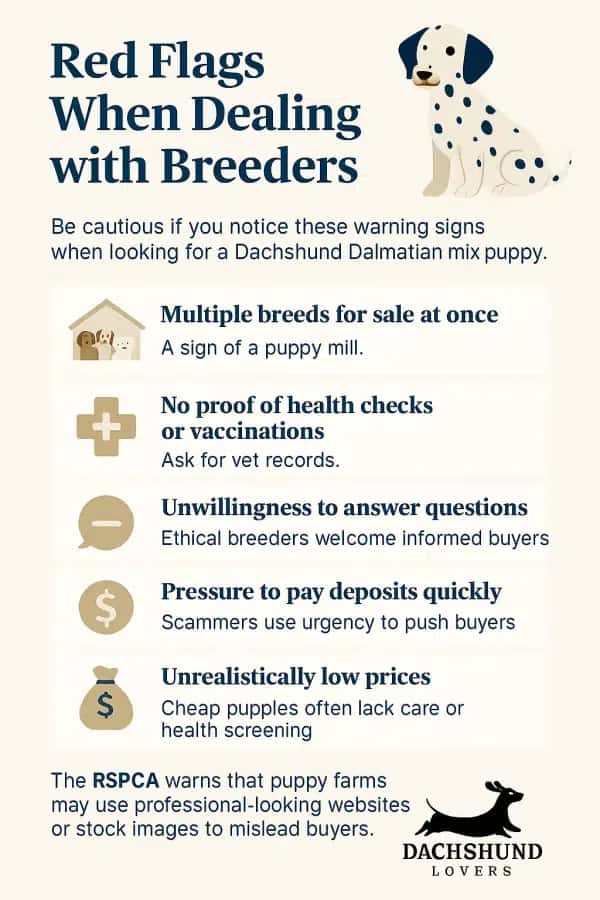
Red Flags When Dealing with Breeders
Be cautious if you notice:
- Multiple breeds for sale at once: A sign of a puppy mill.
- No proof of health checks or vaccinations.
- Unwillingness to answer questions: Ethical breeders appreciate well-informed buyers.
- Pressure to pay deposits quickly: Scammers often use urgency to push buyers.
- Unrealistically low prices: Puppies priced far below market value often lack proper care or health screening.
The RSPCA warns that puppy farms often use professional-looking websites or stock images to mislead buyers (RSPCA Puppy Buying Advice).
Checklist for Meeting a Breeder
Bring this mental checklist when you visit:
- Do the puppies and parents look healthy and clean?
- Are the puppies kept in a home environment, not cages or sheds?
- Does the breeder ask questions about your lifestyle (a good sign)?
- Are health records and vaccination cards provided upfront?
James’ Note
The best breeders feel more like mentors than sellers. They care deeply about where their puppies go, offering honest advice — even if it means you wait for the next litter. I always say: if a breeder feels rushed or secretive, walk away. A well-bred dog is worth waiting for.
Rescue & Adoption Stories
For many families, finding a dachshund Dalmatian mix doesn’t happen through breeders — it begins with rescue organizations and shelters. While this hybrid is rare, the right mix of patience, research, and networking with rescue groups can uncover dogs in need of a home. Adoption isn’t just cost-effective; it’s deeply rewarding. You’re not only welcoming a pet into your family but giving a dog a second chance at life.
Why Consider Adoption?
- Lower Costs: Adoption fees (ranging from $200–$500 USD, £150–£300 GBP, or $250–$500 AUD) typically include vaccinations, spaying/neutering, microchipping, and initial vet checks.
- Adult Dogs with Personality: Many rescues have already developed their temperament, so you can choose a dog whose energy and personality fit your family.
- Support and Guidance: Rescue organizations often provide behavior assessments and training support to ensure a smooth transition.
For guidance on raising younger dogs, you can also refer to our Dachshund Dalmatian Mix Puppies Guide, especially if you adopt a dog under 12 months old.
Real-Life Rescue Stories
- Cooper – Adopted from a US Dalmatian Rescue
Cooper, a spotted dachshund mix, was surrendered due to his owner’s health issues. A Florida-based rescue specializing in Dalmatians stepped in. Within weeks, Cooper found a home with a young couple who adored his quirky blend of dachshund confidence and Dalmatian loyalty. Today, Cooper enjoys regular walks and has become a “local park favorite” thanks to his unique markings. - Molly – A UK Adoption Success
Molly was found as part of an accidental litter and ended up with British Dalmatian Welfare. Her new owner shared that Molly’s personality is “the perfect mix of playful energy and quiet affection.” Molly’s transition into family life was smooth because the rescue had already provided basic training and socialization. - Archie – From Australia’s PetRescue
Archie, a dachshund Dalmatian mix from Victoria, was adopted through PetRescue Australia. His new family praised the adoption process for being transparent and supportive, offering health updates and guidance for Archie’s spinal care — an important factor for dachshund mixes.
Where to Find Rescues
- US: Dalmatian Rescue of South Florida and Coast to Coast Dachshund Rescue often have mixes available.
- UK: British Dalmatian Welfare and Dachshund Rescue UK are top choices.
- Australia: PetRescue and Dachshund Rescue Australia list available mixes nationwide.
If you’re new to adoption, our Full Grown Dachshund Dalmatian Mix Guide includes advice on understanding adult temperament and integrating a dog into your household.
Adoption Tips for First-Timers
- Be Patient: Rare hybrids like the Dalmatian Doxie don’t appear every day in shelters. Set up alerts on Petfinder (US) or PetRescue (AUS) and regularly check welfare websites.
- Ask Questions: Inquire about the dog’s health history, behavior around children or other pets, and any special needs (like spinal care for dachshund-shaped dogs).
- Meet-and-Greet: Spend time with the dog before finalizing the adoption. See how they respond to your voice, touch, and family members.
- Prepare Your Home: Have the basics ready — a safe sleeping area, dog-safe zones (stairs blocked if needed), and starter supplies.
Why Adoption Can Be Easier Than Raising a Puppy
While puppies are adorable, they require intensive time and energy — from housebreaking to training. Adopting an older dachshund Dalmatian mix means you’re getting:
- A dog that’s often past the teething and chewing phase.
- A pet with a more predictable energy level and personality.
- A companion ready to fit into your lifestyle with fewer surprises.
For families that prefer a puppy, our Puppies Guide offers structured training and feeding tips — much of which also applies to younger rescue dogs.
James’ Note
I’ve met many rescue dogs over the years, and they often have a depth of gratitude that’s hard to put into words. When you adopt, you’re not just saving a life — you’re gaining a companion who truly knows what it means to be given a second chance. That loyalty and affection often feel like a reward for simply opening your heart and home.
FAQs About Dachshund Dalmatian Mix for Sale & Adoption
More From This Series:
Finding or adopting a dachshund Dalmatix is just one step in understanding this unique crossbreed. Our full series of guides is designed to take you from breed discovery to daily care, covering everything from puppy training to adult health. If you’re considering adding this hybrid to your family, these articles will help you prepare at every stage.
- About Dachshund Dalmatian Mix
Read Here →
Start with our comprehensive overview of the breed’s history, appearance, and temperament. Learn what makes this hybrid so rare, and how the mix of dachshund independence and Dalmatian loyalty creates such a distinctive personality.
- Dachshund Dalmatian Mix Puppies
Read Here →
From choosing a healthy puppy to early training, feeding, and socialization, this guide is perfect if you’re starting with a young Dalmatian Doxie. It also includes tips on crate training, exercise, and building a positive daily routine.
- Full Grown Dachshund Dalmatian Mix: Size & Growth
Read Here →
Curious about how big they’ll get or how their temperament evolves over time? This article covers growth timelines, adult weight, exercise needs, and personality changes from puppyhood to senior years.
- Dachshund Dalmatian Mix Temperament & Personality
Read Here →
Dive deeper into the behavioral traits, family compatibility, and training tips that bring out the best in this hybrid. If you’re wondering whether this mix is right for your household, start here.
- Dachshund Dalmatian Mix Health & Lifespan
Read Here →
A guide to common health concerns, genetic predispositions, and preventive care, including diet tips and routine vet checks that help extend their lifespan.
- Dachshund Dalmatian Mix for Sale & Adoption Guide
(You’re here!) This article explores where to find this rare hybrid, breeder vs adoption considerations, price breakdowns (US, UK, AUS), and how to avoid scams.
Authored by
James
James is the founder of Dachshund Lovers and the proud human of Harvey, a mini dapple with a big personality. He writes to empower and connect the dachshund community, blending founder insights with honest, experience-based stories about life with this incredible and special breed. James brings candid, experience-backed opinions to the community and always focused on fewer, better products and ideas that genuinely improve life for dachshunds and their people.
Read moreJames is the founder of Dachshund Lovers and the proud human of Harvey, a mini dapple with a big personality. He writes to empower and connect the dachshund community, blending founder insights with honest, experience-based stories about life with this incredible and special breed. James brings candid, experience-backed opinions to the community and always focused on fewer, better products and ideas that genuinely improve life for dachshunds and their people.
Read moreDisclaimer
This content is for informational purposes only and should not be considered veterinary advice. Always consult with a licensed veterinarian regarding your dog’s health and wellbeing.
There are no comments yet
Leave a comment