Dachshund Weight Loss: A Vet-Approved Guide
Dachshund Weight Loss: A Vet-Approved Guide
Discover the best way to support safe weight loss for dachshunds. Food swaps, portion control, and how to make walks actually work. This is what worked for us.
James
Posted on September 17, 2025.
Updated on July 21, 2026.
Table of Contents
- 1.Key Takeaways on Dachshund Weight Loss
- 2.How to Tell If Your Dachshund Is Overweight
- •1. The Rib Test (Tactile Check)
- •2. The Overhead View
- •3. The Side Profile
- •4. Behavioural Signs
- 3.How to Calculate Your Dachshund’s Ideal Weight
- •Weight Ranges by Dachshund Type
- 4.Adjusting Food for Weight Loss (Without the Hunger Meltdown)
- •1. Start With a Calorie Baseline — Then Reduce Gently
- -Formula:
- •2. Don’t Just Cut Food — Change What You’re Feeding
- -What Worked for Harvey:
- •3. Use Vegetables as Low-Calorie Fillers
- -Our go-to low-cal fillers:
- •4. Weigh the Treats — Literally
- •High-calorie offenders:
- •5. Stick to a Schedule — No Grazing
- -Our structure:
- •6. Hydration Supports Satiety and Digestion
- 5.Best Exercises for Dachshund Weight Loss (That Don’t Harm Their Back)
- •1. Two Short Walks Per Day (Minimum)
- -Tips:
- •2. Indoor Movement Counts Too
- •3. Swimming (If Your Doxie Tolerates It)
- •4. Set Up Controlled Obstacle Courses
- •5. Avoid These Common Mistakes
- 6.What to Avoid When Helping Your Dachshund Lose Weight
- •1. Crash Dieting or Drastically Cutting Food
- •2. Inconsistent Feeding or Tracking
- •3. High-Calorie Treats with No Calorie Offsets
- •4. Overexercising Too Soon
- •5. Punishment-Based Mindset
- -More from This Series
- -Disclaimer
Share

There’s no polite way to say it — Harvey got fat.
Not overnight. Not from one too many biscuits. It was slow and sneaky. A few extra treats here, a slightly larger scoop of kibble there and throw in a toddler into the mix who is the lord of the treats and dinner extras. Add in a rainy fortnight without walks around Taren Point Reserve, and suddenly his harness didn’t fit and he refused to climb stairs.
We didn’t panic. But we did take it seriously.
Because with dachshunds, a little extra weight doesn’t just sit on their frame — it pulls on it. Their long backs and short legs make them especially prone to injuries like IVDD (intervertebral disc disease), and even half a kilo of excess weight can increase that risk significantly.
According to the Association for Pet Obesity Prevention (APOP), more than 55% of dogs in Australia and the U.S. are overweight — and small breed dogs like dachshunds are at greater risk of musculoskeletal problems when carrying even a slight excess.
A 2020 review published in Veterinary Clinics of North America: Small Animal Practice found that:
“Obesity in small-breed dogs contributes significantly to the incidence and severity of intervertebral disc disease, osteoarthritis, and reduced lifespan.”
That was enough for us.
This guide isn’t about cutting your doxies food in half or going full keto. It’s a practical, shame-free, vet-aligned roadmap to help your dachshund shed extra weight safely — while still enjoying life.
We’ll cover:
- How to calculate your dachshund’s ideal weight
- Adjusting food portions without creating hunger
- Vet-approved exercise strategies for small, long dogs
- Common mistakes owners make when trying to help
- And how we helped Harvey drop 800g — and keep it off without drama
Grounded in research. Informed by real dachshund life.
Because the goal isn’t skinny. It’s strong, mobile, and healthy.
Key Takeaways on Dachshund Weight Loss
Topic | Summary |
|---|---|
Weight Loss is Health Protection | Even 0.5–1 kg of extra weight can increase a dachshund’s risk of IVDD and joint strain. |
Small Adjustments = Big Impact | Calorie cuts of just 10–20% paired with daily movement can produce steady results. |
Exercise Must Be Breed-Specific | Avoid high-impact activity — opt for short, regular walks and joint-safe play. |
Crash Diets Don’t Work | Sudden food cuts or skipping meals can backfire. Dachshunds do best with structure and routine. |
Vet Advice + Monitoring Matters | Regular weigh-ins and body condition checks are essential for safe progress. |
How to Tell If Your Dachshund Is Overweight
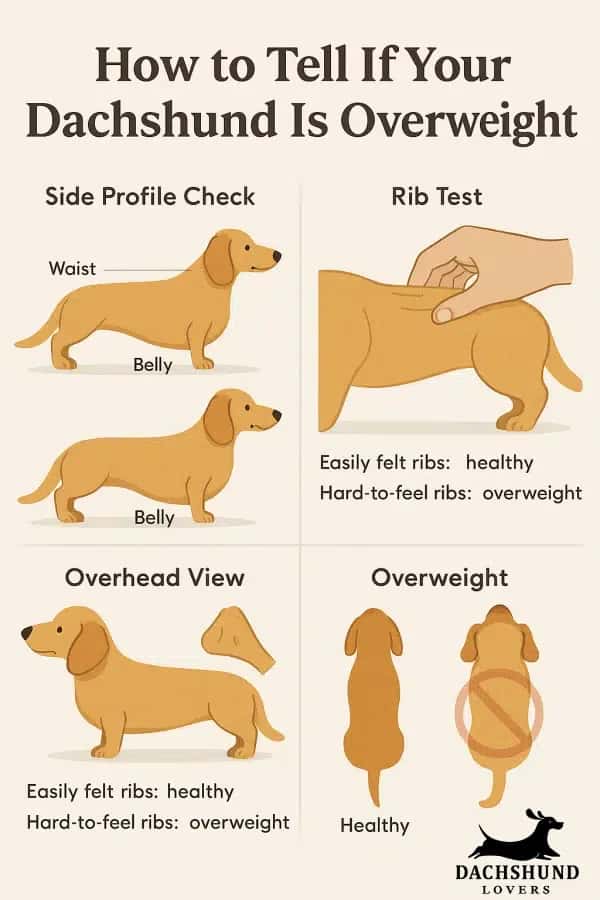
Dachshunds are deceptive. Their long, low silhouette can make it hard to spot early weight gain — especially under all that fur. But if you know what to look for (and feel for), the signs are clear.
We missed them at first. Harvey was still active. Still playful. Still hungry. But gradually, his waistline blurred, and his belly softened. It wasn’t until we did a proper check that we realised he was almost a full kilo over his ideal weight — a big deal for a 5.5 kg mini.
Here’s how to tell if your dachshund is overweight — before it becomes a bigger issue.
1. The Rib Test (Tactile Check)
Run your hands along your dachshund’s ribcage.
- If you can feel ribs easily, with a thin layer of fat — great.
- If you need to press to find ribs, they’re likely overweight.
- If you can’t feel ribs at all, it’s time to act.
Vets often use a Body Condition Score (BCS) — a 1–9 scale where:
- 4–5 = ideal weight
- 6–7 = overweight
2. The Overhead View
Stand over your dachshund and look down.
- Can you see a defined waist behind the ribs?
- Or does their body look oval, sausage-shaped, or uniformly round?
Dachshunds should have a visible “tuck-in” at the waist, even with their unique shape.
3. The Side Profile
From the side, a healthy dachshund will have a gentle upward curve from the chest to the belly.
If their underside hangs lower than their chest — or runs parallel to the ground — they’re likely carrying excess weight.
4. Behavioural Signs
Excess weight can also show up in energy and movement:
- Hesitating on stairs
- Struggling to jump onto furniture
- Panting after short walks
- Sleeping more than usual
- Showing signs of stiffness or reluctance to play
If these sound familiar, your dog’s weight could be part of the picture.
Want to confirm? Pop into your local vet clinic like our local Sylvania Veterinary Hospital — they can check your dachshund’s BCS in under 10 minutes and give advice tailored to your dog’s age and health.
How to Calculate Your Dachshund’s Ideal Weight
Before you can help your dachshund lose weight, you need to know what healthy looks like for them.
Not “skinny.” Not “Instagram shredded.” Just lean, mobile, and pain-free. That’s the goal — especially for a breed built like a loaf with legs.
When Harvey hit 6.4 kg, we assumed he was “just a bit stocky.” But after a weigh-in and a conversation with the team at Sylvania Veterinary Hospital, we learned he was about 800g over his ideal range. That’s more than 10% excess — and for a miniature dachshund, that’s a lot.
So we recalibrated. Literally. We updated his feeding plan, dialed back high-calorie treats, and tracked progress week to week. Within 10 weeks, he was at 5.6 kg and moving better than ever. And that’s why we also our very own dachshund weight calculator to help dachshund lovers alike created
Weight Ranges by Dachshund Type
Dachshund Type | Healthy Weight Range | Ideal Weight Indicators |
|---|---|---|
Miniature | 4.0 – 5.5 kg (9 – 12 lbs) | Ribs are easy to feel, visible waistline, no belly sag |
Tweenie (mid-sized) | 5.5 – 7.5 kg (12 – 16 lbs) | Common in rescue/adopted dogs or mixed lineage |
Standard | 7.5 – 14 kg (16 – 31 lbs) | Larger chest, more muscle — but still requires a tuck |
Note: These are general guidelines. Some minis naturally hover under 4.5 kg, while larger standards with broader chests may be perfectly healthy at 13–14 kg. Focus on body condition over numbers alone. You can use our free Miniature Dachshund Weight Calculator to get a head start.
Signs Your Dachshund Is at Their Ideal Weight
- You can feel their ribs without pressing hard
- There’s a visible waist from above
- From the side, the belly tucks up behind the ribs
- They move easily (walks, stairs, jumps)
- Energy is steady, not sluggish
- Stools are consistent (not frequent or loose from overfeeding)
The 10% Rule: Why Small Changes Matter
According to the Association for Pet Obesity Prevention (APOP), “Dogs that are just 10–20% over their ideal weight have a significantly higher risk of joint injury, back problems, and metabolic disease.”
And dachshunds feel that impact more than most. Their long spinal column and short legs make them biomechanically vulnerable — which means carrying extra weight isn’t just uncomfortable… it’s dangerous.
How to Estimate a Realistic Goal Weight
If your vet hasn’t provided a target, here’s a quick formula to get started:
Target Weight = Current Weight × 0.9
That’s a gentle 10% reduction — ideal for a safe, gradual weight loss plan.
Example:
Harvey at 6.4 kg
6.4 × 0.9 = 5.76 kg
We aimed for 5.6–5.8 kg over 8–10 weeks.
Weekly Weight Loss Targets
The safest pace for most dogs is 1–2% of total body weight per week. For a 7 kg standard dachshund, that’s 70–140g per week.
More than that, and you risk muscle loss or nutritional deficiencies — especially if you’re reducing calories too quickly.
Want to track it properly? We used:
- A baby scale at home (accurate to 50g)
- Weekly Sunday weigh-ins, same time each week
- A simple Google Sheet (columns: date, weight, notes)
Adjusting Food for Weight Loss (Without the Hunger Meltdown)
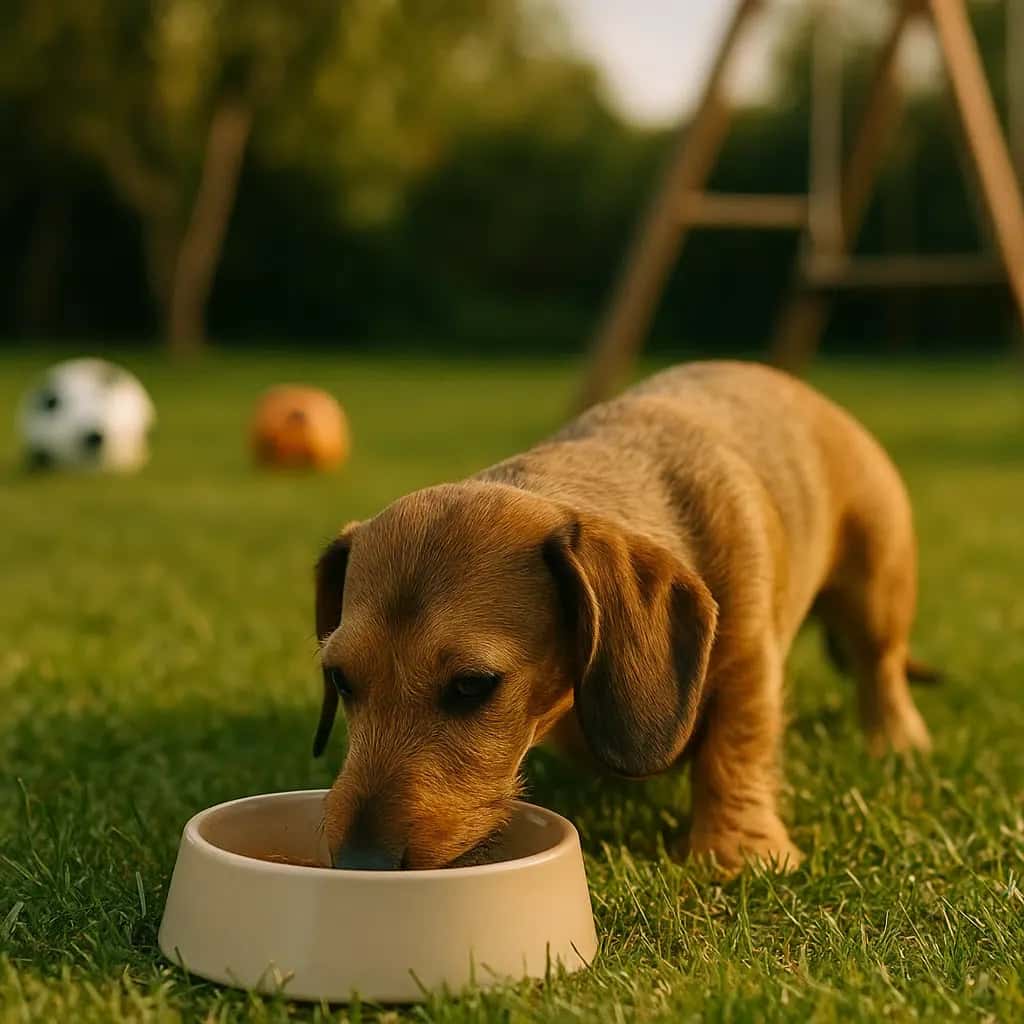
Helping your dachshund lose weight doesn’t mean starving them. It means feeding with purpose — portioning precisely, adding volume wisely, and avoiding the sneaky extras that pile on calories fast.
We learned this the hard way. In our first attempt, we cut Harvey’s food by nearly 30% overnight. He noticed. Immediately. Within days he was moody, restless, and pawing at the pantry between meals. It didn’t feel right — and it wasn’t.
After recalibrating with our vet, we landed on a slow, structured approach that actually worked. Here’s how we did it — and how you can too.
1. Start With a Calorie Baseline — Then Reduce Gently
Don’t eyeball it. Use weight-based calculations to set your dachshund’s true daily energy needs — then aim for a 10–20% deficit to initiate fat loss safely.
Formula:
Target weight (kg) × 30 + 70 = Daily kcal target
This is based on the Resting Energy Requirement (RER) model commonly used by vets.
Example:
Harvey’s target weight = 5.6 kg
5.6 × 30 + 70 = 238 kcal/day
We fed him ~230 kcal daily for 8–10 weeks, then reassessed.
For full breakdowns by life stage and size, use our Dachshund Feeding Guide.
You can also checkout out our free Miniature Dachshund Weight Calculator as well.
2. Don’t Just Cut Food — Change What You’re Feeding
Simply reducing the same food can leave your dog hungry and undernourished. Instead, choose food designed for lean body maintenance:
- Higher protein (keeps muscle intact)
- Moderate fat (not “fat free” — they still need essential oils)
- Low glycemic carbs (sweet potato, oats, brown rice)
What Worked for Harvey:
- Lean home-cooked recipes with chicken, pumpkin, zucchini
- Small-batch dry food with 25% protein, <10% fat
- Broth + veggie-based fillers to add satiety
We saw real improvement after moving off commercial “weight loss” kibble, which was full of carbs and left him constantly hungry.
More tips on formulations in our Homemade Dog Food Guide.
3. Use Vegetables as Low-Calorie Fillers
Once we added steamed green beans, zucchini, and cooked pumpkin to Harvey’s meals, everything changed. He felt full. He stopped pacing after dinner. And most importantly, he stopped begging by 8:00 pm.
Our go-to low-cal fillers:
- Green beans
- Pumpkin purée (no sugar added)
- Zucchini (lightly steamed or raw)
- Cucumber
- Celery (in moderation)
They add fiber, water, and bulk — but almost no calories. Just be careful not to overdo cruciferous veggies like broccoli or cauliflower, which can cause gas.
4. Weigh the Treats — Literally
We used to guess. One biscuit here, a training nibble there. But when we started weighing Harvey’s daily intake — treats included — we realised we were unknowingly feeding him 20–25% more than planned.
High-calorie offenders:
Treat | Calories (avg) |
|---|---|
Dental stick | 70–80 kcal |
Commercial dog biscuit | 30–40 kcal |
Cheese cube | 50 kcal |
Peanut butter (1 tbsp) | 90–100 kcal |
On a 230 kcal/day plan? One “fun treat” can derail the whole thing.
We swapped in:
- Zuke’s Mini Naturals (under 3 kcal each)
- Frozen blueberries (2–3 at a time)
- Boiled chicken breast pieces
- Ice cubes with a splash of bone broth
Find more ideas in our Best Treats for Dachshunds guide.
5. Stick to a Schedule — No Grazing
Free feeding (leaving food out all day) can sabotage even the best weight plan. Dachshunds are habit-driven and often eat out of boredom, not hunger.
Our structure:
- 7:30 AM: Breakfast
- 7:00 PM: Dinner
- Treats: only during training or midday walk
No bedtime snacks. No dropped toast crusts. No “he looks hungry” top-ups.
We used a digital kitchen scale and pre-portioned meals every Sunday — much like meal prep for humans. It reduced temptation to overfeed and gave us full control.
6. Hydration Supports Satiety and Digestion
Dogs can confuse thirst for hunger — just like we do.
We made sure Harvey always had fresh, cool water in three spots around the house. We also added a splash of water or low-sodium broth to meals for extra hydration and perceived volume.
More on hydration strategies in our Dachshund Water Intake Guide.
Best Exercises for Dachshund Weight Loss (That Don’t Harm Their Back)
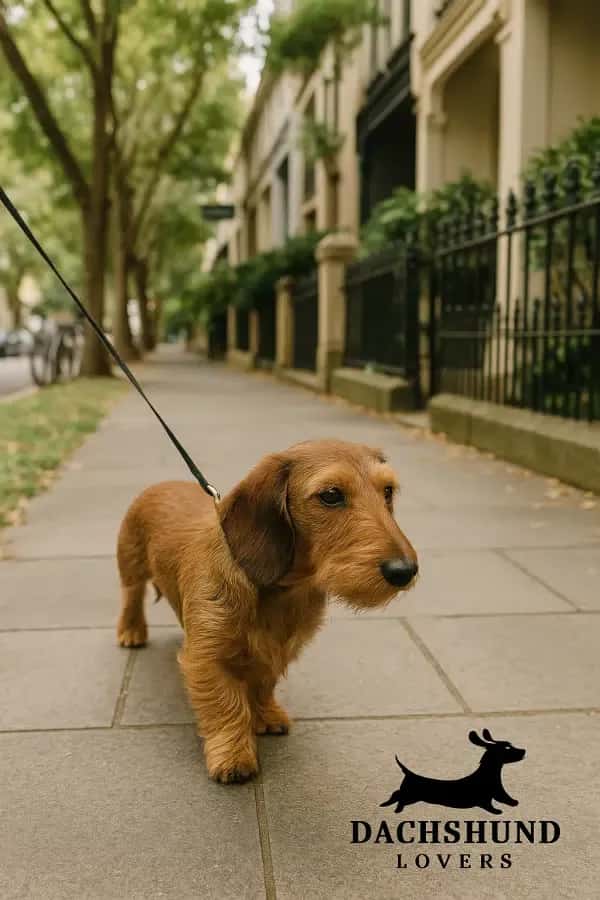
One of the trickiest parts of dachshund weight loss? You need movement — but not just any movement.
The wrong type of exercise can do more harm than good. Long-backed breeds like dachshunds are vulnerable to IVDD, especially if they’re jumping, sprinting on slippery floors, or trying to keep up with bigger dogs.
So when Harvey needed to drop weight, we didn’t throw him into a bootcamp. We built a gentle, sustainable routine that protected his spine while improving stamina, mobility, and muscle tone.
Here’s what actually worked.
1. Two Short Walks Per Day (Minimum)
Long walks can overdo it. Instead, aim for two 15–20 minute walks, spaced out — morning and evening.
This boosts metabolism, aids digestion, and helps maintain lean muscle mass without tiring your dachshund out.
Tips:
- Stick to grass or soft paths (we love the walking loop near Shelly Park)
- Use a harness, not a collar, to avoid spinal stress
- Avoid long stair climbs, hills, or sharp turns
We noticed the biggest weight drop once Harvey’s walks became non-negotiable — rain or shine.
2. Indoor Movement Counts Too
Not every dachshund loves the outdoors — especially in winter. But indoor play adds up:
- Snuffle mats
- Hide-and-seek with treats
- Short tug games on carpeted areas
- Food puzzles (slows eating, burns energy)
We rotate these between meals to keep Harvey moving, even when the weather’s awful.
3. Swimming (If Your Doxie Tolerates It)
Low-impact, high-reward. Swimming can strengthen core and back muscles without joint stress.
Some dachshunds hate water — others thrive like Harvey. If your dog tolerates it:
- Try a canine hydrotherapy pool
- Use a life vest for support
- Keep sessions short and supervised
Harvey? Absolute no-go. But we know doxies who love it and have seen major progress.
4. Set Up Controlled Obstacle Courses
Think of it like “doggie Pilates” — gentle, controlled movement that improves flexibility and coordination.
Ideas:
- Walk across couch cushions (on the floor)
- Step over rolled towels or soft foam blocks
- Use low poles for slow step-overs (no jumping!)
Always supervise. Keep surfaces grippy. Avoid any lifting or full-height agility.
5. Avoid These Common Mistakes
Don't Do This | Why |
|---|---|
Let them jump on/off furniture | Risk of spinal compression and IVDD |
Sprint with larger dogs | Their body can’t handle the pace |
Run on hard or slippery surfaces | Can damage paws, joints, and lower back |
Skip warm-ups | Even 1–2 minutes of slow walking helps prevent strain |
Push past signs of fatigue | Lethargy or stiffness means it’s time to rest — not keep pushing |
A 2022 study published in Frontiers in Veterinary Science found that “controlled, moderate activity — such as twice-daily leash walks on soft surfaces — supports healthy weight loss in small breeds without increasing injury risk.”
mistakes (crash diets, reward gaps, vague tracking) — plus a note on mindset.
What to Avoid When Helping Your Dachshund Lose Weight
Weight loss for dachshunds isn’t just about the what — it’s about the how. You can feed the right food, set the right goals, and still stall progress (or worse, create new problems) if the strategy isn’t sustainable.
Here’s what we learned the hard way — and what many well-meaning owners get wrong.
1. Crash Dieting or Drastically Cutting Food
This is the most common — and dangerous — mistake.
Reducing your dachshund’s portions by 30–50% overnight might get quick results, but it comes with risks:
- Muscle loss
- Nutrient deficiencies
- Lethargy or irritability
- Slowed metabolism (which makes future weight loss harder)
Harvey became withdrawn, stopped engaging during walks, and looked generally off when we tried to reduce his intake too aggressively.
Better: cut calories gradually (10–15% at first) and add volume with veg to keep meals satisfying.
2. Inconsistent Feeding or Tracking
You can’t manage what you don’t measure. Feeding a “small scoop” in the morning and “eyeballing” dinner leads to inconsistency — and often accidental overfeeding.
We used:
- A digital kitchen scale (everything weighed in grams)
- A Google Sheet with date, weight, meal notes, treat count
- Weekly weigh-ins every Sunday morning (before breakfast)
It sounds tedious — but it took less than 5 minutes a day and gave us clarity.
3. High-Calorie Treats with No Calorie Offsets
This one’s sneaky. Even low-fat diets can fail if you’re handing out 3–4 high-calorie treats a day.
If you’re giving:
- Dental chews
- Pig ears
- Table scraps
- Licks of peanut butter
…you’re often adding 100–200+ kcal a day — enough to maintain or gain weight, not lose it.
See Best Treats for Dachshunds for options under 3 kcal per piece.
4. Overexercising Too Soon
More exercise isn’t always better. If your dachshund hasn’t been active for weeks or months, suddenly ramping up walks or activity can lead to:
- Muscle strain
- Fatigue
- Paw pad injuries
- Back stress (especially with steep hills or stairs)
Instead, build activity gradually over 2–3 weeks — starting with short, flat walks on soft ground. Track their response (movement, stools, energy) and increase slowly.
5. Punishment-Based Mindset
Dachshund weight gain is usually a human problem, not a dog one.
Harvey didn’t choose his portion sizes. He didn’t sneak into the pantry. His job is to eat what’s given. So when it was time to change, we approached it as a reset — not a punishment.
- No scolding
- No skipping meals
- No food shaming
Just small, intentional changes and daily movement.
Weight loss is easier (and more effective) when it’s framed as care, not correction.
Frequently Asked Questions (FAQs)
More from This Series
Looking to build the ultimate supplement and feeding routine for your doxie?
- What Can Dachshunds Eat? Safe & Unsafe Foods Explained
- Best Dog Food for Dachshunds in 2025
- Dachshund Feeding Guide: How Much & How Often?
- Top Supplements for Dachshunds: What’s Worth It?
- Hydration & Dachshunds: Why Water Intake Matters
- Homemade Dog Food for Dachshunds
- Dachshund Weight Loss: A Vet-Approved Guide
- Best Treats for Dachshunds
- Best Dog Food for Miniature Dachshunds vs Standard Dachshunds
- Raw vs Cooked Food for Dachshunds
Authored by
James
James is the founder of Dachshund Lovers and the proud human of Harvey, a mini dapple with a big personality. He writes to empower and connect the dachshund community, blending founder insights with honest, experience-based stories about life with this incredible and special breed. James brings candid, experience-backed opinions to the community and always focused on fewer, better products and ideas that genuinely improve life for dachshunds and their people.
Read moreJames is the founder of Dachshund Lovers and the proud human of Harvey, a mini dapple with a big personality. He writes to empower and connect the dachshund community, blending founder insights with honest, experience-based stories about life with this incredible and special breed. James brings candid, experience-backed opinions to the community and always focused on fewer, better products and ideas that genuinely improve life for dachshunds and their people.
Read moreDisclaimer
This content is for informational purposes only and should not be considered veterinary advice. Always consult with a licensed veterinarian regarding your dog’s health and wellbeing.
There are no comments yet
Leave a comment