Raw vs Cooked Food for Dachshunds: What We Learned from Trying Both
Raw vs Cooked Food for Dachshunds: What We Learned from Trying Both
The raw food diet for dachshunds: what worked, what didn’t, and the one step we recommend before switching. Backed by real experience.
James
Posted on September 20, 2025.
Updated on July 20, 2026.
Table of Contents
- 1.Key Takeaways on Raw Food Diet For Dachshunds
- 2.Raw Food for Dachshunds: What We Tried, and What Went Wrong
- •Week 2: The First Signs
- •Week 3: Course Correction
- •What Raw Looked Like in Practice
- •What We Appreciated About Raw
- •But For Harvey? It Didn’t Work
- 3.Cooked Food for Dachshunds: Why It’s Worked Better for Us
- •What Cooked Food Looks Like for Harvey
- •What’s Improved Since We Switched
- •Why Cooked Food Works Well for Dachshunds
- •But It’s Not Effort-Free
- 4.Raw vs Cooked: Which One Is Right for Your Dachshund?
- •Raw vs Cooked Food for Dachshunds: Full Comparison
- •Our Take — Based on Harvey
- -More from This Series
- -Disclaimer
Share

We were in Hurstville one weekend — shopping, grabbing lunch, coffee stop at king carlos ,doing errands — and stopped into a pet store to pick up treats. That’s when we saw it: the freezer. Raw duck necks, lamb hearts, kangaroo tails. Packaged like boutique gelato.
I’d been reading about the dachshund raw food diet, and the timing felt right. Harvey’s appetite was strong, his energy was steady, and honestly, we were curious.
So we tried it.
The first few meals went fine. Then came the soft stools. The weird, oily coat. And after three weeks, a noticeable drop in Harvey’s energy — something wasn’t right.
We weren’t anti-raw after that — we were just more cautious.
As the American Veterinary Medical Association (AVMA) states:
“Feeding raw or undercooked animal-source protein to pets may increase the risk of foodborne illness for both pets and people.”
We’ve also done months of gently cooked food, both homemade and store-bought. Some formulas worked beautifully. Some failed quietly — through itchiness, boredom, or bloating.
This guide walks through:
- What we learned from feeding both raw and cooked food
- When raw food might make sense — and when it probably won’t
- How dachshund anatomy changes the game (especially for minis)
- What to ask your vet before switching
- And why we now take a hybrid approach — not because it’s trendy, but because it works
If you’re wondering whether raw food is good for dachshunds — or just tired of feeling unsure — this one’s for you.
Key Takeaways on Raw Food Diet For Dachshunds
Topic | Summary |
|---|---|
Raw Food Isn’t Automatically Better | While some dogs thrive on raw, others struggle — especially dachshunds with sensitive digestion. |
Cooked Food Is Easier to Digest | Gently cooked meals are often safer, more consistent, and easier to balance nutritionally. |
Small Dogs = Higher Risk | Mini dachshunds are more vulnerable to bacteria, fat imbalance, and digestive upset on raw. |
Hybrid Can Work Well | We now combine cooked meals with raw toppers or freeze-dried bites, based on how Harvey responds. |
Always Consult a Vet | A poorly balanced raw or cooked diet can do more harm than good. Know your dog, and get expert guidance. |
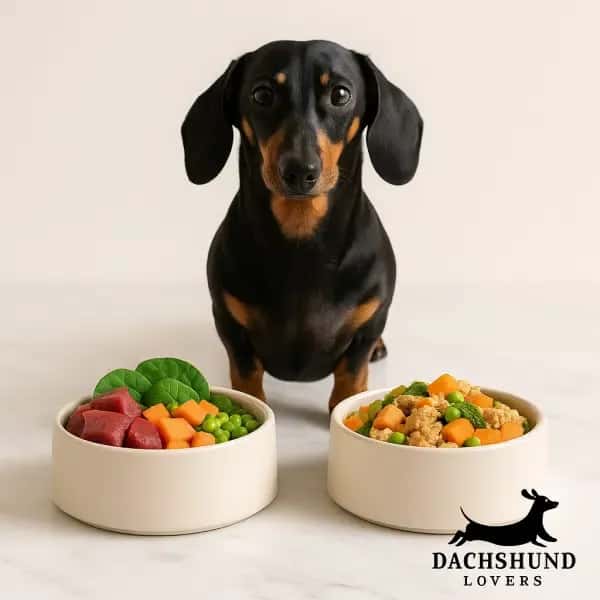
Raw Food for Dachshunds: What We Tried, and What Went Wrong
We gave raw feeding a fair shot.
After weeks of reading articles, watching vet Q&As, and obsessing over nutrient ratios, we decided to give the dachshund raw food diet a go. The plan was to try it for four weeks and monitor Harvey’s energy, coat, digestion, and weight.
We sourced human-grade frozen blends from a boutique supplier in Hurstville. Clean branding, single-animal proteins, locally processed — the works. It felt premium, intentional, and healthy.
And for the first 5–6 days? It was great.
Harvey loved it. He finished every meal and looked at us like we’d finally figured out what he wanted. His coat was shinier within the week. His eyes were bright. We felt… smug.
Then the shift started.
Week 2: The First Signs
- Stools became loose and greasy
What started as perfect logs turned into soft piles that were harder to pick up and frequent. Not diarrhoea, but off. - He started pacing after meals
Not the relaxed stretch-and-snooze we were used to — he seemed a little uncomfortable. - Gas
And not the harmless kind. The room-clearing, “did something die?” kind. - Lethargy
He wasn’t excited for his afternoon walks. He walked slower. He napped longer.
Week 3: Course Correction
We adjusted:
- Switched from lamb to kangaroo (leaner)
- Cut portion size slightly
- Added pumpkin to stabilise digestion
- Increased hydration (more broth, more bowl changes)
But the issues persisted — especially with bone-in blends. Even when ground finely, Harvey would gag on sharp, flaky bits. We tried boneless recipes, but his stools turned runny. There was no middle ground.
What Raw Looked Like in Practice
- 80/10/10 ratio (muscle meat, organ, bone)
- Packaged, frozen, thawed overnight in fridge
- Served cool or room temp
- Fed twice daily, ~120g per meal
- Supplements added separately (including calcium, omega-3, and multivitamin)
We used a digital scale for every meal. The food itself was high-quality. But it simply didn’t suit Harvey’s digestion — or his energy needs.
What We Appreciated About Raw
- Clean ingredients — no weird additives or preservatives
- High-value meals — Harvey loved eating them
- Easy to rotate proteins — we trialed kangaroo, lamb, and chicken
- The food felt “real” — no filler, no starch, just meat
But For Harvey? It Didn’t Work
Challenge | Why It Was a Problem |
|---|---|
Fat sensitivity | Even lean proteins triggered coat dullness and itchy ears |
Digestive inconsistency | Alternating between soft and firm stools made tracking hard |
Too much bone | Even in “balanced” formulas, bone content caused discomfort |
No carbs = low energy | Without oats, rice, or veg, Harvey’s stamina noticeably dipped |
Prep anxiety | Raw chicken handling + supplements + thawing = more effort than expected |
And that’s without even touching the food safety risks — especially important in a household with young kids or immunocompromised humans.
The American Veterinary Medical Association (AVMA) warns:
“Feeding raw or undercooked animal-source protein increases the risk of pathogens like Salmonella, E. coli, and Listeria — which can infect both pets and people.”
Cooked Food for Dachshunds: Why It’s Worked Better for Us
After the raw experiment ended, we took a few days off. Gave Harvey a bland diet: boiled chicken, rice, steamed pumpkin. Nothing fancy.
And within 48 hours, things changed.
- Stools firmed up.
- His coat looked better — not greasy, just healthy.
- He had more energy on walks.
- No more 3am pacing. No more weird gas.
That’s when we leaned fully into gently cooked food — first as a transition, then as a long-term base.
Not because it was trendy. Not because it was “cleaner.”
But because it actually worked.
What Cooked Food Looks Like for Harvey
We now prep batches every Sunday:
- Lean protein: Chicken thigh, turkey mince, or scrambled egg
- Carbohydrates: Brown rice, rolled oats, or sweet potato
- Veggies: Pumpkin, zucchini, green beans (steamed)
- Fats: A small amount of olive oil or tinned salmon
- Supplements: Calcium powder, multivitamin, occasional fish oil
We measure every meal by grams — 115g per serve, twice daily.
You can find our full method in the Homemade Dog Food Guide.
What’s Improved Since We Switched
Aspect | Change After Switching to Cooked |
|---|---|
Stool consistency | Regular, easy to pick up, no midday diarrhoea surprises |
Energy levels | More stable — no afternoon crashes or skipped walks |
Coat + skin health | Shinier coat, less paw licking or ear scratching |
Appetite | Still enthusiastic — but no frantic post-meal begging |
Digestive tolerance | No gas, no bloating, no midnight restlessness |
Why Cooked Food Works Well for Dachshunds
- Easier to digest than raw
- Safer for small dogs prone to GI upset
- Lets you control fat and protein ratios precisely
- You can rotate ingredients without shocking the system
- It supports slow, healthy weight management, which is key for back health
According to the American Kennel Club:
“Home-cooked diets, when formulated properly, can support long-term health in dogs — especially those with digestive or dietary sensitivities.”
But It’s Not Effort-Free
Let’s be honest: cooking for your dog is a time commitment.
We:
- Shop weekly
- Batch cook in glass containers
- Weigh every ingredient
- Track calories with a spreadsheet
- Clean extra bowls, prep areas, and storage jars every week
It’s work. But it’s work that’s helped Harvey stay healthy, lean, and consistently well.
And that’s worth it.
Raw vs Cooked: Which One Is Right for Your Dachshund?
Let’s be honest — most dachshund owners just want to feed their dog something that works. Something that doesn’t upset their stomach. Doesn’t cause weight gain. Doesn’t require a PhD in animal nutrition. Something your doxie eats happily, regularly, and stays healthy on.
We’ve now tested both raw and cooked food for Harvey. We didn’t go in with bias — just curiosity. And after months of experimenting, logging meals, and tracking stools (yes, literally), here’s what we found:
There’s no clear winner — but there is a better fit depending on your dachshund’s size, age, and gut tolerance.
Raw vs Cooked Food for Dachshunds: Full Comparison
Category | Raw Food | Cooked Food |
|---|---|---|
Digestibility | Can cause soft stools, gas, and discomfort in sensitive dogs (especially minis) | Gently cooked food is easier on the gut and helps stabilize digestion |
Palatability | Very high — most dogs love raw | Also high — cooked food with warm, soft textures is easy to eat and smells great |
Bacterial Risk | Higher risk of Salmonella, Listeria, and E. coli — especially for seniors, puppies, or homes with kids | Minimal risk if cooked thoroughly and stored properly |
Nutrient Control | Precise control — but only if you balance bone, organ, supplements | Still requires balance, but simpler to monitor and adjust |
Energy Response | Can cause energy dips if low in carbs or too high in fat | More stable energy when paired with clean carbs and moderate fat |
Prep Time | Involves thawing, handling raw meat, and strict hygiene routines | Requires batch cooking and portioning, but can be less stressful overall |
Storage & Convenience | Needs freezer space, thawing, and tighter safety rules | Stores easily in fridge or pre-portioned containers; easier to travel with |
Vet Support | Divisive — many vets caution against it unless formulated by a specialist | Generally supported if cooked meals are balanced and supplemented properly |
Cost | High if buying premium, low if DIY (but riskier) | Flexible — often cheaper if cooking in bulk at home |
Best Suited For | Young, healthy, active dogs with strong digestion and no GI history | Sensitive dogs, seniors, minis, or dogs recovering from IVDD or obesity |
Our Take — Based on Harvey
Raw felt exciting. Premium. Instinctual.
Cooked felt… boring. But it worked.
If you’d asked us six months ago, we would’ve told you raw seemed like the ideal. But now, after watching Harvey thrive on a cooked rotation for 20+ weeks — with better energy, firmer stools, and consistent weight — we’re not going back.
We’re not saying raw is wrong. We’re saying cooked is right for our dog.
And that’s really the question you need to ask yourself:
- What makes your dachshund feel and function best?
- What’s realistic for your household and routine?
- And what feeding approach lets you be consistent, not just enthusiastic?
Because raw feeding can work beautifully — but only if you’ve got the knowledge, time, and a dog that tolerates it.
And cooked food? It may not feel radical, but in our experience, it’s quietly effective — and a safer bet for the average dachshund.
Frequently Asked Questions (FAQs)
More from This Series
Looking to build the ultimate supplement and feeding routine for your doxie?
- What Can Dachshunds Eat? Safe & Unsafe Foods Explained
- Best Dog Food for Dachshunds in 2025
- Dachshund Feeding Guide: How Much & How Often?
- Top Supplements for Dachshunds: What’s Worth It?
- Hydration & Dachshunds: Why Water Intake Matters
- Homemade Dog Food for Dachshunds
- Dachshund Weight Loss: A Vet-Approved Guide
- Best Treats for Dachshunds
- Best Dog Food for Miniature Dachshunds vs Standard Dachshunds
- Raw vs Cooked Food for Dachshunds
Authored by
James
James is the founder of Dachshund Lovers and the proud human of Harvey, a mini dapple with a big personality. He writes to empower and connect the dachshund community, blending founder insights with honest, experience-based stories about life with this incredible and special breed. James brings candid, experience-backed opinions to the community and always focused on fewer, better products and ideas that genuinely improve life for dachshunds and their people.
Read moreJames is the founder of Dachshund Lovers and the proud human of Harvey, a mini dapple with a big personality. He writes to empower and connect the dachshund community, blending founder insights with honest, experience-based stories about life with this incredible and special breed. James brings candid, experience-backed opinions to the community and always focused on fewer, better products and ideas that genuinely improve life for dachshunds and their people.
Read moreDisclaimer
This content is for informational purposes only and should not be considered veterinary advice. Always consult with a licensed veterinarian regarding your dog’s health and wellbeing.
There are no comments yet
Leave a comment