Preparing for Dachshund Puppies: Nesting, Supplies & First Days
Preparing for Dachshund Puppies: Nesting, Supplies & First Days
Get ready for dachshund puppies with a thoughtful guide to space, supplies, whelping prep, and the first few weeks of life.
James
Posted on September 1, 2025.
Updated on July 21, 2026.
Table of Contents
- 1.Key Takeaways on Preparing For Dachshund Puppies
- 2.Signs Labor Is Near
- •1. Drop in Body Temperature
- •2. Nesting Behaviors Intensify
- •3. Refusing Food
- •4. Clinginess or Withdrawal
- •5. Panting, Trembling, Pacing
- •6. Visible Contractions
- 3.Nesting & Pre-Birth Behaviors
- •The Urge to Dig, Rearrange, and Hide
- •Real Example
- •When to Step In
- 4.Supplies Checklist for Dachshund Puppy Prep
- •Whelping Area Essentials
- •Birth & Postnatal Supplies
- •Feeding Support (Only If Needed)
- •Emergency Prep
- •Founder Tip
- 5.Whelping Setup Tips
- •Pick the Right Spot
- •What the Box Should Look Like
- •Bonus: Add a “Pig Rail”
- •Founder Reminder
- 6.Post-Birth Care & First 72 Hours
- •What to Expect from Mum and Pups
- •How You Can Help — Without Overstepping
- •Real-World Note
- 7.When to Call the Vet
- •During Labor
- •After Birth
- -More from This Series
- -Disclaimer
Share

The last stretch before puppies arrive is when things start to shift. You feel it before you see it. Your dachshund sleeps a little deeper. Nests harder. Moves less, but watches more. There’s tension — but it’s focused, not frantic. Her body knows what’s coming. Your job now is to keep everything around her stable enough so she can do what she’s built to do.
A few weeks ago, I caught up with a friend down at South Cronulla Park. Her girl — a miniature named Bonnie — was about nine days out. She’d turned the spare bedroom into what looked like a cross between a linen cupboard and a birthing suite. Pine whelping box, flannel bedding, dim lighting, towels stacked within arm’s reach. Bonnie was curled up inside, already dragging socks into the corner and defending it like she was on a mission.
“I’ve read three guides and watched five YouTube videos,” my friend said. “Still feel like I’m winging it.”
That feeling? It’s common. Especially in the final week when everything is about to happen — but hasn’t happened yet.
This guide is here to simplify that moment. No overload. Just what matters in the final days before labor and the first 72 hours after pups arrive. What to look for. What to prep. What to leave alone. From recognizing early signs and creating a proper whelping setup, to knowing when to intervene and when to step back — this is the clear, real-world version of what actually helps.
If you want a more clinical overlay, RSPCA Australia’s pregnancy care guide is solid. But if you’re preparing for a dachshund — with her quirks, emotions, and need for soft corners — start here.
Key Takeaways on Preparing For Dachshund Puppies
Topic | Summary |
|---|---|
Nesting Behaviors | When she starts digging, pacing, or hoarding soft items, labor isn’t far off. Trust the shift. It’s instinct kicking in. |
Whelping Box Setup | Quiet, draft-free, and enclosed. Low sides. Soft, washable bedding. Set it up early so she can claim it on her terms. |
Supplies Checklist | Clean towels, thermometer, gloves, heating pad, notebook, suction bulb, and your vet’s number in the phone — and printed. |
Signs Labor is Starting | Temp drops below 37.2°C, panting, nesting intensifies, food refusal, contractions start. Know the stages, don’t overreact. |
First Days Post-Birth | Puppies feed constantly. Mum may be protective or anxious. Monitor warmth, latch, and weight. Quiet is your best tool. |

Signs Labor Is Near
You’ll notice it in the small things. She’s not eating. She’s dragging blankets into corners. She’s pacing, then freezing, then staring like she’s thinking ten steps ahead.
The final 48 hours before delivery are quiet, focused, and full of signs — if you know how to read them.
1. Drop in Body Temperature
This is your most reliable cue. A healthy dog’s rectal temperature usually sits around 38.3–39.2°C (101–102.5°F). Once it drops below 37.2°C (99°F) — labor’s likely within 12–24 hours. Check twice daily in the final week. Same time, same way, same thermometer.
2. Nesting Behaviors Intensify
If she was lightly nesting before, now she’s committed. Digging, circling, hiding socks, moving bedding every hour. She’s choosing a space. If she’s not choosing the one you set up, gently guide her — but don’t force it.
More on how to support this here: Caring for a Pregnant Dachshund
3. Refusing Food
Most dachshunds will turn down food within 12–24 hours of labor. Doesn’t matter how food-driven she usually is — when it’s time, appetite shuts off.
4. Clinginess or Withdrawal
Some will glue themselves to you. Others will disappear into the corner of a cupboard and not want company. Neither is wrong. Just follow her lead.
5. Panting, Trembling, Pacing
This is early labor — Stage I. Her body’s getting ready. She can’t settle. Breathing fast. Lying down, then standing up again. This can last up to 12 hours.
6. Visible Contractions
When you start seeing abdominal tightening — strong, deliberate — you’re in Stage II. This is when pups start arriving. Have towels, gloves, and your vet’s number ready.
Nesting & Pre-Birth Behaviors
By this point, she’s already chosen her zone — or she’s about to. Nesting isn’t a quirk. It’s instinct. It’s also your signal that things are getting close.
The Urge to Dig, Rearrange, and Hide
Expect her to:
- Scratch at bedding, carpets, or under furniture
- Drag towels or clothes into corners
- Circle before settling — again and again
- Guard the space she’s chosen, even from you
Some girls get territorial. Some just want the space untouched. Either way, don’t overcorrect. This is her prep phase. You’re just there to make sure it’s safe, warm, and quiet.
If she’s avoiding the whelping box you set up, gently redirect her — but don’t force it. She needs to feel like she’s in control of her space.
Real Example
One of Harvey’s extended family — a small red mini — bypassed the freshly set-up whelping zone and set up camp behind a laundry basket. She dug under the shelf, moved three folded beach towels, and delivered there two days later. It wasn’t the plan — but it worked. Sometimes you work with her, not against her.
When to Step In
If she starts nesting more than a week out from her due date or seems anxious or obsessive, check with your vet. Early labor or complications can show up disguised as strong nesting.
Keep her hydrated. Don’t over-handle. And if she stops leaving the space to eat or drink, monitor her closely — this usually means labor’s not far off.
Supplies Checklist for Dachshund Puppy Prep
You don’t need a vet clinic in your lounge room. You just need the right tools, in the right place, ready when you need them. Keep it simple. Keep it close.
Here’s what we recommend having sorted before day 58.
Whelping Area Essentials
- Whelping box – low sides, no sharp edges, wipeable base
- Puppy pads or liners – easy cleanup and absorbent
- Soft, washable bedding – old towels or fleece you won’t miss
- Heating pad or heat lamp – for colder rooms or winter births
- Digital thermometer – for monitoring pre-labor temperature dips
Birth & Postnatal Supplies
- Clean towels – for drying pups and lining the box
- Sterile gloves – just in case you need to step in
- Blunt scissors + dental floss – cord management, if needed (ask your vet)
- Bulb syringe or suction tool – for clearing airways
- Puppy scale – daily weight checks from Day 1
- Notebook or tracking app – log birth order, weights, nursing patterns
Feeding Support (Only If Needed)
- Milk replacer (puppy-specific) – backup if mum can’t nurse
- Small bottles or feeding syringes – only use if advised
- High-protein food and snacks for mum – recovery support
Emergency Prep
- Your vet’s number + nearest 24-hour clinic – saved and printed
- Pet-safe travel crate – ready in case of emergency
- Our Week-by-Week Pregnancy Guide – bookmarked for quick reference
Founder Tip
We keep everything in a lidded tub next to the whelping box. Labeled. Prepped. Easy to open with one hand. Because when labor starts at 2:30 a.m., you don’t want to be rummaging through drawers.
Whelping Setup Tips
You don’t need to overengineer this. The goal is comfort, safety, and control — for her and for you. Think low-stress. Easy to clean. Quiet. That’s the entire brief.
Pick the Right Spot
- Low foot traffic — not the hallway, not near the front door
- Dim lighting — natural light is fine, but avoid harsh overheads
- Consistent temperature — not next to a heater or window
- Noise control — no loud TV, no kids racing past
Laundry rooms, spare bedrooms, or quiet corners of a main room often work best.
What the Box Should Look Like
- Low walls – just high enough to keep puppies in, but easy for her to step over
- Non-slip base – fleece or textured liner to help puppies grip
- Large enough – she needs to stretch out fully on her side
- Easy to clean – plan for mess; you’ll be wiping it down daily
You can buy a whelping box online (EZwhelp, Dura-Whelp) or build your own from timber or Corflute. Some use kiddie pools or crates with the door removed — all fine as long as they’re safe and warm.
Bonus: Add a “Pig Rail”
Optional, but smart — a pig rail is a small barrier around the inside of the box to prevent mum from accidentally rolling on the pups. Especially helpful if the litter’s big or she’s a heavy sleeper.
Founder Reminder
Once it’s set up, don’t move it. And don’t change the bedding too often unless it’s soiled. She’s chosen it. Leave it. A stable environment does more for her stress levels than any supplement or chew toy ever could. Looking for a full breakdown of the whelping process? Our Week 9: Labor Signs & Preparation section walks you through what to expect hour-by-hour.
Post-Birth Care & First 72 Hours
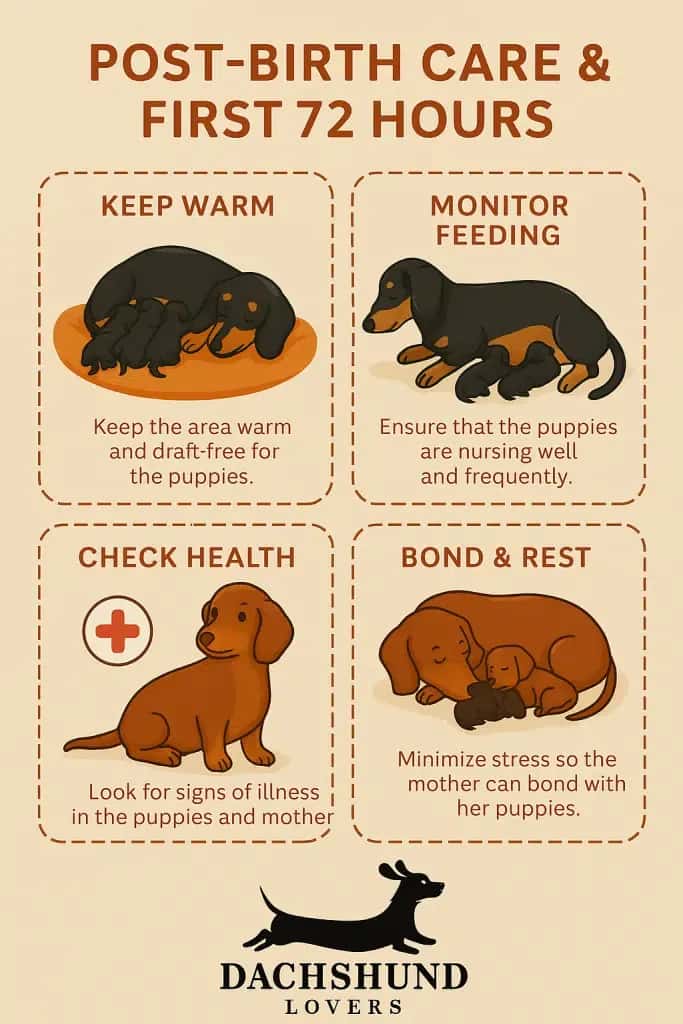
Once the last pup is out and she’s settled, everything slows. The energy shifts from active labor to protection mode. She’ll tuck her body into a half-circle, pulling the pups toward her belly, checking each one, then doing it all again an hour later.
This first stretch — the initial 72 hours — is critical. But it’s not complicated. You don’t need to hover or interfere. You just need to know what’s normal, what’s not, and how to support her without creating more noise.
What to Expect from Mum and Pups
- Nursing on a loop — Newborns feed every 2 to 3 hours, day and night. A full belly means quiet, warm puppies. Crying = something’s off.
- Protectiveness — She may growl if other pets or strangers come near. Let her lead. This usually fades after a few days.
- Sleep-heavy rhythms — Both mum and pups will nap deeply between feeds. That’s good. Don’t try to wake them unless something’s wrong.
- Post-delivery discharge — Light red to brown spotting is normal for up to 7–10 days. If it’s green, smells strong, or she seems unwell — call the vet.
If her breathing is labored, she won’t eat, or she seems detached from the litter — those aren’t small things. That’s a flag. Get on the phone to your vet, even if it’s after hours.
How You Can Help — Without Overstepping
- Keep the room warm and still
Newborn pups can’t regulate their own body temperature. Room should stay between 29–32°C (85–90°F). Use a heat pad or lamp safely, but always allow an unheated “escape zone” in the box. Never trap them in heat. - Weigh the pups daily
Use a kitchen scale and track the same time each day. Normal gain is around 10% of body weight per day. If one pup is falling behind, give them extra time nursing — ideally on a rear teat (more milk flow). - Support, don’t clean constantly
Don’t change bedding every few hours unless it’s soaked or soiled. She’s built her scent around that space. Too much cleaning can make her anxious and unsettled. - Check for proper latching
Watch that each pup finds and stays latched for several minutes. Small or weaker pups may need gentle guidance to a teat. - Offer mum water and small meals
Set a bowl within reach so she doesn’t have to leave the pups. Many mums won’t walk away for the first 24–48 hours — and dehydration slows milk production. You can offer warmed, wet puppy food or small portions of her regular high-protein meals.
Real-World Note
In one litter we supported, the smallest pup struggled to latch for more than 20 seconds before falling asleep. We tracked weight twice daily, noted which teat he was using, and added supervised nursing breaks every 4 hours. By Day 3, he’d caught up.
That’s what support looks like. Not panic — just observation and adjustment.
If anything feels off and you’re unsure, go with your gut and call your vet. It’s always better to check early than to correct late.
For a more detailed breakdown of dachshund pregnancy week-by-week (including post-birth care), visit our full guide: Dachshund Pregnancy Week by Week.
When to Call the Vet
Most dachshund births go smoothly. They’re instinct-driven and surprisingly self-sufficient. But things can shift fast — and when they do, you need to move.
This isn’t about overreacting. It’s about knowing the line between normal and not.
Here’s when to stop Googling and pick up the phone.
During Labor
Call your vet if:
- She’s straining for more than 30 minutes with no puppy delivered
- There’s more than 2 hours between pups and you know more are coming
- You see green or foul-smelling discharge before any pup has arrived
- A pup is stuck halfway and she can’t push it out
- She’s shaking, panting hard, or seems confused or distressed
- You have any reason to believe she’s in pain, not just discomfort
Even if you’re not sure what’s wrong — call. You won’t regret acting early.
After Birth
Call your vet if:
- Mum has no interest in the pups after 30–60 minutes
- She refuses food or water for more than 24 hours
- There’s a high fever, ongoing panting, or belly swelling
- The pups aren’t feeding well, seem cold, or aren’t gaining weight
- You see signs of retained placenta (smelly discharge, fever, lethargy)
Also — keep your local emergency vet’s number saved in your phone and printed next to the whelping box. Because if things go sideways at 3:00 a.m., you won’t want to waste time searching.
Frequently Asked Questions (FAQs)
More from This Series
Explore other guides in our Dachshund Pregnancy collection to support every step of the journey:
- Pregnancy in Dachshunds: Essential Tips for New Owners
Your complete starting point — from signs to care and prep. - Dachshund Pregnancy Week by Week
A detailed look at every stage, from conception to delivery. - Early Signs of Pregnancy & Phantom Pregnancy
How to tell if it’s the real thing — or just a false alarm. - Caring for a Pregnant Dachshund
Nutrition, vet visits, and everything in between.
Authored by
James
James is the founder of Dachshund Lovers and the proud human of Harvey, a mini dapple with a big personality. He writes to empower and connect the dachshund community, blending founder insights with honest, experience-based stories about life with this incredible and special breed. James brings candid, experience-backed opinions to the community and always focused on fewer, better products and ideas that genuinely improve life for dachshunds and their people.
Read moreJames is the founder of Dachshund Lovers and the proud human of Harvey, a mini dapple with a big personality. He writes to empower and connect the dachshund community, blending founder insights with honest, experience-based stories about life with this incredible and special breed. James brings candid, experience-backed opinions to the community and always focused on fewer, better products and ideas that genuinely improve life for dachshunds and their people.
Read moreDisclaimer
This content is for informational purposes only and should not be considered veterinary advice. Always consult with a licensed veterinarian regarding your dog’s health and wellbeing.
There are no comments yet
Leave a comment