Pregnancy in Dachshunds: Essential Tips for New Owners
Pregnancy in Dachshunds: Essential Tips for New Owners
From hidden symptoms to emotional shifts, explore the realities of dachshund pregnancy with care, clarity, and no sugarcoating. Learn more.
James
Posted on August 31, 2025.
Updated on June 3, 2026.
Table of Contents
- 1.Key Takeaways on Pregnancy In Dachshunds
- 2.What Is Dachshund Pregnancy?
- 3.How Long Are Dachshunds Pregnant?
- •Typical Timeline
- 4.Signs and Symptoms of Pregnancy in Dachshunds
- •Common Early Signs (Weeks 3–4)
- •Mid-Pregnancy Changes (Weeks 4–6)
- •Later Stage Indicators (Weeks 7–9)
- 5.Pregnancy Timeline Overview
- •Typical Timeline at a Glance
- 6.Preparing for Puppies
- •Creating the Whelping Area
- •Supplies You’ll Need
- 7.Monitoring for Labor
- •Signs Labor Is Close
- •What to Do (and What Not To)
- •Know When to Call the Vet
- 8.Litter Size & What to Expect
- •What We’ve Seen in Real Life
- •Tracking Birth Order & Health
- •Feeding & Early Days
- -More from This Series
- -Disclaimer
Share

You don’t need a vet to tell you when something’s shifted. If you’ve lived with a dachshund long enough, you start to pick up on the small things. The slower walk to the food bowl. The sudden silence on the lounge. The way she carries a toy around like it matters more than usual.
I remember standing outside Our Father Cafe waiting for my saturday morning coffee — when I saw a woman holding her chocolate dachshund close to her chest. The dog was still, belly just starting to curve out. “She’s four weeks,” she told me. “Still chasing birds — but only between naps.”
That moment stuck. It was quiet. Ordinary. But there was that look of half-certainty on her face — like she’d been tracking every minor change for weeks, trying to decode the signs. And if you’ve been through a phantom pregnancy, you know how easy it is to second-guess everything. We had just supported a friend through one — full nesting, mood swings, toy hoarding. All the signs, none of the puppies.
(If that’s where you’re at, our guide to phantom pregnancy in dachshunds breaks down what’s real, what’s hormonal, and when to stop guessing.)
This guide is here for the rest of it — the part where you know, or strongly suspect, and need a plan. It walks through the full timeline of a dachshund pregnancy, from those first changes to the day you hear tiny paws in the whelping box. Clear. Practical. Built from experience, not theory.
If you’re looking for a vet-authored reference alongside this, VCA’s overview of canine pregnancy is a good companion read.
Key Takeaways on Pregnancy In Dachshunds
Topic | Summary |
|---|---|
Pregnancy Length | Most dachshunds carry for around 63 days. It’s not exact — some go early, some take their time — but nine weeks is your working number. |
First Visible Signs | Appetite changes, mood shifts, or slight belly rounding usually show up around week 4 or 5. Earlier than that, it’s all guesswork. |
Ultrasound Timing | Your vet can confirm pregnancy via ultrasound around day 28. Before that, you’re watching symptoms and hoping for clarity. |
Behavioral Clues | Nesting, clinginess, and sleeping more than usual are common — especially in minis. Some start as early as week 3. |
Mini vs Standard Differences | Mini dachshunds usually show sooner and carry fewer pups (3–5). Standards average 4–6. Smaller frames = earlier signs. |
Care Essentials | Focus on stable routines, quality food, gentle movement, and early vet check-ins. Overcorrection is more harmful than helpful. |
False Pregnancy Risk | Phantom pregnancies are common in dachshunds. The signs look real, but there are no pups. This guide explains the difference. |
When to Call the Vet | If you’re unsure, don’t wait. Vet input early on clears up a lot of confusion and helps you plan better — especially if it’s your first time. |
What Is Dachshund Pregnancy?

On paper, dachshund pregnancy works like any other small-breed dog. Conception, implantation, fetal development, and birth — all within roughly 63 days. But the moment you’re actually living it, you realise pretty quickly that dachshunds don’t do anything by the book.
They’re long-backed, emotionally dialed-in, and dramatic in all the small ways that matter. That makes pregnancy in dachshunds both quiet and intense — sometimes at the same time.
One day she’s barking at birds like nothing’s changed. The next, she’s dragging towels behind the couch like she’s preparing for a storm. It’s subtle, but if you know her well, you’ll feel the difference before you see it.
Here’s the structural side:
- Average length: 63 days, but safe range is 58–68
- Early signs: Start around day 21 — small appetite changes, swollen nipples, lower energy
- Confirmation: Day 28 is usually when vets will do an ultrasound
- Litter check: Around day 45+, an X-ray may be done to estimate numbers
- Miniatures vs standards: Minis usually show signs earlier and carry fewer pups (3–5 vs. 4–6), partly due to their smaller frame
What makes it feel different with dachshunds is their emotional volume. You’ll see signs that aren’t in any guide — carrying toys into her bed, staring into corners, pausing mid-meal like she forgot what she was doing. It’s not dramatic. It’s quiet and specific.
We’ve had people write in thinking their girl was off because she skipped a morning walk. Others said they just “knew” something was different before any physical change showed up. They were usually right.
There’s no one-size-fits-all timeline, and there’s no hard line between what’s behavioral and what’s hormonal. It’s part instinct, part pattern recognition.
If you’re deep in the wondering phase — noticing things, not sure how to name them — you’re in the right place. This guide covers the key phases and symptoms. And if you want the week-by-week version, with more granular detail, that lives here.
How Long Are Dachshunds Pregnant?
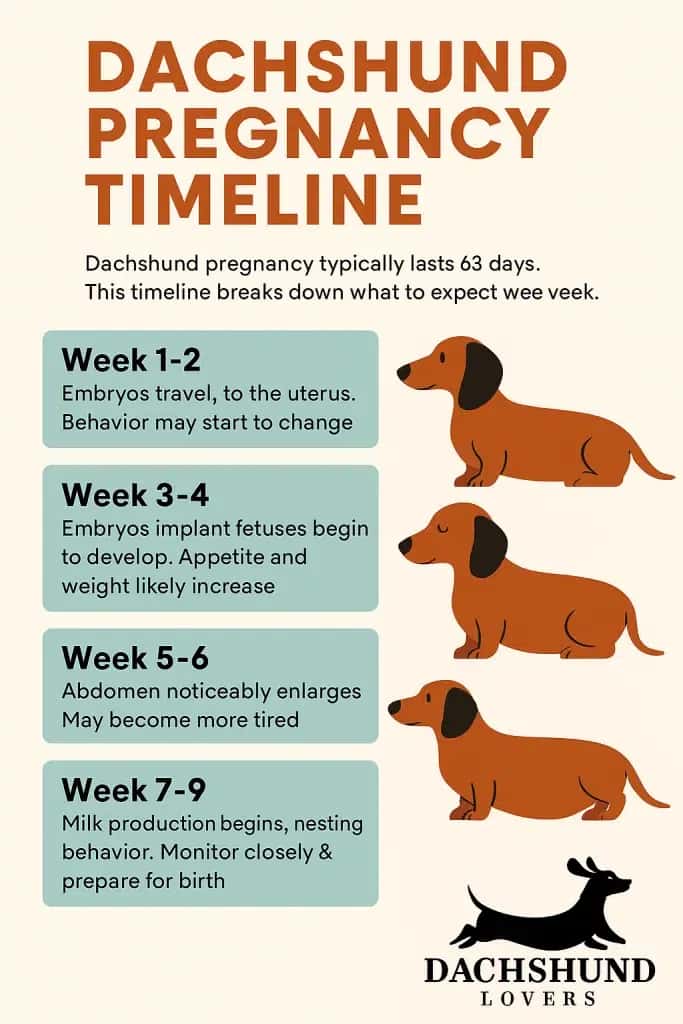
The average dachshund pregnancy lasts around 63 days. That’s the standard number you’ll hear — but don’t get too attached to it. Real-world pregnancies don’t follow a timer. Some girls go early at day 58. Others hold out until day 68. Both are normal.
The countdown starts from ovulation, not from mating. If you’re working with a vet and tracking progesterone levels, you’ll have a more accurate read. But if you’re like most owners — especially if this wasn’t a planned pregnancy — you’re probably estimating from the last known mating date.
That’s fine. Use it as your reference point, not your deadline.
Typical Timeline
- Day 0–7: Fertilisation and early cell division
- Day 18–21: Embryo implantation begins
- Day 28: Ultrasound can confirm pregnancy
- Day 45+: X-ray may be used to estimate litter size
- Day 58+: Pups are viable — labor could start any time now
- Day 63: Most common timing for delivery
- Day 68: Upper edge of the safe window — if nothing’s happened by now, speak to your vet
Some breeders follow things closely with testing. But for most dachshund owners — especially first-timers — the best approach is observation and preparation. Watch how she moves. Track her appetite. See when her behavior shifts. That’ll tell you more than a calendar ever will.
If you’re past day 58 and feeling the pressure, don’t stress. The final days often feel slow. One minute she’s sleeping under a pile of blankets, the next she’s up, pacing, and panting. That switch can happen quickly — and it usually does.
When the time comes, the signs will be clear. We’ll cover labor prep and whelping details later in this guide. For now, just know that the 63-day estimate is useful — but your real guide is your dog.
Signs and Symptoms of Pregnancy in Dachshunds
Early dachshund pregnancy isn’t loud. There’s no dramatic shift. No big reveal. Just a few subtle cues that start stacking up — and if you know your dog well, you’ll spot them.
Some owners notice a change in appetite. Others see mood shifts, longer naps, or quiet nesting habits. The challenge is knowing what’s real, what’s hormonal, and what’s just her being her.
Here’s how the signs typically show up.
Common Early Signs (Weeks 3–4)
- Slight dip in appetite or hesitancy at meals
- Longer naps or slower mornings
- Slight pinking or swelling of the nipples
- More cuddly — or suddenly more distant
- Mild nausea or brief vomiting (usually passes quickly)
On their own, these aren’t confirmation. But when you start seeing two or three together, consistently, it’s time to start watching more closely. You don’t need to change anything yet — just track.
Mid-Pregnancy Changes (Weeks 4–6)
- Nipple size and color become more noticeable
- Subtle belly rounding just behind the ribs
- Early weight gain — especially in smaller frames
- Nesting behavior: moving blankets, hiding soft items, crate rearrangement
- Mood shifts — some days she’s glued to your side, other days she wants quiet
This is also the stage when most people finally book the vet visit. If you haven’t already, week five is a good time to check in and get confirmation.
Later Stage Indicators (Weeks 7–9)
- Clearly rounded belly — no more second-guessing
- Movement visible or felt when she’s resting
- Teats are darker, fuller, and more pronounced
- She may stop jumping on furniture or take stairs more cautiously
- Pacing, panting, and deeper nesting routines begin as labor nears
Every dachshund will show differently — minis often show earlier due to size, and emotional signs tend to be more obvious in sensitive or high-strung dogs.
If you’re still unsure whether what you’re seeing is pregnancy or something else, check out our phantom pregnancy guide. It breaks down the overlap and helps you sort through what’s likely.
For a more clinical angle, the AKC’s dog pregnancy guide offers a week-by-week breakdown from a vet’s perspective — helpful to read alongside your own observations.
Pregnancy Timeline Overview
Dachshund pregnancy isn’t just about counting days — it’s about noticing the shifts. Some changes are physical. Some are subtle. But taken together, they form a rhythm.
This timeline gives you a big-picture view of what usually happens across the nine weeks. If you want the deep dive — with symptoms, care tips, and how things look at each stage — head to our full guide:
Dachshund Pregnancy Week by Week
Typical Timeline at a Glance
Week | What's Happening |
|---|---|
1-2 | Fertilisation happens, then early cell division. No outward signs yet. |
3-4 | Implantation begins. Appetite dips, mood shifts, and subtle signs may appear. |
5-6 | Belly starts to round. Nipples darken. Nesting instincts kick in. |
7-8 | Pups grow fast. Movement may be felt. She slows down and seeks quiet. |
9 | Labor signs begin — panting, pacing, and nesting get more intense. Puppies soon. |
Care Essentials | Focus on stable routines, quality food, gentle movement, and early vet check-ins. Overcorrection is more harmful than helpful. |
False Pregnancy Risk | Phantom pregnancies are common in dachshunds. The signs look real, but there are no pups. This guide explains the difference. |
When to Call the Vet | If you’re unsure, don’t wait. Vet input early on clears up a lot of confusion and helps you plan better — especially if it’s your first time. |
No two dachshunds follow this perfectly. Some glide through all nine weeks without much fuss. Others turn into little interior designers by week five, building nests in laundry baskets and under the couch.
One thing we’ve seen across the board: week six is usually the turning point. Energy drops. Routines tighten. You feel the shift — and so does she.
If you’re already tracking her signs and symptoms week by week, bookmark the full weekly breakdown. It’s built for owners who want clarity without being overwhelmed.
Preparing for Puppies

The final two weeks of pregnancy are when things shift — for her and for you. She’s moving less, sleeping more, and becoming more selective about where she rests. You’ll notice her scouting out quiet corners or suddenly going missing for long stretches, only to find her curled up under the bed with a towel she dragged there herself.
It’s not just behavior — it’s instinct. Her body’s getting ready. So should yours.
Creating the Whelping Area
You don’t need to build a full vet suite in your laundry. But you do need to give her a space that feels safe, consistent, and out of the way. That’s the foundation.
Here’s what matters:
- Low walls she can step over — not jump
- Soft, non-slip bedding that you can wash (and wash again)
- Enough room for her to stretch out fully — especially important during delivery
- No drafts, low foot traffic, and minimal lighting — think “quiet guest room,” not kitchen hallway
Size-wise, something around 30×40 inches is good for most minis. Standards will need a little more width.
Some owners invest in purpose-built whelping boxes (like EZwhelp or Dura-Whelp), while others modify a plastic tub, storage crate, or baby playpen. Either works — the key is that she feels comfortable in it before the big day.
You’ll know she’s accepted the space when she goes there on her own. If she’s still trying to build a nest in your wardrobe, you’ve either set it up too late — or she’s just being a dachshund. Redirect gently and stay consistent.
Founder note: One of Harvey’s cousins refused the $120 whelping box and gave birth under a laundry shelf instead. Sometimes their instincts outvote your setup. That’s okay. Work with it.
Supplies You’ll Need
Get these sorted at least a week before day 58. You don’t want to be racing to the shops once labor starts.
Essentials:
- Clean towels — some to line the space, some to dry pups
- Puppy pads or waterproof liner — for easier cleanup underneath
- Digital thermometer — check daily in the final week (a drop below 37.2°C / 99°F usually signals labor within 24 hours)
- Gloves and sanitiser — better to have them and not need them
- Unwaxed dental floss and clean scissors — for emergency cord management only (ask your vet first)
- Notebook or notes app — record time of birth, pup weights, feeding patterns
- Heating pad or hot water bottles — only if the room’s cold
- Small lamp or flashlight — for gentle lighting during delivery
- Emergency vet contact — saved in your phone and written down
Optional but useful:
- Puppy-safe kitchen scale
- Trash bags, paper towels
- Phone with enough battery to call, text, or take photos for your vet if needed
You don’t need to overprepare — just be organised. The goal is to be calm when things start moving, not digging through drawers looking for scissors.
If you want a full visual setup, supply photos, and post-delivery checklist, check out our complete Preparing for Dachshund Puppies article. It pairs well with this guide and covers real-world setups that actually work.
Monitoring for Labor
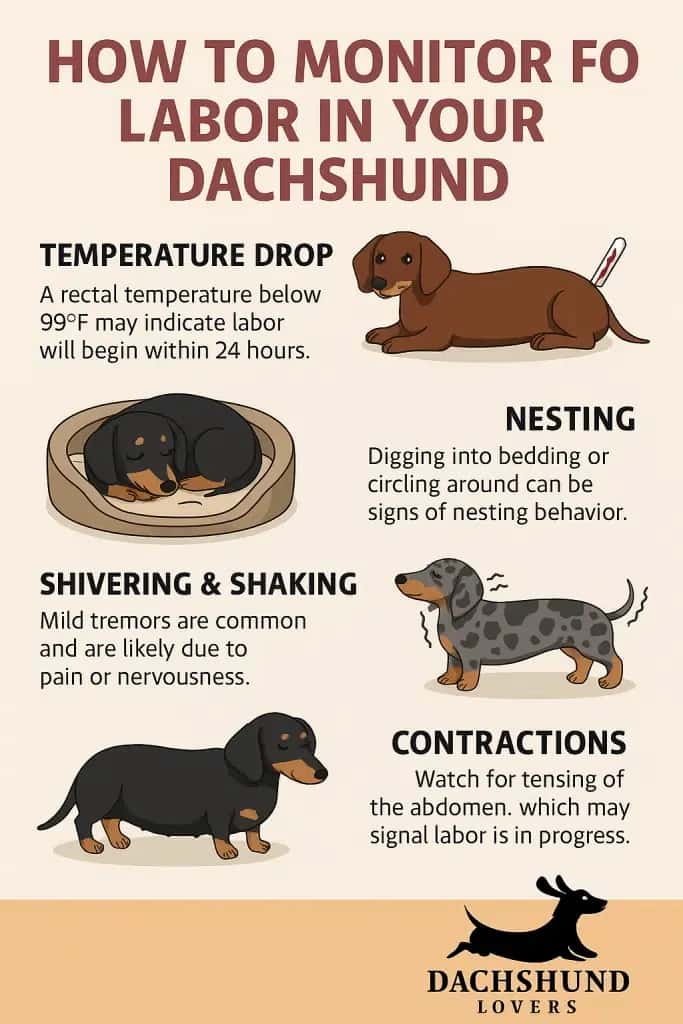
By week nine, you’re watching closely. Not in a panicked way — just tuned in. She’s quieter. Picks at her food. Moves from room to room like she’s waiting for something. She is.
Labor can start suddenly, or it can announce itself over 24–48 hours through a slow build of behavior changes. Either way, the signs are usually there if you know what to look for.
Signs Labor Is Close
- Drop in body temperature
A fall below 37.2°C (99°F) often means labor is 12–24 hours away. Use a digital rectal thermometer if she’ll tolerate it. Check at the same time each day for consistency.
- Loss of appetite
A skipped meal isn’t uncommon. If she was eating normally and suddenly won’t touch food, this could be the pre-labor dip.
- Restlessness or pacing
She may start walking circles, scratching at her bedding, or relocating her blankets every 20 minutes.
- Digging or nesting
Even if she’s already chosen a spot, she might dig like she’s prepping for a storm. Let her work it out — it’s part of her process.
- Licking her vulva
This is part cleaning, part instinct. It often signals early labor is starting or that discharge is present.
- That distant look
Hard to describe, easy to recognise. She seems “elsewhere.” Focused, alert, but inward. That’s when you know it’s close.
What to Do (and What Not To)
- Keep the environment calm. Don’t start rearranging the room now.
- Don’t introduce new people or pets. Keep it quiet and familiar.
- Keep a close eye — but don’t hover. She needs space.
- Don’t try to “help” too early. Let her do the work unless something seems wrong.
When labor kicks in, the first puppy usually arrives within 1–2 hours of hard contractions. Most dachshunds will deliver naturally and know exactly what to do. Your job is to observe, log what happens, and call the vet if anything feels off.
Know When to Call the Vet
- More than 2 hours between puppies with no progress
- Excessive strain or distress with no pup delivered
- Thick green or bloody discharge before first pup arrives
- Any pup stuck or halfway delivered with no movement
- She seems exhausted, confused, or disoriented
Keep your vet’s number close. If it’s after hours, know your nearest emergency vet location now — not later.
We go deeper into labor stages, timing, and troubleshooting in our Week-by-Week Pregnancy Guide, including what to expect if a C-section becomes necessary.
Litter Size & What to Expect
First question we usually get: “How many puppies should I expect?”
Short answer — it depends. Litter size is affected by age, genetics, nutrition, and whether it’s her first pregnancy. There’s no fixed number, and you won’t know for sure until they’re here.
But here’s the general range:
- Miniature dachshunds: Typically 3–5 puppies
- Standard dachshunds: Usually 4–6 puppies
- First litters: Often smaller — sometimes just one or two
- Larger litters: Not common, but not impossible. We’ve seen seven. Rarely eight.
The earlier you confirm pregnancy, the better you can plan. Ultrasounds can sometimes give a ballpark count — but don’t treat it as gospel. X-rays around day 45 are more accurate, but even then, a surprise pup or two can still show up during delivery.
What We’ve Seen in Real Life
One of Harvey’s cousins had three pups in her first litter — vet predicted two. Another local family thought their girl was done after five… then number six came 40 minutes later. Stay calm. Track timing. And don’t assume she’s finished until she’s truly settled and resting.
Tracking Birth Order & Health
You don’t need to be a professional breeder to manage this well — just stay organised:
- Keep a notepad or phone log of time of birth and order
- Weigh each pup with a small kitchen scale — track daily
- Rotate feeding if one is being pushed out
- Watch for pups who aren’t gaining weight or seem weak
Most dachshund mums handle it instinctively. Your job is just to observe and step in if something seems off.
Feeding & Early Days
Newborns feed frequently — every 2–3 hours in the beginning. Make sure all pups are warm, dry, and able to latch. If one is smaller or slower, you may need to help reposition them at feeding time.
Our full Newborn Dachshund Puppy Care Guide walks through feeding, temperature regulation, and how to spot red flags in the first few days.
Frequently Asked Questions about Dachshund Pregnancy
More from This Series
Explore the full Dachshund Lovers pregnancy collection to guide you through every stage:
- Dachshund Pregnancy Week by Week
Follow each stage from fertilization to labor with real-life stories and weekly care tips. - Early Signs of Pregnancy & Phantom Pregnancy
Understand how to tell if your doxie is truly pregnant — or just experiencing a false alarm. - Caring for a Pregnant Dachshund
From feeding to gentle exercise, this guide walks you through everyday care essentials. - Preparing for Dachshund Puppies
Everything you need for a smooth delivery and the first few days with newborn pups. - Dachshund Pregnancy Hub
Browse the entire cluster, find FAQs, or jump straight to the section you need.
Authored by
James
James is the founder of Dachshund Lovers and the proud human of Harvey, a mini dapple with a big personality. He writes to empower and connect the dachshund community, blending founder insights with honest, experience-based stories about life with this incredible and special breed. James brings candid, experience-backed opinions to the community and always focused on fewer, better products and ideas that genuinely improve life for dachshunds and their people.
Read moreJames is the founder of Dachshund Lovers and the proud human of Harvey, a mini dapple with a big personality. He writes to empower and connect the dachshund community, blending founder insights with honest, experience-based stories about life with this incredible and special breed. James brings candid, experience-backed opinions to the community and always focused on fewer, better products and ideas that genuinely improve life for dachshunds and their people.
Read moreDisclaimer
This content is for informational purposes only and should not be considered veterinary advice. Always consult with a licensed veterinarian regarding your dog’s health and wellbeing.
There are no comments yet
Leave a comment