Piebald Dachshund Puppies: The Spotted Start to a Lifelong Love
Piebald Dachshund Puppies: The Spotted Start to a Lifelong Love
Curious about piebald dachshund puppies? Learn about their coats, care, and what to expect in their first year.

Ellie
Posted on July 25, 2025.
Updated on July 21, 2026.
Table of Contents
- 1.Key Takeaways on Piebald Dachshund Puppies
- 2.What Is a Piebald Dachshund Puppy?
- 3.Coat Patterns and How They Form
- 4.Long-Haired Piebald Dachshund Puppies
- 5.Dapple Piebald Puppies: A Complex Mix
- 6.Puppy Temperament and Socialization
- 7.Health and Ethical Breeding
- 8.Grooming Tips by Coat Type
- 9.Where to Find One Responsibly
- •More From This Series:
- •Disclaimer
Share

I met my first piebald dachshund puppy in the middle of a rainy New York afternoon at Bluestone Lane Cafe near Bryant Park. I was on a writing break—latte in hand, maple pastry half-eaten—when I spotted a speckled ball of white and chocolate fur being fussed over by three strangers and a barista. Her name was Olive. She was ten weeks old, wearing a tiny pink harness and already giving side-eye like a professional. I barely remember what I ordered, but I can tell you exactly how her spots curved down her back like brushstrokes.
That was years ago, before I brought Maple into my life back home in Sydney. But Olive started something for me. A fascination with dachshund coat patterns—especially the unmistakable charm of the piebald.
If you’re here because you’ve just discovered piebald dachshund puppies or are thinking about bringing one home, welcome. Let’s walk through what to expect—from their coloring and coat types to health, grooming, and what makes them so utterly unforgettable.
Key Takeaways on Piebald Dachshund Puppies
Topic | Summary |
|---|---|
What Is a Piebald Dachshund Puppy? | A dachshund puppy with a white base coat and large patches of color (like black, red, or chocolate). Caused by the recessive piebald gene. |
Puppy Patterns | Their markings are present from birth and stay fairly consistent, though they may shift slightly in shape or contrast as the pup matures. |
Coat Types | Piebald puppies can be smooth, long-haired, or wire-haired—each with different grooming needs. |
Health Considerations | Avoid “extreme piebalds” with too much white on face/ears, as they may be more prone to hearing issues. |
Temperament | Typical dachshund personality: loyal, bold, affectionate, and occasionally dramatic. |
Training & Socialization | Start early with positive reinforcement. Their cuteness can make people too lenient—consistency is key. |
Ethical Breeding | Look for breeders who avoid pairing two piebald parents and who test for hearing and vision health. |
What Is a Piebald Dachshund Puppy?
A piebald dachshund puppy is born with a creamy white base coat and distinctive, solid-colored patches—most commonly black, red, or chocolate. These bold markings are the result of the recessive piebald gene (sp), which must be inherited from both parents for the pattern to appear. Unlike dapple, piebald has no marbling—just clean contrast.
You’ll often see piebald markings:
- Across the ears and back
- As a “cap” on the head
- At the tail base or tip
- Scattered across the legs, belly, or chest
These patches generally stay consistent in placement throughout the puppy’s life. However, as your puppy matures, you might notice a subtle softening in tone or contrast—especially around the edges of darker patches. It’s less dramatic than a full coat change but still part of watching your dachshund grow into their look.
Ellie’s Note: There’s something endlessly charming about a pup with their own personal ‘ink splatter.’ Each piebald is one of one.
Coat Patterns and How They Form
It’s easy to mistake a piebald dachshund for a dapple at first glance—especially when the white patches are large or symmetrical. But genetically, these patterns are entirely different, and understanding them can help you make more informed decisions when it comes to breeding, health, or simply choosing a puppy that suits your family.
Feature | Piebald | Dapple |
|---|---|---|
Pattern | Bold solid-colored patches on white | Marbled swirls or speckles |
Genetics | Recessive “sp” gene | Dominant merle (dapple) gene |
Appearance | Crisp contrast, high definition | Flecks and blended shade transitions |
Piebald is controlled by the recessive piebald gene (sp), which means a puppy must inherit one copy from each parent to display the pattern. If only one parent carries the gene, the pup may be a silent carrier with no visible piebald traits. This recessive nature also explains why piebald puppies can sometimes be a surprise in litters where the coat genetics weren’t fully understood or tested.
Dapple, by contrast, comes from the dominant merle gene, and only one copy is needed for the pattern to show. Dapple pups tend to have lightened or mottled areas within their base color, creating a more ‘misted’ effect rather than distinct patches.
Ellie’s Tip: Think of piebald as bold brush strokes on a white canvas, and dapple as mist drifting over a color wash. And yes, it’s completely possible for both genes to show up in one puppy—we’ll get to that next.
For a full breakdown of piebald coat genetics, see: Piebald Dachshund
Long-Haired Piebald Dachshund Puppies
There’s something quietly magical about a long-haired piebald dachshund puppy. The pattern itself—already striking on a smooth coat—takes on a softer, dreamlike quality when expressed through feathery fur. Instead of crisp color blocks, you get a gentle watercolor effect, where each patch subtly blends into the next. Around the ears, tail, and chest, the long wisps seem to frame the markings, giving these pups an almost painterly elegance.
Beyond aesthetics, long-haired piebalds tend to mature into slightly more relaxed companions. While temperament is always individual, many long-haired dachshunds are known for their calm, affectionate nature—perhaps a result of their spaniel ancestry. These puppies often bond deeply with their people and may show a preference for quieter, cosier environments, making them ideal for families, apartment living, or older pet parents.
Expect:
- More daily grooming – Their fine fur is prone to tangles, especially behind the ears and on the legs.
- A slightly calmer personality as they mature – Though still playful, they may be more content to curl up than sprint endlessly.
- Strong visual impact – These are the pups that turn heads at the park or café.
Read more about this coat type here: Long-Haired Piebald Dachshund
Dapple Piebald Puppies: A Complex Mix
When a piebald and a dapple dachshund are paired responsibly, the result can be truly captivating. Dapple piebald puppies are often described as “living artwork”—each one completely unique, with layered patterns that almost seem hand-painted. These puppies inherit both the recessive piebald gene and the dominant merle (dapple) gene, leading to marbled, speckled, or swirled patches that sit atop a white base coat.
You might notice areas where the white piebald backdrop is broken up by dappled color — swirls of silver, blue-gray, or chocolate within the darker patches. Some pups even show double dappling within patches, though this should be approached with care (and never deliberately bred). Eye color can also be affected: one or both eyes may appear icy blue, speckled, or even different colors entirely—a condition called heterochromia, often associated with the dapple gene.
While beautiful, these combinations must be approached with caution. Breeding two dapples or two piebalds (or even one of each without health screening) significantly increases the risk of deafness, vision issues, and other neurological complications—especially when over 80% of the coat is white. It’s vital that breeders understand genetic compatibility and prioritise health over pattern.
Signs of a healthy dapple piebald:
- Balanced markings (not overly white)
- Normal hearing and vision (BAER test confirmed)
- Clear lineage showing only one dapple parent
Curious about how these markings evolve? Explore our full guide: Dapple Piebald Dachshund
Piebald dachshund puppies might look distinctive with their bold markings, but at heart, they’re just as dachshund as any other pup—opinionated, clever, and endlessly curious. From a young age, they’ll show a surprising amount of personality: some will be bold and investigative, while others may be more reserved but still deeply attached to their people.
In the early months, socialization is everything. Exposing your puppy to gentle, positive experiences—new textures, safe noises, calm people and pets—lays the groundwork for a confident adult dog. Without it, dachshunds can become anxious or overly territorial, which isn’t ideal when paired with their natural watchdog tendencies.
Expect:
- Affection and loyalty that runs deep—they often bond closely with one or two people
- Endless curiosity—they’ll nose through bags, under furniture, and into anything new
- Burrowing instincts—don’t be surprised to find them under blankets, pillows, or your jumper
- A surprisingly loud bark for such a small dog (you’ll hear it when the post arrives!)
Start leash training and crate time as soon as possible. Even at 8–10 weeks, they can begin learning simple cues like their name, “sit,” or “wait.” These small early lessons help shape their independence and help ease separation anxiety later.
Ellie’s Tip: “It’s tempting to carry them everywhere—they’re tiny, adorable, and those spots! But give them space to explore on their own too. Confidence comes from trying things with your support, not being shielded from everything.”
Health and Ethical Breeding
Piebald dachshund puppies, while stunning, require thoughtful breeding practices to ensure they live healthy, happy lives. The piebald gene is recessive, meaning both parents must carry it for a puppy to display the coat. When breeders don’t fully understand (or don’t prioritize) genetics, issues like deafness or vision problems can arise—especially in “extreme piebalds,” where more than 80% of the dog’s body is white.
A reputable breeder won’t just be focused on producing pretty puppies—they’ll be deeply committed to the breed’s health and temperament. That means careful genetic pairings, early health screening, and full transparency about lineage.
A responsible breeder will:
- Avoid pairing two piebald parents, reducing the risk of genetic hearing issues
- Perform BAER hearing tests on pups with significant white markings (especially those with white faces or ears)
- Only breed a piebald with a non-piebald partner to maintain balance and reduce health risk
- Share health records for both dam and sire, including DNA tests and patella/eye checks
- Allow visits (or video calls) to meet the parents and see the pups’ environment
Be cautious if a breeder:
- Uses phrases like “rare colors” or “designer coat” without health documentation
- Refuses to show the parents or explain the coat’s genetics
- Offers pups with full white faces, ears, and paws, but no test results or transparency
Questions to ask:
- Have both parents been DNA tested for the piebald and dapple genes?
- Has the puppy undergone a BAER hearing screening?
- What’s your breeding goal—temperament and health, or just color?
Ellie’s Note: “I know it’s easy to fall for a beautiful photo online, but please—take your time. Ethical breeders might have a waitlist, but they’ll offer guidance, honesty, and a puppy who’s been loved from day one.”
Grooming Tips by Coat Type
Piebald dachshund puppies might have eye-catching markings, but grooming needs vary greatly depending on coat type—smooth, long-haired, or wire-haired. Each requires a different rhythm of care to keep their coats healthy, their white areas bright, and their overall comfort in check.
Coat Type | Brushing | Bathing | Notes |
|---|---|---|---|
Smooth | 1x/week | Monthly | Quick to dry, but white fur can stain easily—especially on paws and belly |
Long-Haired | Daily | Every 3–4 weeks | Use detangler or leave-in conditioner to manage knots and keep feathering silky |
Wire-Haired | Weekly + trimming | Monthly | Needs hand-stripping every 2–3 months to maintain coat texture and avoid matting |
Regardless of coat type, all piebalds have one thing in common: those white patches can pick up dirt and discoloration fast. A gentle whitening or brightening shampoo every few washes can help maintain contrast without irritating sensitive puppy skin.
More grooming tips:
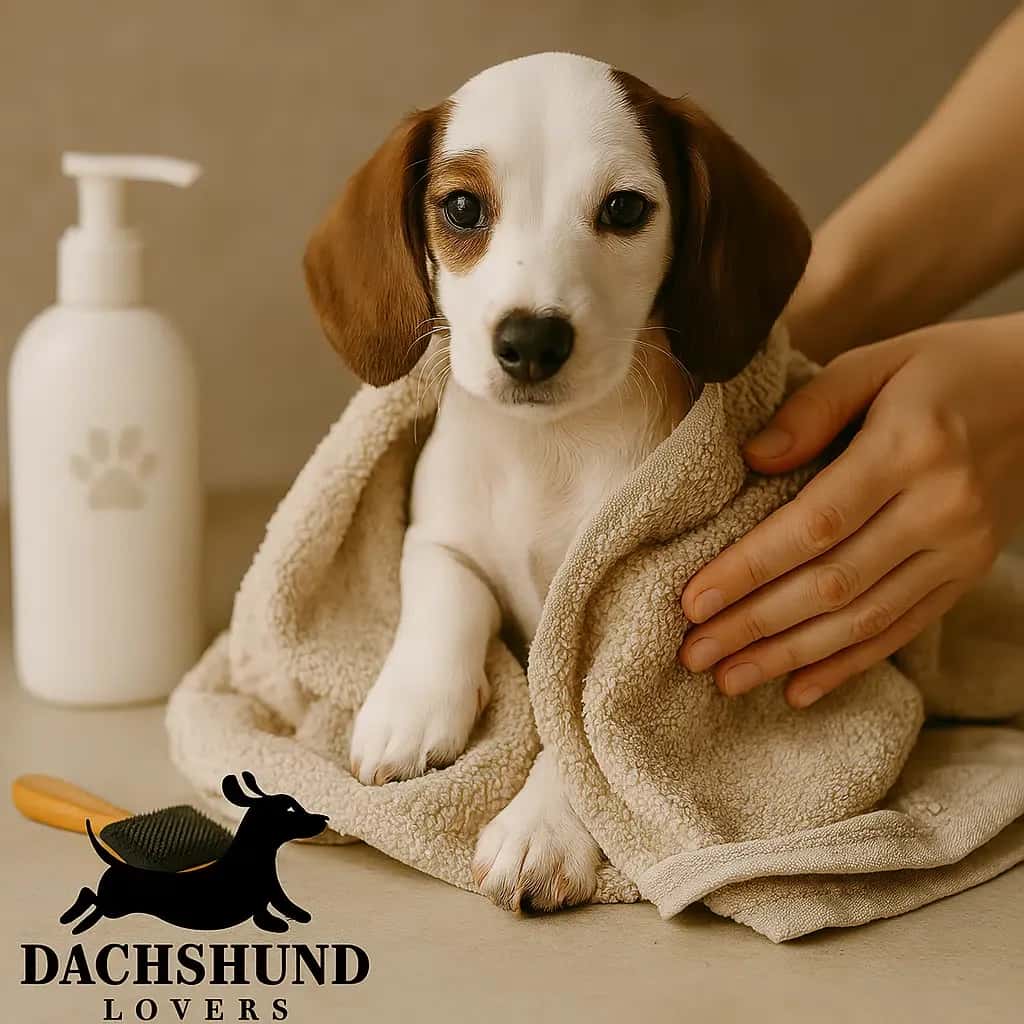
- Start early. Get your puppy used to being brushed, bathed, and having their paws and ears handled from the first few weeks home. It sets the tone for stress-free grooming as they grow.
- Ears need weekly checks and cleaning. Especially with floppy-eared pups, trapped moisture can lead to infections. A quick swipe with a dog-safe ear cleaner keeps things fresh.
- Keep nails trimmed. Short nails are key for posture, joint health, and comfort. If you can hear clicking on hard floors, it’s time for a trim.
- Watch tear stains on lighter faces. A clean, damp cloth or vet-approved wipe can help reduce build-up around the eyes.
- Don’t forget dental hygiene. Brushing with a dog-friendly toothpaste 2–3x a week keeps puppy breath tolerable and adult teeth strong.
Ellie’s Tip: “I keep a small grooming basket in our hallway with a soft brush, ear cleaner, paw balm, and wipes—makes it so much easier to keep up with daily maintenance without turning it into a chore.”

Where to Find One Responsibly
If you’ve fallen for the charm of a piebald dachshund puppy, the next step is finding one through ethical, informed avenues. While social media and online listings might seem like the quickest path, they rarely offer the depth of care and health transparency that piebald pups—especially those with high white coverage—require.
Start with these trusted sources:
- Breed clubs and kennel associations. National or regional dachshund clubs can point you toward breeders who meet strict ethical and health-testing criteria:
- Dachshund-specific rescues. While piebald puppies are less common in rescue, they do appear occasionally. These organizations often include health screenings and offer a second chance to dogs in need:
- Reputable breeders with waiting lists. A good breeder won’t rush the process. They’ll ask thoughtful questions, provide health clearances, and share honest insights into the pup’s temperament and care needs. Look for signs of intentional breeding—lineage documentation, BAER test results (especially for white-heavy pups), and visible efforts toward early socialization.
Avoid these red flags:
- Puppies marketed as “rare” or “designer” just for their coloring.
- Sellers who won’t provide health history or photos of the puppy’s parents.
- “Extreme piebalds” (mostly white body and face) with no BAER testing or understanding of risk factors.
Helpful questions to ask breeders:
- Have both parents been DNA tested?
- Has the puppy had a hearing screening (BAER test)?
- Are your litters bred primarily for health and temperament?
Ellie’s Note: “When I met Maple’s breeder, she invited me to her home, showed me the parents’ gentle personalities, and even had a printed grooming guide ready to take home. That moment set the tone for everything to come. If it feels rushed or vague—it’s worth stepping back and waiting for the right fit.”
FAQs
More From This Series:
Authored by
Ellie
Ellie is a lifelong dachshund lover and the proud human of Maple, a long-haired brown doxie with a regal side-eye. While not a vet, Ellie brings honest, researched, and experience-based insights into every article she writes for the Dachshund Lovers community.
Read moreEllie is a lifelong dachshund lover and the proud human of Maple, a long-haired brown doxie with a regal side-eye. While not a vet, Ellie brings honest, researched, and experience-based insights into every article she writes for the Dachshund Lovers community.
Read moreDisclaimer
This article is for informational purposes only and should not replace professional veterinary advice. Always speak to a licensed vet or breeder when making decisions about your dachshund’s health or care.
There are no comments yet
Leave a comment