Fun Facts About Dachshunds
Fun Facts About Dachshunds
Did you know dachshunds used to hunt badgers? I’ve gathered my favorite fun facts about these long legends—and yes, some made me laugh out loud.
James
Posted on October 30, 2025.
Updated on July 19, 2026.
Table of Contents
- 1.The Things You Don’t Expect — But Never Forget
- 2.Key Takeaways
- 3.Unusual Origins: What Most People Get Wrong
- •They weren’t just badger hunters — they were scent hounds.
- •The breed came in three sizes — for three types of prey.
- •They weren’t just working dogs — they were royal favourites.
- 4.Dachshunds in Pop Culture: From Art Studios to Olympic Stadiums
- •Lump: Picasso’s four-legged muse
- •Waldi: The first Olympic mascot
- •Scene-stealers on screen
- •Advertising’s favorite shape
- •They were used in World War I propaganda — on both sides.
- •Their coat types reflect their hunting roles.
- •Dachshunds come in more colors and patterns than almost any other breed.
- •Their eyebrows move more than most breeds.
- 5.Dachshund Intelligence: Smarter Than They Let On
- •They learn patterns quickly — and then test them.
- •They apply logic in sneaky ways.
- •They problem-solve in silence.
- •Why it’s often misread
- 6.How Their Body Shape Shapes Their Personality
- •Low to the ground means high alert.
- •Their size doesn’t match their confidence.
- •They play differently — and expect others to keep up.
- •Posture affects emotion.
- 7.Daily Life with a Dachshund: Things You Only Learn by Living It
- •They don’t lie on furniture — they become part of it.
- •Tone of voice matters more than words.
- •They sulk — and they don’t hide it.
- •They take routines seriously — and they expect you to do the same.
- •Their loyalty shows up in small, consistent ways.
- -More from This Series
- -Disclaimer
Share

The Things You Don’t Expect — But Never Forget
A few weeks after bringing Harvey home, I found him staring at the dishwasher. Not barking. Not whining. Just… watching. Still as a statue, tail twitching slightly. Five full minutes passed before I realised he’d spotted his own reflection — and decided it was a rival.
That’s the thing about dachshunds. You think you’ve got them figured out — clever, loyal, stubborn — and then they throw you something entirely new. A sound you’ve never heard. A behavior you weren’t ready for. A moment that makes you say, “I didn’t know they did that.”
They’re small dogs with a lot going on under the surface — genetically, historically, behaviorally. And the more time you spend around them, the more curious details you uncover.
This isn’t a “101” breed guide. This is a collection of the kind of facts that make you lean in. Things you can tell your vet, your friends, your barista — and they’ll probably raise an eyebrow.
And yes — some of these came from Harvey himself. The rest we researched, tested, or heard from other doxie owners who, like us, are always learning.
Key Takeaways
Fun Facts | Why It Matters |
|---|---|
Dachshunds were the first Olympic mascot. | A dachshund named Waldi represented the 1972 Munich Games — chosen for his tenacity and charm. |
They have an unusually loud bark for their size. | Bred to alert hunters underground, their bark was meant to travel — which explains why it still carries through apartment walls. |
Their sense of smell rivals that of a bloodhound. | Dachshunds have over 125 million scent receptors, making them elite scent trackers despite their size. |
They were originally bred in three sizes. | Standard, miniature, and the now rare kaninchen (“rabbit”) — each built for specific prey. |
Picasso had a dachshund named Lump. | Lump appeared in over 40 of Picasso’s paintings — a living muse with very short legs. |
Unusual Origins: What Most People Get Wrong
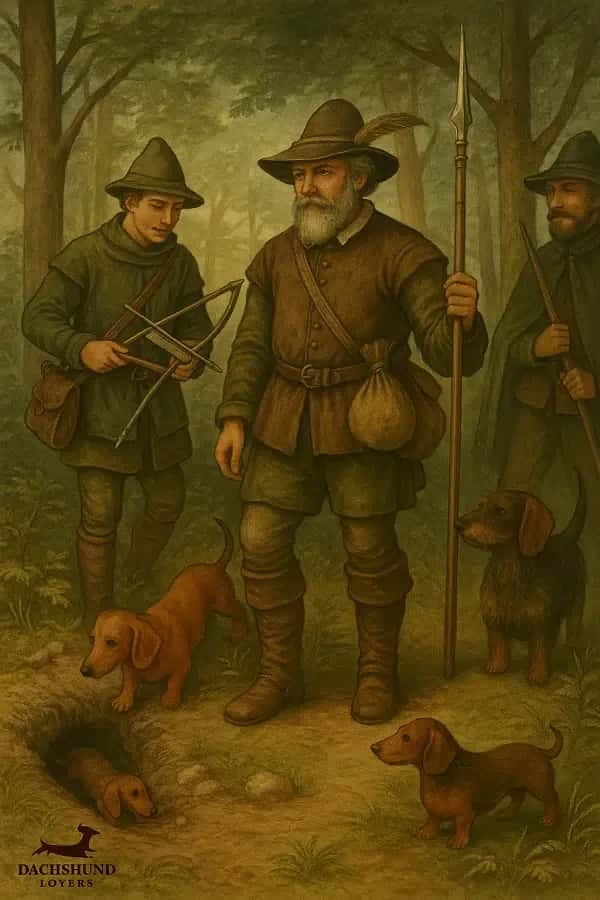
The dachshund might be one of the most visually recognisable breeds in the world, but their backstory? Most people only know the headline — “badger dog.” There’s more to it than that.
They weren’t just badger hunters — they were scent hounds.
We tend to associate dachshunds with digging and burrowing, but their sense of smell is elite. They rank just behind bloodhounds and basset hounds in scent-tracking ability. That’s why some dachshunds were used above ground to track wounded deer — especially in the wire-haired and standard-sized lines.
The American Kennel Club lists the dachshund among the top scent hound breeds, noting their “tenacity and determination” in tracking prey.
Source: AKC – Dachshund Breed Standard
The breed came in three sizes — for three types of prey.
- Standard Dachshunds were bred for badgers and foxes
- Miniature Dachshunds targeted smaller animals like rabbits
- Kaninchens (German for “rabbit”) were the smallest, and now rare outside Europe
Each size had a job. The scale of the dog matched the size of the tunnel — and the attitude always outpaced the body.
They weren’t just working dogs — they were royal favourites.
Queen Victoria is often credited with popularising the breed in Britain. She reportedly had several dachshunds and described them as “clever, devoted, and brave.” Their popularity in the royal court helped fuel their rise across Europe.
And while many breeds faded in wartime, dachshunds endured — even with a name that marked them as distinctly German. During World War I, U.S. media briefly tried to rebrand them as “liberty pups,” but the name (thankfully) didn’t stick.
Dachshunds in Pop Culture: From Art Studios to Olympic Stadiums
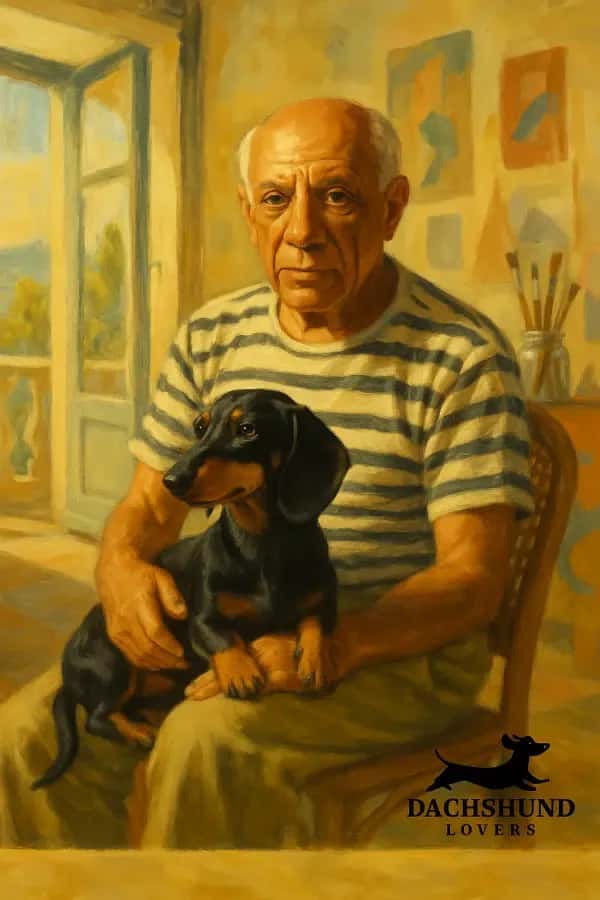
For a breed that started life underground, dachshunds have had a surprisingly public trajectory. Over the last century, they’ve become design icons, artistic muses, Olympic ambassadors, and animated sidekicks. The world noticed their shape — and never looked away.
Their cultural presence isn’t accidental. It’s the result of a dog that’s visually distinct, emotionally expressive, and just unpredictable enough to be interesting. Below the surface-level cuteness, there’s a story. Sometimes several.
Lump: Picasso’s four-legged muse
In 1957, photographer David Douglas Duncan introduced Picasso to a small, smooth-haired dachshund named Lump. It was meant to be a casual visit. Lump never left.
He became Picasso’s companion — a calm presence in the chaos of an art studio. Picasso even gave Lump his own plate at mealtimes. But what’s more fascinating is how Lump began appearing in Picasso’s work, most notably in reinterpretations of Las Meninas by Velázquez, where Lump replaced the original dog.
Read more about Lump’s life in Picasso & Lump: A Dachshund’s Odyssey (David Douglas Duncan, 2006) or via Smithsonian Magazine, which profiled their unlikely bond.
Waldi: The first Olympic mascot
Fast forward to 1972. Munich is preparing to host the Summer Olympics, and Germany wants a symbol that reflects both national pride and playful optimism. Enter Waldi — a stylised dachshund designed by Otl Aicher.
Waldi wasn’t just cute. He was clever branding. Chosen for his tenacity, athletic build, and connection to Bavarian identity, Waldi became the first official Olympic mascot — setting a precedent followed by every Olympic Games since.
The Olympic Museum explains why Waldi’s shape, colors, and posture reflected more than just design — it reflected Germany’s post-war optimism.
Scene-stealers on screen
From Toy Story’s Slinky Dog to The Secret Life of Pets’ Buddy, dachshunds have carved out an unmistakable niche in animation. Their shape is inherently expressive. A long pause and a side-eye from a dachshund says more than dialogue ever could.
Directors and animators use dachshunds because they’re recognisable — but also because they have presence. They move differently. React differently. And audiences notice.
- In Wes Anderson’s Isle of Dogs, the character Duke (voiced by Jeff Goldblum) delivers one of the film’s most dryly comedic performances — wrapped in the unmistakable silhouette of a wire-haired dachshund.
- Even classic cartoons like The Looney Tunes Show and Tom & Jerry featured exaggerated dachshunds, always portrayed as sharp, slightly snarky, and unusually resilient.
Advertising’s favorite shape
Dachshunds are regularly cast in advertising not because they’re trendy — but because they’re instantly recognisable, emotionally engaging, and subtly unexpected. Their image has been used in:
- Audi and Volkswagen campaigns (often playing on the German heritage)
- Pet food brands that want to convey loyalty and personality
- Banks and insurance companies where memorability matters more than breed neutrality
They’re not “in fashion.” They’re always in orbit — just strange and stylish enough to cut through.
Want more real-world examples? We’ve profiled Lump, Waldi, and more in Famous Dachshunds in History.
They were used in World War I propaganda — on both sides.
Because of their German origin, dachshunds were used to symbolise the enemy in Allied propaganda — often drawn with spiked helmets and scowls. But back in Germany, they were painted as symbols of loyalty and grit. It’s rare for a breed to be politicised — rarer still to be used by both sides.
The Imperial War Museums archives contain several wartime illustrations featuring dachshund caricatures.
Their coat types reflect their hunting roles.
- Smooth-haired dachshunds were best suited to dry, open terrain.
- Wire-haired dachshunds were bred for thorny, brush-filled areas.
- Long-haired dachshunds were believed to have spaniel ancestry, better suited for cold-weather work.
Each coat wasn’t just aesthetic — it was adapted to different landscapes and prey.
Dachshunds come in more colors and patterns than almost any other breed.
From chocolate and tan, to blue, cream, wild boar, and patterns like dapple, piebald, and brindle — dachshunds have one of the most diverse coat palettes in the dog world. Some of these are tied to rare gene expressions (like the merle gene), while others were selectively bred for show ring appearance.
Their eyebrows move more than most breeds.
This sounds odd, but it’s true. Dachshunds — especially wire-haired and long-haired varieties — have extremely expressive brow muscles. You’ll notice it when they pause mid-thought or tilt their head. It’s part of what gives them such readable expressions, and part of why they get away with more than they should.
Dachshund Intelligence: Smarter Than They Let On

If you measure intelligence by obedience, dachshunds rank low. They’re not likely to win precision heel competitions or bring your slippers unprompted. But if you shift the definition — if you consider decision-making, independence, and problem-solving — they start to look a lot smarter than their reputation suggests.
They just don’t always use their intelligence in ways that benefit you.
They learn patterns quickly — and then test them.
Harvey knows the sound of the fridge opening, but more specifically: he knows the difference between snack fridge sounds and meal fridge sounds. He also knows that if he stares at the treat drawer for long enough, someone — eventually — will break.
This isn’t coincidence. Dachshunds are observers. They clock routines, read emotional tone, and notice details most dogs ignore. But instead of defaulting to cooperation, they negotiate with the information.
It’s a different kind of smarts — not golden retriever intelligence, but border collie stubbornness with a bit of terrier logic thrown in.
They apply logic in sneaky ways.
- Figuring out how to open sliding doors
- Using smaller furniture as stepping-stones to access beds or couches
- Hiding toys in the same spot until you forget about them
- Playing favorites — not because of emotion, but leverage
These aren’t random behaviors. They’re decisions based on experience. And once they work, your dachshund will repeat them with terrifying consistency.
They problem-solve in silence.
Unlike other dogs who bark or whine when frustrated, dachshunds will often go quiet. You’ll find them under a table, silently wedging a chew behind the leg of a chair like they’re building a tiny survival cache.
One owner I know came home to find their doxie had stacked three cushions to reach a windowsill. Not jumped. Not climbed. Stacked. It’s hard to call that disobedient. It’s just… resourceful.
Why it’s often misread
Because they resist commands, people assume dachshunds are difficult or dim. But in truth, they’re:
- Fast at adapting
- Highly attuned to consequence
- Motivated by self-interest, not external validation
They learn quickly — they just decide whether it’s worth it.
How Their Body Shape Shapes Their Personality
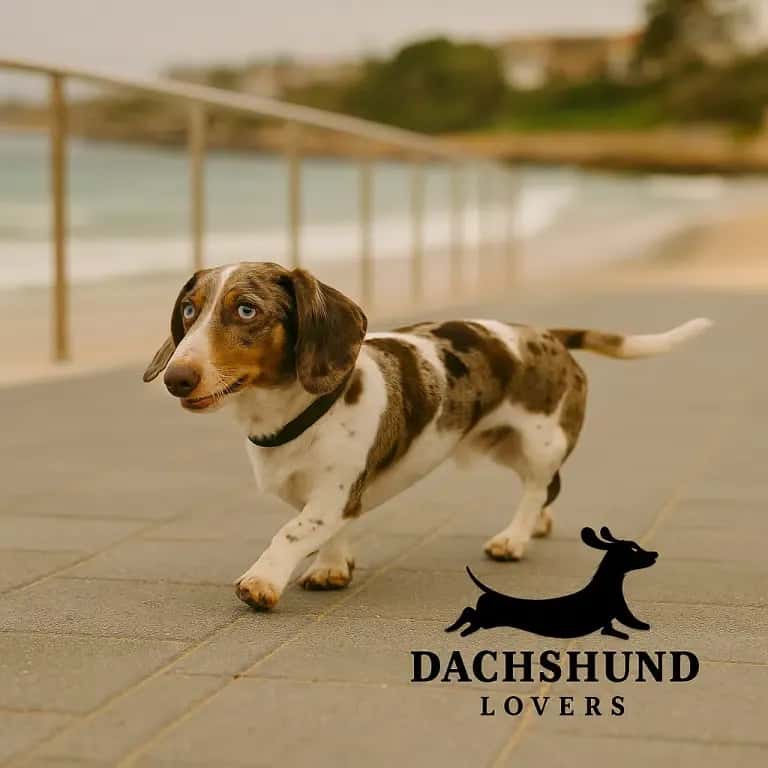
Most people see the dachshund’s shape as a physical trait. Long back. Short legs. Funny silhouette. But what gets overlooked is how that shape influences who they are — not just how they move, but how they behave, react, and relate to the world.
It’s not just design. It’s identity.
Low to the ground means high alert.
Dachshunds live at ankle height. They feel vibration. They sense movement before other dogs notice. That closeness to the floor changes how they interpret the world — and how often they feel the need to react to it.
This explains why your dachshund might bark when a delivery arrives before the knock. Or why a rolling suitcase sets off a reaction you weren’t prepared for. Their field of view is limited — so they rely on sound, scent, and subtle shifts in rhythm to understand what’s coming.
Their size doesn’t match their confidence.
There’s something bold about the way dachshunds carry themselves. They walk like they own the hallway. They’ll square up to dogs three times their size — not because they’re aggressive, but because they don’t seem to realise (or care) that they’re small.
That confidence has a lot to do with body memory. Historically, they were sent into tunnels alone. No backup. No handler in sight. They had to rely on their own judgment and hold their ground. That legacy still shows up — especially in situations where they feel the need to protect.
It’s why they’ll often bark first and ask questions later. It’s not insecurity. It’s protocol.
They play differently — and expect others to keep up.
Dachshunds rarely play the way labs or spaniels do. Their style is closer to stalking, springing, and stealing. They like sneaky pounces, tug-of-war ambushes, and games where they stay in control.
Their shape informs this. Long bodies mean they’re less agile in wide circles, more strategic in tight spaces. You’ll often see them hiding behind furniture before making a “sprint” — which, to them, is three sideways hops followed by a dramatic flop.
It’s not about speed. It’s about timing.
Posture affects emotion.
One thing I noticed early with Harvey: when he’s unsure, he flattens. Not just ears back — entire body low. You realise how much the spine and body carriage reveal mood in this breed. The long shape exaggerates everything.
You can read a dachshund’s tension in their back before it hits their bark. The twitch of the tail, the shift in balance, the way they anchor themselves when they feel unsure — it’s all shaped by structure. And it gives you clues, if you’re paying attention.
Daily Life with a Dachshund: Things You Only Learn by Living It
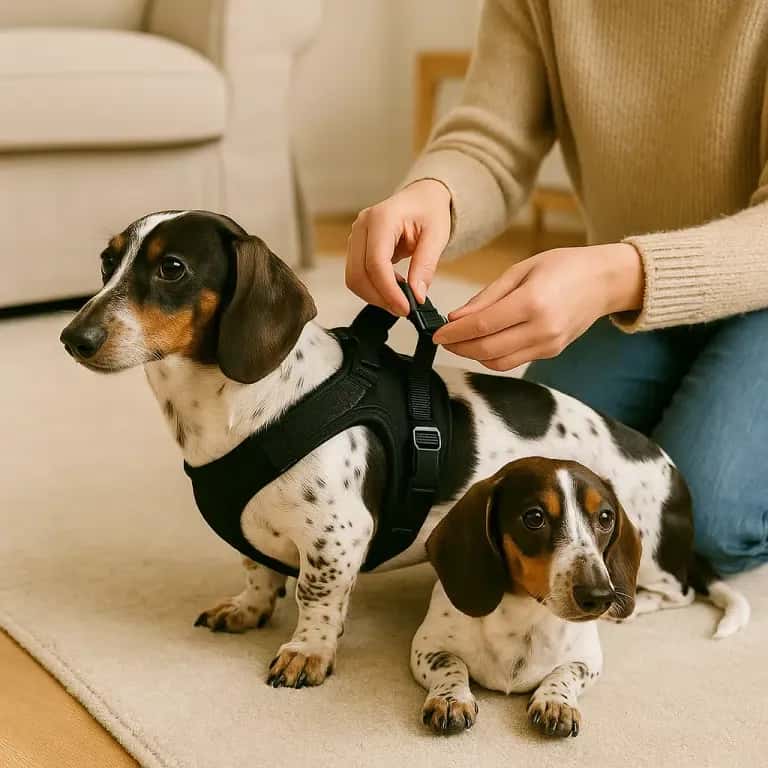
You can read every breed guide, watch every training video, follow all the right accounts — but there are things about dachshunds that you only understand once one moves into your life. And takes over your furniture. And your schedule.
They’re not just dogs. They’re housemates with opinions.
They don’t lie on furniture — they become part of it.
Harvey has a favourite spot on the couch — top of the backrest, cat-style, like a lookout tower. It’s never the seat. Never the floor. Always elevated. Always strategic.
Dachshunds don’t sit on things. They settle into them. Pillows, duvets, baskets of clean laundry. Anything soft becomes theirs within seconds. It’s not about comfort. It’s about claiming territory with complete confidence.
And if you sit in their spot? Expect a look.
Tone of voice matters more than words.
You can say “dinner” with the wrong tone, and your dachshund won’t budge. You can say “nothing for you” with the right tone, and they’ll come running. They respond to emotional frequency more than commands — and they know when you mean it.
This works both ways. A stern tone will shut them down. A soft cue will bring them back in. It’s less about discipline, more about conversation. Once you realise that, things shift.
They sulk — and they don’t hide it.
Tell your dachshund “no” and they won’t just move on. They’ll withdraw. Sometimes to the corner of the room. Sometimes under a chair. Sometimes to their crate, with one slow, disappointed look over their shoulder.
It’s not drama. It’s feedback.
Dachshunds don’t forget slights. They also don’t forget routines, locations, or who gave them the best snack. Their emotional memory is long, and it shapes how they engage with you daily.
They take routines seriously — and they expect you to do the same.
Miss a walk and you’ll hear about it. Feed them five minutes late and you’ll feel the stare. Try to change your morning flow and you’ll get shadowed until you revert.
But once a routine is locked in, it becomes a shared rhythm. Dachshunds settle best when they can predict what’s next. And if you treat the rhythm with respect, they’ll give you their trust in return.
Their loyalty shows up in small, consistent ways.
It’s not always tail wags or licks. Sometimes it’s the way they position themselves — halfway between you and the front door. Or how they lie facing you in the evenings, even if you’re not engaging. Or how they follow you from room to room, never close enough to interrupt, but always within range.
There’s a steadiness to it. They don’t ask for attention. They just want to be part of the environment you’re in.
FAQs About Fun Facts & Dachshund Quirks
More from This Series
Explore more surprising insights, stories, and breed-specific curiosities in our Fun Facts & Trivia series:
- Why Are Dachshunds So Long?
Discover the evolutionary reasons behind that iconic stretched-out frame — and what it means for daily life. - When is National Dachshund Day?
A celebration of the longest day of the year, for the longest dog in the game. - Dachshunds in Movies
From scene-stealers to animated classics — how dachshunds earned their place on screen. - Famous Dachshunds in History
Meet the real dogs behind Picasso’s art, Olympic branding, and wartime loyalty. - Why Do Dachshunds Have Short Legs?
A look at the genetic condition that defines the breed’s iconic low-to-the-ground build. - What Were Dachshunds Bred For?
Beyond badgers — the working history and job-specific features that shaped the breed. - Are Dachshunds Smart?
A clear-eyed look at the intelligence beneath the sass — and why obedience isn’t the only metric. - Guinness World Records Dachshunds
The longest, oldest, fastest, and most headline-making dachshunds in the world.
Authored by
James
James is the founder of Dachshund Lovers and the proud human of Harvey, a mini dapple with a big personality. He writes to empower and connect the dachshund community, blending founder insights with honest, experience-based stories about life with this incredible and special breed. James brings candid, experience-backed opinions to the community and always focused on fewer, better products and ideas that genuinely improve life for dachshunds and their people.
Read moreJames is the founder of Dachshund Lovers and the proud human of Harvey, a mini dapple with a big personality. He writes to empower and connect the dachshund community, blending founder insights with honest, experience-based stories about life with this incredible and special breed. James brings candid, experience-backed opinions to the community and always focused on fewer, better products and ideas that genuinely improve life for dachshunds and their people.
Read moreDisclaimer
This content is for informational purposes only and should not be considered veterinary advice. Always consult with a licensed veterinarian regarding your dog’s health and wellbeing.
There are no comments yet
Leave a comment