Brindle Piebald Dachshund: Stripes, Spots & Rare Charm
Brindle Piebald Dachshund: Stripes, Spots & Rare Charm
Discover the brindle piebald dachshund — a rare mix of stripes and spots. Learn about genetics, coat care, and what makes this dachshund truly one of a kind.

Ellie
Posted on June 22, 2025.
Updated on July 17, 2026.
Table of Contents
- •A Dachshund Like No Other
- 1.Key Takeaways on Brindle Piebald Dachshund
- 2.What Is a Brindle Piebald Dachshund?
- 3.Brindle Piebald Dachshund Genetics
- 4.Piebald Dachshund Coat Types
- •Smooth Coat
- •Long-Haired
- •Wire-Haired
- 5.Common Misconceptions
- •Misconception #1: Brindle Piebald = Dapple
- •Misconception #2: Brindle Piebald = Shaded Red
- •Misconception #3: Brindle Piebald = Merle
- •Temperament & Personality
- •Loyal to Their People
- •Sharp, Curious, and Clever
- •Independent, But Never Aloof
- •Sensitive to Routine and Tone
- 6.Care Considerations
- •Sun Sensitivity
- •Staining
- •Skin Health
Share

A Dachshund Like No Other
At a weekend artisan market in Bowral, I spotted a dachshund so unique I actually walked into a potted olive tree. She had a white body with a brindled ear, and one tan leg streaked with darker stripes — like a watercolor painting that hadn’t dried properly.
Her name was Penny. And she was a brindle piebald dachshund.
That coat — part-stripe, part-spot, part-something else — is one of the rarest and most misunderstood in the dachshund world. This article is your guide to what makes it special, how it’s inherited, and how to care for a dachshund with such a distinct look.
Key Takeaways on Brindle Piebald Dachshund
Topic | Summary |
|---|---|
Coat Type | White base with brindled patches (typically on ears, face, or body) |
Genetics | Requires inheritance of both brindle and piebald genes |
Temperament | Same as any dachshund — loyal, bold, often hilarious |
Rarity | Extremely rare and often mistaken for dapple or shaded red |
Grooming Needs | Based on coat length — not pattern |
What Is a Brindle Piebald Dachshund?
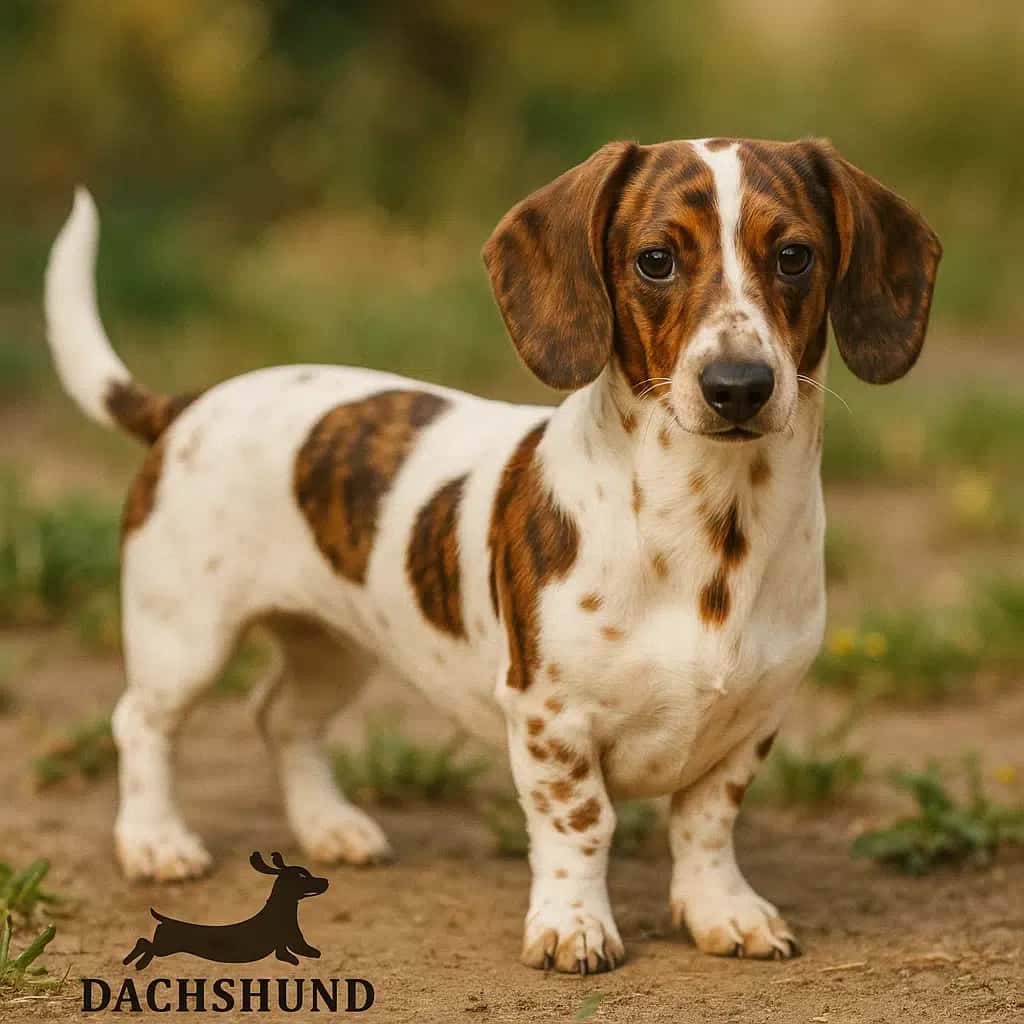
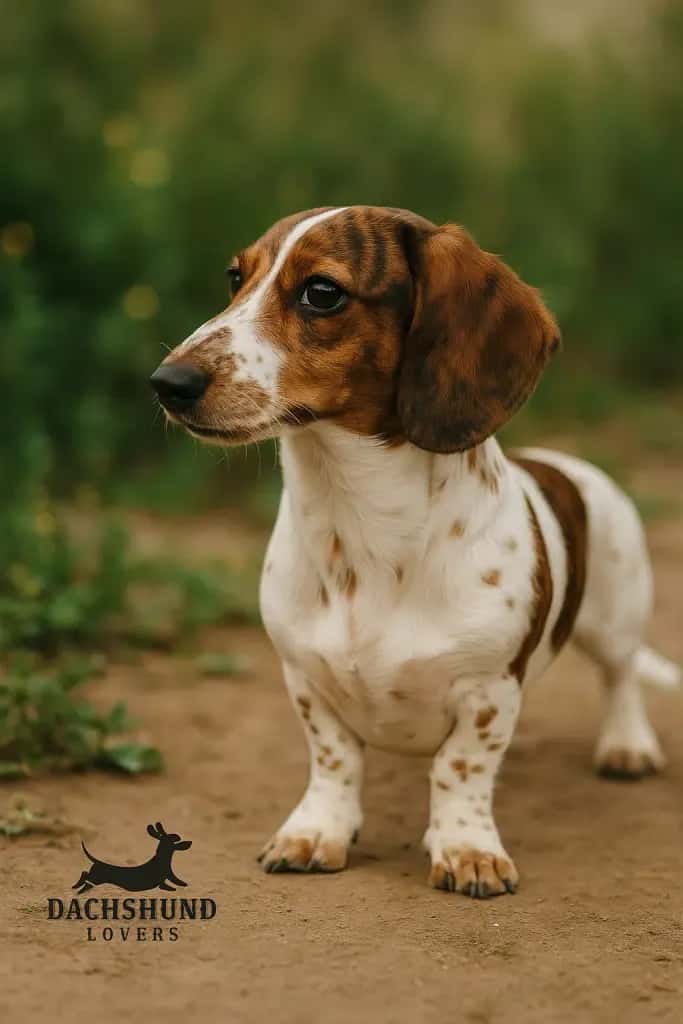
A brindle piebald dachshund is a rare and visually striking dachshund whose coat combines two separate patterns: brindle striping and piebald spotting. Most commonly, these dogs have a white base coat, thanks to the piebald gene, and patches of brindled coloring, where dark stripes overlay red or tan pigment. You might see a single brindled ear, a stripy mask around one eye, or a random patch on the back or tail — there’s no “standard” look, and that’s what makes them so captivating.
The brindle portion creates narrow, tiger-like stripes, while the piebald gene removes pigment, resulting in areas of bright white. Together, the effect is both soft and dramatic — like someone painted over a white canvas with deep brushstrokes and then stepped back to admire the asymmetry.
It’s important to clarify: this is not a breed variation or a different type of dachshund. Brindle piebalds are still 100% dachshund, and the pattern is a natural — albeit rare — genetic expression. You’ll find brindle piebalds across different coat types including smooth, long-haired, and less commonly, wire-haired dachshunds.
One of the reasons this coat is so rare is that it requires two separate genetic components — and both need to be passed down in a very specific way. As a result, most breeders don’t see this pattern often, and when it does appear, it’s usually unexpected. Some puppies may only show faint brindling at first, with their stripes becoming more visible as they age. Others might have one clear brindled patch from the start.
And while coat pattern doesn’t affect behavior, the uniqueness of brindle piebalds tends to draw attention. I’ve yet to meet someone who didn’t pause, squint a little, and ask: “Is that really a dachshund?”
It absolutely is — just one with a one-of-a-kind wardrobe.
You can find brindle piebalds in all coat types — smooth, long-haired, and occasionally wire-haired. And what makes them truly remarkable? The pattern is entirely unpredictable. No two are alike — not even within the same litter.
Brindle Piebald Dachshund Genetics
When you look at a brindle piebald dachshund, you’re seeing the result of two different genetic patterns layered together like a mixed-media artwork. It’s not just beautiful — it’s genetically fascinating.
To understand how this rare pattern happens, we need to break it down:
- The piebald gene, located at the S locus, is responsible for the white spotting. This gene suppresses pigment in certain parts of the coat, leaving behind patches of white. If a dog inherits two copies of the piebald gene (one from each parent), the white areas are more pronounced — often covering the chest, legs, belly, and sometimes much of the body.
- The brindle gene, found at the K locus (specifically the K^br allele), is responsible for striping. It overlays dark stripes onto red- or fawn-colored areas of the coat. Only one copy of the brindle gene is needed for the pattern to appear, but how strongly it shows depends on the coat type and other modifier genes.
For a dachshund to visually express both genes — brindle and piebald — it must inherit:
- Two piebald alleles (one from each parent)
- At least one brindle allele (from one parent)
When these align, you get a dog with a white base coat interrupted by bold or subtle brindled patches — on the ears, the face, a hip, or even just one paw. Some dogs will have distinct stripes on just one side of their body, while others may have a fully brindled face that looks like it was dipped in ink.
This dual-expression is rare, partly because most breeders don’t intentionally pair for both patterns. Responsible breeders prioritize health and temperament first. And because both patterns can mask or interact with other coat traits, it takes real knowledge to understand what’s likely to emerge in a litter.
It’s also why brindle piebalds are often misidentified as dapple or shaded red. But genetically, they’re a unique combo — not just spotted or striped, but both, making them one of the most unusual and eye-catching coat types in the dachshund world.
Learn more about the base pattern in our Brindle Dachshund guide
Piebald Dachshund Coat Types
When it comes to brindle piebald dachshunds, the pattern may be rare — but how it shows up across different coat types is even more unpredictable. Because the piebald gene removes pigment and the brindle gene adds stripes over red or tan areas, the final look is shaped not just by genetics, but by coat length and texture too.
Let’s break it down:
Smooth Coat
Smooth-coated brindle piebalds show the clearest contrast between white and striping. You’ll typically see:
- Clean lines and high-definition brindling
- Sharp-edged patches (e.g. a single brindled ear or eye patch)
- A sleek, glossy look that really highlights the color separation
In some lights, these coats look like they’ve been illustrated — the kind of dachshund you’d see on a poster and wonder if the colors were edited.
Long-Haired
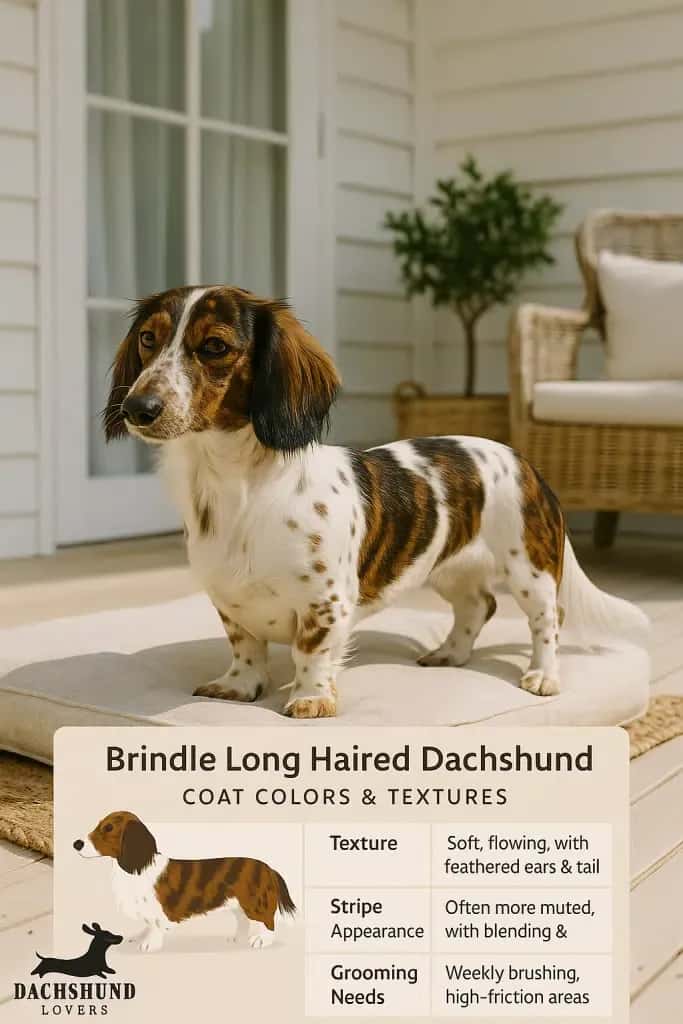
This version is softer and often more subtle. Long hair causes the brindle striping to feather and blend slightly, which gives a more brushed or “smoked” appearance. Common traits:
- Light streaks that blend into longer fur
- Flowing transitions between white and color
- A romantic, painterly effect — like someone watercolored stripes onto silk
Long-haired brindle piebalds may not look as bold at first glance, but up close? They’re stunning. The contrast is more textural than graphic.
Wire-Haired
Rare and rugged. Wire-haired coats tend to mute both piebald and brindle markings. Expect:
- A rougher texture with a peppered or streaky appearance
- Brindle showing up as subtle shading instead of clean stripes
- Piebald sections looking more ivory than bright white
Because wire-haired dachshunds are less common in general — and combining piebald + brindle is already rare — this particular type is something of a unicorn.
Each coat type offers its own version of the brindle piebald story. Some dogs will have full brindled faces, others just one distinct stripe down a leg. One littermate may appear mostly white, while another is boldly marked. It’s part of the joy — and mystery — of dachshund genetics.
Want to see how this looks on long coats? Visit our Brindle Long Haired Dachshund guide.
Common Misconceptions
Brindle piebald dachshunds tend to stop people in their tracks — but not always for the reasons you’d expect. While their coats are undeniably beautiful, they’re also widely misunderstood. I’ve lost count of how many times someone has said, “Oh, is she a dapple?” while looking at a clearly striped piebald. It’s not a fault — just a case of dachshund pattern confusion.
Let’s clear things up.
Misconception #1: Brindle Piebald = Dapple
This is the most common mix-up. Dapples have marbled, uneven blotches of lighter and darker color — typically grey, silver, or cream mixed over a base color. The edges blur, and the pattern can cover the whole body.
By contrast, brindle is striped — often like narrow tiger stripes — and when paired with piebald, those stripes appear in very specific patches over a white base. Think: clean contrast, not swirl.
Want to see the difference? Visit our Blue Dapple Dachshund guide for visuals on true dapple coats.
Misconception #2: Brindle Piebald = Shaded Red
Another common mistake — shaded red dachshunds have darkened areas (usually around the ears, tail, and along the back), but it’s more of a fade or gradient than a pattern. There are no stripes, no white spotting, and no clear borders.
A brindle piebald, on the other hand, will often have distinct white sections, and their dark striping is much more precise — especially in smooth coats.
Misconception #3: Brindle Piebald = Merle
Merle doesn’t naturally occur in purebred dachshunds — and when it’s present, it usually points to crossbreeding or an improperly labeled double dapple. Merles also come with higher risks of hearing and vision issues, particularly when bred unethically.
Brindle piebald dachshunds are not merle. They’re the product of entirely different genes — and entirely safe when bred responsibly.
When in doubt, check the edges:
Dapple = blurred and splotchy
Brindle = striped
Piebald = clean white with bold contrast
Brindle piebalds are not just a mix of patterns — they’re often mislabelled, overlooked, or misunderstood. And once you know how to spot them, you’ll never confuse them again.
Temperament & Personality
Brindle piebald dachshunds may look rare and regal, but under all that artistic striping and spotting, they’re still classic dachshunds — full of spunk, smarts, and a surprising amount of stubbornness for a dog that fits in a tote bag.
Their coat doesn’t affect their personality, but it does seem to attract more attention. I’ve found that brindle piebalds often become social magnets — not because they’re extroverts (though some are), but because everyone wants to ask, “What kind of dachshund is that?”
Here’s what to expect, personality-wise:
Loyal to Their People
Like most dachshunds, brindle piebalds tend to bond closely with one or two people in the household. They’ll tolerate others — sometimes grudgingly — but they’ll save their deepest cuddles and fiercest protectiveness for “their human.”
They’re not the kind of dog that zones out. Whether it’s watching the birds from the window or keeping tabs on your snack habits, they’re alert. Sometimes too alert. Don’t be surprised if they bark at a leaf falling… or their own reflection.
Independent, But Never Aloof
Dachshunds like to be in control of their world — and your schedule. But they’re not distant. In fact, brindle piebalds often demand to be near you… but on their terms. They’ll burrow into blankets, shadow you from room to room, and then mysteriously vanish when it’s bath time.
Sensitive to Routine and Tone
These dogs pick up on your energy. A raised eyebrow, a changed tone of voice, a shift in your morning routine — they’ll notice. That sensitivity also makes them highly trainable (when they want to be) and deeply affectionate with consistent, kind leadership.
So while the brindle piebald coat may be what catches your eye, it’s the big personality in a little body that will win your heart. They’re bold, funny, vocal, and emotionally attuned — like a tiny comedian who just happens to look like a walking work of art.
Care Considerations
Caring for a brindle piebald dachshund isn’t much different from caring for any other dachshund — but their coat does bring a few unique considerations, especially around skin, sun, and stain-prone areas.
Here’s what I’ve learned (through trial, error, and one unfortunate incident involving a beetroot smoothie):
Sun Sensitivity
Because the piebald gene creates white fur, these areas lack pigment and can be prone to sunburn — especially on short-haired dogs or those with exposed bellies, ears, or noses. If your brindle piebald likes to sunbathe (and most doxies do), limit midday exposure or try a pet-safe sunscreen. Yes, that’s a thing — and no, human sunscreen isn’t safe.
If you live somewhere warm and sunny like I do in Sydney, consider using shade cloth in the backyard or keeping walk times to early morning or late afternoon.
Staining
White fur, while beautiful, is a bit like a cream couch — everything shows. Dirt from the park, food residue, grass stains, even tears or saliva can discolor white areas, especially around the paws, muzzle, and eyes.
My go-to? A gentle damp cloth wipe-down after meals and walks, and a white-brightening shampoo every few months (not too often — you don’t want to dry the skin). I like the one from Chris Christensen — it keeps Maple’s white markings looking fresh without altering her natural tones.
Skin Health
Brindle piebalds don’t have extra skin issues by default, but their white areas can make it easier to spot hot spots, dryness, or irritation — especially in long-haired coats where trapped moisture can cause trouble.
Be sure to:
- Brush regularly (based on coat type)
- Check skin during grooming — especially in friction areas like armpits and under the collar
- Use hypoallergenic grooming products if your dog has sensitive skin
Ellie’s Tip: Grooming is the best time to bond. Keep sessions short, calm, and consistent. A few treats don’t hurt either.
FAQ’s
Authored by
Ellie
Ellie is a lifelong dachshund lover and the proud human of Maple, a long-haired brown doxie with a regal side-eye. While not a vet, Ellie brings honest, researched, and experience-based insights into every article she writes for the Dachshund Lovers community.
Read moreEllie is a lifelong dachshund lover and the proud human of Maple, a long-haired brown doxie with a regal side-eye. While not a vet, Ellie brings honest, researched, and experience-based insights into every article she writes for the Dachshund Lovers community.
Read moreThere are no comments yet
Leave a comment