Reactive Dachshund Training
Reactive Dachshund Training
Barking, lunging, growling. Sound familiar? Here's a step-by-step approach to managing and training a reactive dachshund and what we've learnt with our doxie.
James
Posted on November 5, 2025.
Updated on July 21, 2026.
Table of Contents
- 1.Key Takeaways on Reactive Dachshund Training
- 2.Understanding Reactivity in Dachshunds
- 3.Common Reactivity Triggers
- 4.Training Strategies for Reactive Dachshunds
- 5.Building Confidence in a Reactive Dachshund
- •Step One: Understanding Reactivity in Dachshunds
- •Step Two: Controlled Socialisation
- •Step Three: Confidence-Building Activities
- •Step Four: Predictable Routines
- •Step Five: Pairing Calm with Praise
- •Step Six: Managing the Environment
- •Step Seven: Learning from Setbacks
- •Why Confidence-Building Matters
- -More from This Series
- -Disclaimer
Share

I first realised Harvey was a “reactive dachshund” on a walk through Gunnamatta Park. We’d barely made it past the first row of fig trees when another dog appeared in the distance. Harvey froze, his tail stiff, then launched into a volley of barks that echoed across the water. It wasn’t aggression — it was his way of announcing himself to the world, fuelled by excitement, a dash of nerves, and that ever-present dachshund confidence.
To this day, Harvey is still reactive. I’ve learned that reactivity isn’t something you simply “cure”, t’s a trait you manage. Some days he’ll pass another dog with little more than a glance; other days, the sight of a Labrador 30 metres away sends him into a barking frenzy. Over the years, I’ve learned to focus less on eliminating the reaction and more on controlling the environment, reading his body language, and giving him tools to cope. And to be honest, its about protecting him and not worrying about other peoples reaction. Some dog owners can be just oblivious to reactive dogs and will try to push the interaction with their dog and yours. My advice be firm, direct and walk away and give space. That’s what has worked really well for Harvey when we’re out and about.
Reactive dachshund training is about more than just quieting the bark. It’s about understanding the triggers, whether that’s another dog, a skateboard, or a sudden sound, and teaching your dachshund an alternative response. According to the American Veterinary Society of Animal Behavior, the most effective approach combines behaviour management with positive reinforcement, rather than punishment, to reduce stress and build trust.
In this guide, we’ll explore why dachshunds are prone to reactivity, how to spot the early warning signs, and step-by-step strategies that can help turn tense moments into teachable ones. I’ll also share the methods that have made our walks calmer and more enjoyable, even on Harvey’s more “spirited” days.
Key Takeaways on Reactive Dachshund Training
Fact | Why It Matters |
|---|---|
Reactivity in dachshunds is often driven by excitement, not aggression. | Understanding the motivation behind the behaviour helps tailor training methods. |
Early warning signs include stiff posture, intense staring, and a sudden shift in breathing. | Recognising these signals gives you time to redirect before a reaction escalates. |
Positive reinforcement is more effective than punishment. | Rewarding calm behaviour builds trust and teaches an alternative response. |
Distance is your best tool in the early stages. | Keeping space between your dachshund and the trigger reduces stress and sets them up for success. |
Management and training go hand-in-hand. | Using barriers, quiet routes, or controlled exposure ensures progress without overwhelming your dog. |
Reactivity can improve with time but may never fully disappear. | The goal is to manage and reduce incidents, not expect perfection. |
Understanding Reactivity in Dachshunds
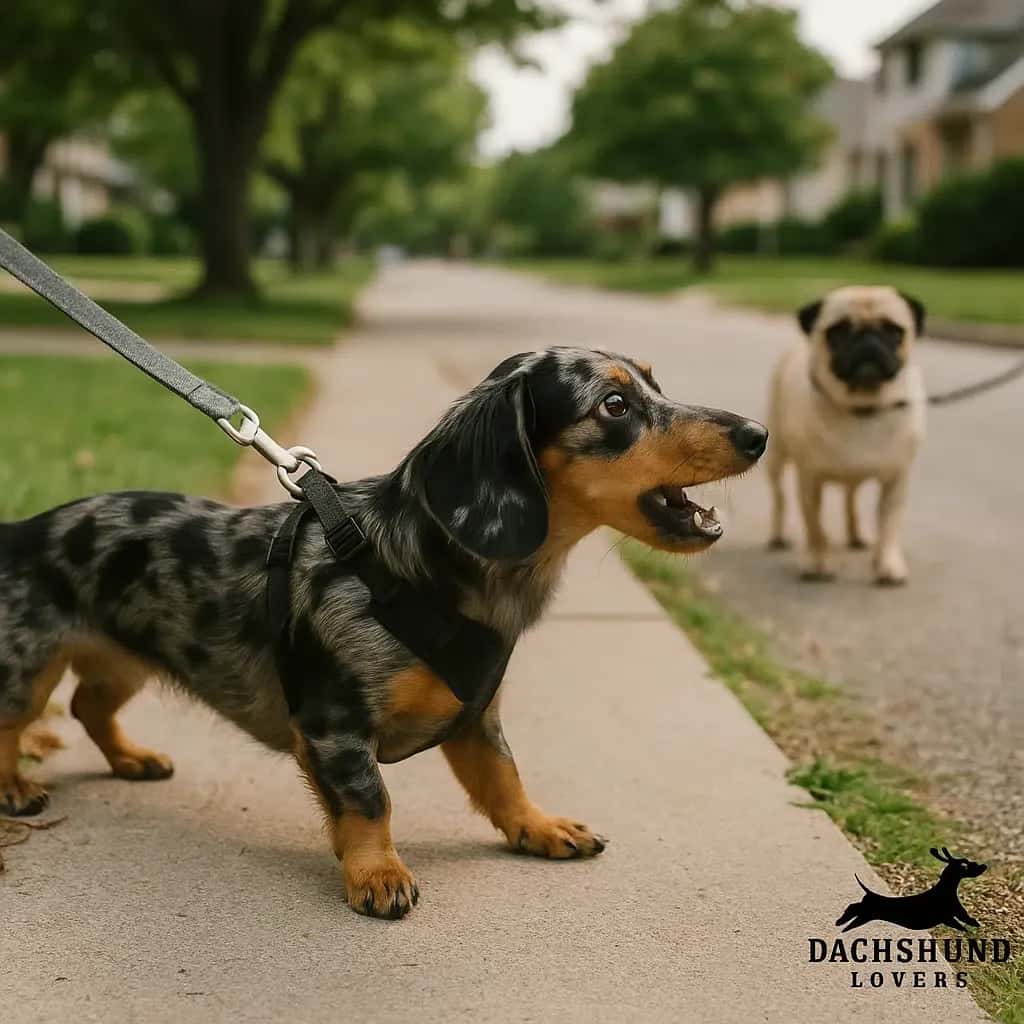
If you’ve ever walked a dachshund past another dog and suddenly felt the lead jerk like you’ve hooked a marlin, you’ve experienced reactivity in its truest form. Harvey, my own dachshund, has been reactive since he was a puppy. To this day, if we round a corner and there’s an off-leash dog bounding towards us, his body tenses, his tail shoots up, and he’s ready to sound the alarm. It’s not that he’s aggressive — far from it — but in his mind, it’s his job to respond before thinking things through.
Reactivity in dachshunds often stems from a mix of traits bred into them for generations. These dogs were designed to alert, chase, and defend. According to the American Kennel Club, dachshunds have a naturally heightened awareness of their surroundings and a strong instinct to vocalise at perceived threats. In a suburban park, that “threat” might just be a jogger in a bright jacket.
What makes dachshunds unique is the intensity of their reactions. Some breeds might freeze or take a cautious step back. A dachshund will lunge, bark, and sometimes even throw in a little pogo-stick jump for emphasis. For owners, it can feel dramatic — and a bit embarrassing — but it’s important to remember this behaviour comes from confidence, not fear, in many cases.
Recognising the difference between reactivity and aggression is key. A reactive dachshund might settle quickly once the trigger has passed, while an aggressive dog is more likely to escalate. If you’re not sure which category your dog falls into, working with a certified trainer or behaviourist can give you a clear plan forward.
For owners dealing with reactivity, I recommend first reading our Dachshund Training guide. It lays the foundation for communication and control that you’ll need before tackling specific triggers. From there, you can layer in targeted reactivity strategies that respect the dachshund’s instincts while helping them navigate the modern world calmly.
Common Reactivity Triggers
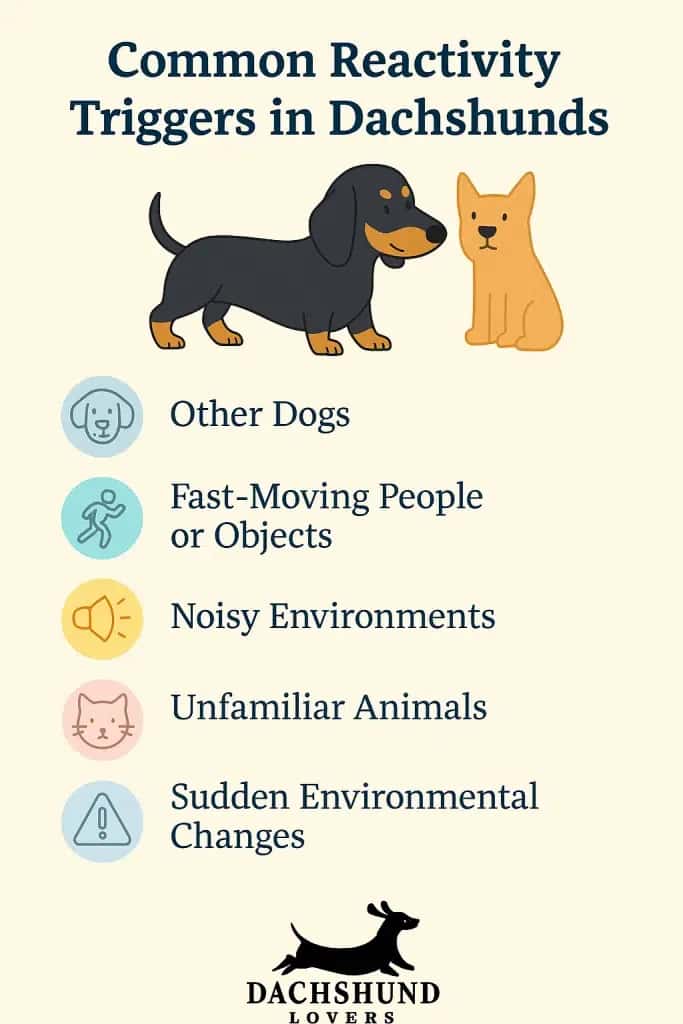
When I first started tracking Harvey’s reactivity, I kept a little notebook after each walk. It didn’t take long to notice patterns — the same kinds of things set him off every time. While each dachshund has its own quirks, there are a few universal triggers that come up again and again.
- Other Dogs
The most common trigger for dachshunds, and one of Harvey’s big ones. It doesn’t matter if it’s a German Shepherd across the park or a tiny terrier on the footpath — a dachshund will often feel the need to announce their presence. This is partly territorial, partly the breed’s natural alertness. Early, controlled socialisation is one of the best ways to manage this. - Fast-Moving People or Objects
Joggers, scooters, bicycles — anything that moves quickly can activate a dachshund’s chase instinct. Because they were bred to pursue small, fast animals, their brains often register these movements as “game on” without stopping to check context. - Noisy Environments
Construction sites, garbage trucks, or even a café with clattering cups can overwhelm a dachshund’s senses. For some, it’s not fear but a desire to control or stop the source of the noise. Gradual exposure, paired with calm reassurance, helps reduce overreaction. - Unfamiliar Animals
Cats, birds, and especially possums in the evening can set off a reactive episode. The scent alone may be enough — dachshunds are scent hounds first and foremost. Once they pick up on an unfamiliar smell, they’ll often lock onto it until it’s gone. - Sudden Environmental Changes
A new object in their regular walking route — like a parked trailer or a stack of bins — can cause suspicion. It sounds small, but dachshunds are observant, and anything “out of place” can become a trigger.
The trick to managing reactivity is identifying the specific patterns for your dog. In Harvey’s case, I know that peak reactivity happens when another dog is moving directly toward us on a narrow path. By anticipating it, I can put space between us early, redirect his focus, and prevent the reaction from escalating.
For a deeper dive into creating calmer walk routines, you can explore our Dachshund Leash Training section, which lays out step-by-step methods for walking a dachshund that’s both safe and structured.
Training Strategies for Reactive Dachshunds
Living with a reactive dachshund is not about eliminating the behaviour entirely — it’s about teaching them better ways to respond when the world feels too big or too close. With Harvey, we learned early on that reactivity isn’t simply “bad behaviour.” It’s a combination of instinct, environment, and emotion.
- Build a Solid Foundation with Basic Obedience
Before tackling reactivity, make sure your dachshund has reliable basic commands — “sit,” “stay,” “watch me.” These become your lifeline in situations where their instinct is to bark, lunge, or bolt. Our Dachshund Training guide covers these foundations in depth, and they’re worth mastering before you add more complexity. - Distance is Your Friend
If another dog triggers a reaction, create physical space before your dachshund reaches boiling point. This might mean crossing the street, turning into a driveway, or stepping behind a car. According to the American Veterinary Society of Animal Behavior, the single most effective way to prevent a reactive outburst is to avoid the trigger until you’ve had time to desensitise your dog. - Use Controlled Exposure
Once you know the triggers, gradually reintroduce them in a controlled environment. For example, if bicycles are an issue, start by watching bikes from a distance your dog can handle, rewarding calm behaviour. Over time, reduce the distance in small increments. This is called “systematic desensitisation” and works especially well when paired with counterconditioning — changing their emotional response from “threat” to “neutral” or even “good thing.” - Redirect the Focus
The “watch me” command is invaluable here. As soon as you spot a trigger, call your dachshund’s name and reward eye contact. It interrupts the chain of reactivity before it has a chance to escalate. - Keep Walks Structured
Unstructured walks with no clear pace or direction make it harder for a reactive dachshund to stay calm. Use consistent leash cues, maintain a steady pace, and avoid situations where they feel they need to make decisions for both of you. For dachshunds that also pull on leash, revisit the tips in our Dachshund Leash Training section. - Stay Calm Yourself
Dogs read our body language better than we often realise. If you tense up when you see a trigger approaching, your dachshund will too. The calmer and more neutral you can stay, the better chance they have of mirroring that energy. - Seek Professional Help When Needed
If reactivity escalates to aggressive behaviour, or if you’re not making progress after months of work, consider working with a certified behaviourist. Look for trainers who specialise in positive reinforcement and have experience with hounds or small breeds.
To this day, Harvey is still more reactive than most dogs we meet. But by understanding his triggers, managing the environment, and using the right training tools, we’ve gone from tense, unpredictable walks to outings where the good moments outweigh the bad.
Building Confidence in a Reactive Dachshund
Step One: Understanding Reactivity in Dachshunds
Reactivity isn’t the same as aggression, though the two are often confused. Aggression is about intent to harm, while reactivity is about an emotional response that spills over into visible behaviour. A reactive dachshund might bark furiously at another dog, not because they want to fight, but because they feel cornered, unsure, or overstimulated.
Their history as hunting dogs plays into this. Dachshunds were bred to work independently in close quarters underground, where quick decision-making meant survival. That same instinct can make them quick to respond to perceived threats or high-energy situations.
If you’re dealing with reactivity, it’s worth reading our guide on Reactive Dachshund Training for an in-depth look at triggers, thresholds, and how to use desensitisation effectively.
One of the biggest mistakes owners make is trying to “fix” reactivity by flooding their dog with whatever sets them off. Taking a reactive dachshund into a packed off-leash park and hoping they’ll adjust is like dropping someone afraid of heights onto a roller coaster — it’s more likely to reinforce fear than remove it.
Controlled socialisation means choosing safe, low-stress situations and building from there. For example:
- Start with exposure at a distance. If other dogs are the trigger, find a park where you can watch from 20–30 metres away.
- Let your dachshund observe without pressure. Keep sessions short (5–10 minutes) and end on a calm note.
- Reward small wins. A glance at the trigger without barking is worth marking with praise or a treat.
When Harvey was younger, his biggest trigger was kids on scooters. We began by watching from across a wide field, rewarding him for simply noticing them without barking. Over several weeks, we slowly decreased the distance, always staying just short of his “explosion” point. Now, he can walk past a scooter with little more than an interested glance.
Step Three: Confidence-Building Activities
Confidence doesn’t come from exposure alone — it also grows from achievement. Giving your dachshund tasks that they can complete successfully builds their resilience, making them less likely to overreact in challenging situations.
Here are a few that have worked well for us:
- Scent Work – Tap into their natural hunting instincts by hiding treats around the house or garden. Start easy, then increase difficulty as they improve.
- Puzzle Toys – Food-dispensing puzzles keep their brain engaged and create small, satisfying victories.
- Low-Impact Agility – Set up small jumps (no higher than elbow height) or tunnels in your backyard. Keep it fun and pressure-free.
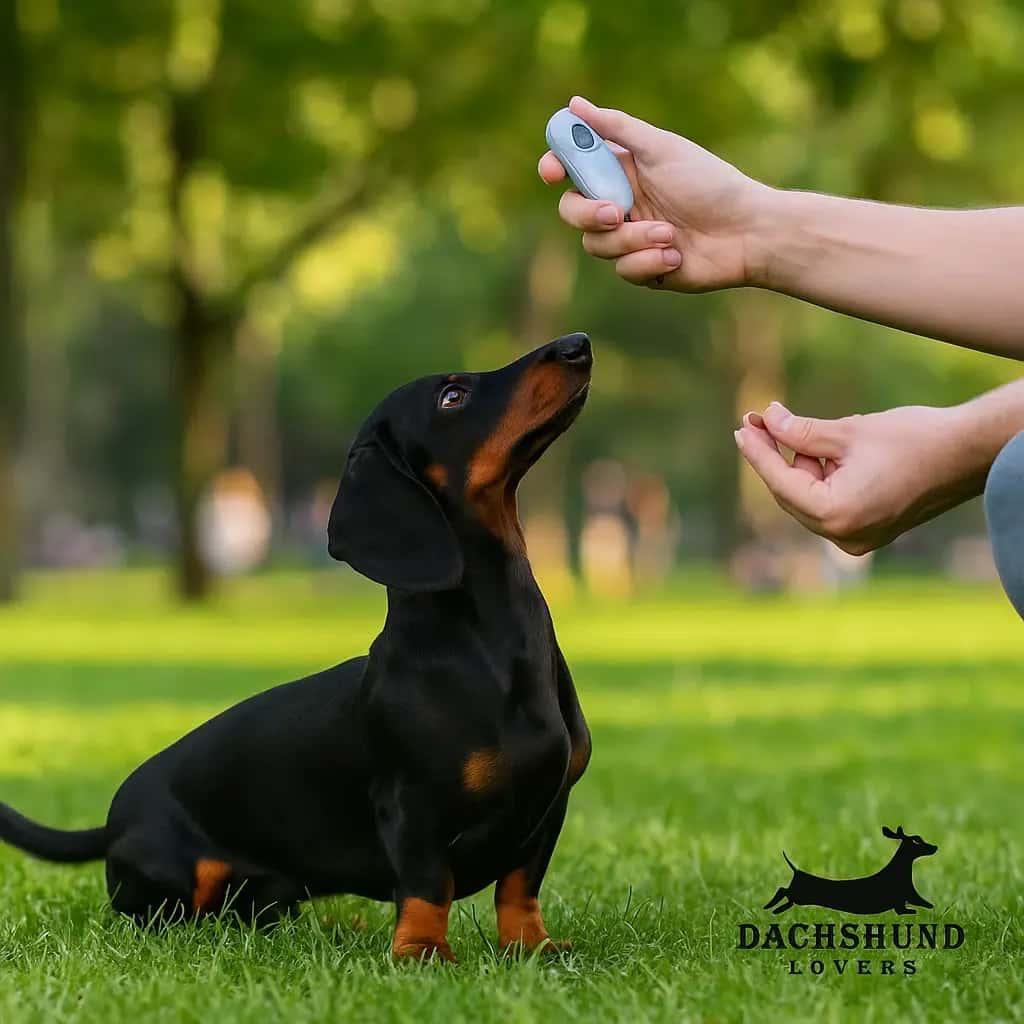
- Clicker Training – Teach small tricks — shake, spin, touch — and watch their body language change as they master each one.
The American Kennel Club’s enrichment guide has a wealth of inspiration for activities you can tailor to your dachshund’s age, size, and energy level.
Step Four: Predictable Routines
Reactivity often spikes when a dachshund feels they can’t predict what’s coming next. Establishing a consistent routine builds a sense of security. If your dog knows when walks, meals, and rest times happen, they start to relax into that rhythm.
Harvey, for instance, used to get hypervigilant in the late afternoons. We realised it was because that time of day was unpredictable — sometimes a walk, sometimes visitors, sometimes nothing at all. Once we created a set pattern (walk, dinner, quiet time), his reactivity in that time slot reduced dramatically.
This doesn’t mean you can’t add variety to their life. It simply means that the core framework stays the same, so surprises feel exciting rather than threatening.
Step Five: Pairing Calm with Praise
Every time your dachshund chooses a calm response, you have a golden training opportunity. Mark it immediately with praise, treats, or a quick game. Over time, they’ll learn that calmness isn’t just the absence of bad behaviour — it’s a pathway to rewards.
One technique that worked wonders for Harvey was the “look at me” cue. Whenever we spotted a trigger in the distance, I’d say, “look at me,” and reward him for making eye contact instead of focusing on the scooter, dog, or loud noise. Now, even without the cue, he often turns to me first when something startles him.
Step Six: Managing the Environment
While the goal is to expand your dachshund’s comfort zone, there’s no shame in avoiding overwhelming situations while you’re still in the early stages. Choosing quieter walking routes, crossing the street to avoid direct confrontations, or visiting parks at off-peak times are all smart management choices.
Think of it like training in layers — you gradually increase the level of difficulty while ensuring your dachshund experiences more successes than setbacks.
Step Seven: Learning from Setbacks
Even with progress, there will be days when your dachshund reacts more than you expect. This doesn’t mean the training has failed — it simply means you’ve hit a point that’s too challenging right now. Step back to an easier distance or environment, reinforce calm behaviour, and try again another day.
To this day, Harvey still has moments where a particular noise or unexpected movement makes him bark first and think later. The difference now is that he recovers faster, and I know how to guide him back into a calm state without escalating the situation.
Why Confidence-Building Matters
A confident dachshund isn’t one that never barks or reacts — it’s one that can process what’s happening and choose a calmer option. When you invest in their confidence, you’re not just reducing reactivity; you’re giving them the tools to navigate the world without fear.
For more step-by-step strategies that build on these principles, you might also like our House Training a Dachshund guide. Many of the same patience-and-consistency techniques carry over from house manners to public behaviour.
FAQs – Dachshund Training
More from This Series
Explore more breed-specific training tips in our Dachshund Obedience & Training collection:
- House Training a Dachshund – A patient, practical guide to teaching your dachshund where (and when) to go, without the stress.
- Reactive Dachshund Training – Step-by-step strategies for calming a dachshund who barks, lunges, or gets overexcited on walks.
- How to Train a Dachshund to Lay Down – A simple, reward-based method for teaching one of the most useful everyday commands.
Authored by
James
James is the founder of Dachshund Lovers and the proud human of Harvey, a mini dapple with a big personality. He writes to empower and connect the dachshund community, blending founder insights with honest, experience-based stories about life with this incredible and special breed. James brings candid, experience-backed opinions to the community and always focused on fewer, better products and ideas that genuinely improve life for dachshunds and their people.
Read moreJames is the founder of Dachshund Lovers and the proud human of Harvey, a mini dapple with a big personality. He writes to empower and connect the dachshund community, blending founder insights with honest, experience-based stories about life with this incredible and special breed. James brings candid, experience-backed opinions to the community and always focused on fewer, better products and ideas that genuinely improve life for dachshunds and their people.
Read moreDisclaimer
This content is for informational purposes only and should not be considered veterinary advice. Always consult with a licensed veterinarian regarding your dog’s health and wellbeing.
There are no comments yet
Leave a comment