Famous Dachshunds
Famous Dachshunds
Some chased fame. Some chased tennis balls. But all of them became unforgettable. Meet the doxies that left a mark.
James
Posted on October 30, 2025.
Updated on July 20, 2026.
Table of Contents
- •A breed that appears in margins — and stays there forever
- 1.Key Takeaways on Famous Dachshunds
- 2.The Artistic Muse — Dachshunds in the Studios of Great Creators
- •Lump: Picasso’s quietly assertive muse
- •Stanley and Boodgie: Hockney’s visual anchors
- •Archie and Amos: Warhol’s quiet companions
- 3.The Royal & Political Companions — Dachshunds in High Places
- •Queen Victoria: The monarch who made dachshunds fashionable
- •Kaiser Wilhelm II and Erdmann
- •Grover Cleveland: The dachshund at the White House
- •John F. Kennedy: A dachshund in the Kennedy family
- 4.Cultural Icons & Mascots — The Dachshund as Emblem
- •Waldi: The first official Olympic mascot
- •Crusoe: The first viral dachshund
- •Modern community mascots
- 5.On Screen & In the Public Eye — The Doxie in Film, TV, and Advertising
- •Slinky Dog — Toy Story’s loyal and stretchable sidekick
- •Buddy — The Secret Life of Pets
- •Dachshunds in classic film and European cinema
- •Advertising’s most recognisable shape
- 6.Dachshunds Behind the Velvet Rope — Sport & Pop Icons Who Chose the Long Dog
- -Charles Leclerc: Ferrari’s golden boy and dachshund dad
- -Audrey Hepburn: Style, grace, and a dachshund named Famous
- -Clint Eastwood: A long-time fan of the breed
- -Jack Black: Comic timing and dachshund love
- -Dachshunds and the modern celebrity pet culture
- -More from This Series
- -Disclaimer
Share

Some dogs chase attention. Others command it without even trying. Dachshunds, for all their size and stubbornness, tend to fall in the latter group. They don’t fetch fame. They occupy it — slowly, firmly, and almost always on their own terms.
Like most people, I associated the breed with long backs, low bellies, and the occasional Halloween costume shaped like a hotdog. But after bringing Harvey home, I started seeing dachshunds in places I didn’t expect: in Picasso’s paintings, in historical photographs of royal courts, even on Olympic posters. Not posed. Not paraded. Just… present.
And not just as pets, either. As companions. As characters. As quiet constants in the lives of artists, musicians, writers, and rulers.
A breed that appears in margins — and stays there forever
The dachshund’s fame isn’t loud. It’s not the fame of movie contracts or red carpets (though we’ll get to that later). It’s the kind of enduring, quietly-integrated presence that shows up in studio apartments, oil portraits, wartime diaries, and gallery openings.
And it’s been happening for centuries.
Queen Victoria helped popularise the breed in Britain, keeping several dachshunds during her reign and reportedly referring to them as “clever and devoted.” According to the UK’s Royal Collection Trust, she was often painted with them, and her fondness helped spread the breed beyond its German origins.
Pablo Picasso’s relationship with his dachshund Lump has been widely documented — including in the photography book Picasso & Lump: A Dachshund’s Odyssey by David Douglas Duncan. Lump wasn’t just a pet. He was a muse, appearing in over 40 of Picasso’s works and reportedly having free rein of the studio.
More recently, the American Kennel Club has documented how dachshunds, once viewed suspiciously during wartime due to their German roots, have gone on to become one of the most recognisable and culturally embedded breeds in the world. As their article Meet the Dachshund notes, these dogs are “more than just a shape” — they are a temperament, a presence, and a statement.
This article is a deep dive into that presence. From royal estates to Olympic stadiums, from sketchbooks to screenplays, these are the dachshunds who didn’t just live — they left a mark.
Key Takeaways on Famous Dachshunds
Dachshund | Why They’re Famous |
|---|---|
Lump (Picasso) | Appeared in more than 40 of Picasso’s artworks; considered a muse and companion, not just a pet. |
Stanley and Boodgie (David Hockney) | Inspired an entire painting series; symbolised stillness, comfort, and the emotional weight of home. |
Archie and Amos (Andy Warhol) | Frequently photographed in Warhol’s arms and studios; reflected his obsession with loyalty and repetition. |
Waldi (1972 Munich Olympics) | First official Olympic mascot — designed as a dachshund to reflect athleticism, endurance, and charm. |
Queen Victoria’s dachshunds | Helped popularise the breed in Britain during the 19th century; often painted alongside her. |
Kaiser Wilhelm II’s dachshund, Erdmann | Famous for his personality and public presence in the imperial court of Germany. |
Slinky Dog (Toy Story) | Cemented the dachshund as a pop culture icon for a new generation; loyal, stretchy, and memorable. |
Crusoe the Celebrity Dachshund | One of the first internet-famous pets; built a global following through costume comedy and video skits. |
WWI propaganda dachshunds | Used by both the Allies and Central Powers in posters — sometimes as enemies, sometimes as emblems of loyalty. |
The Artistic Muse — Dachshunds in the Studios of Great Creators
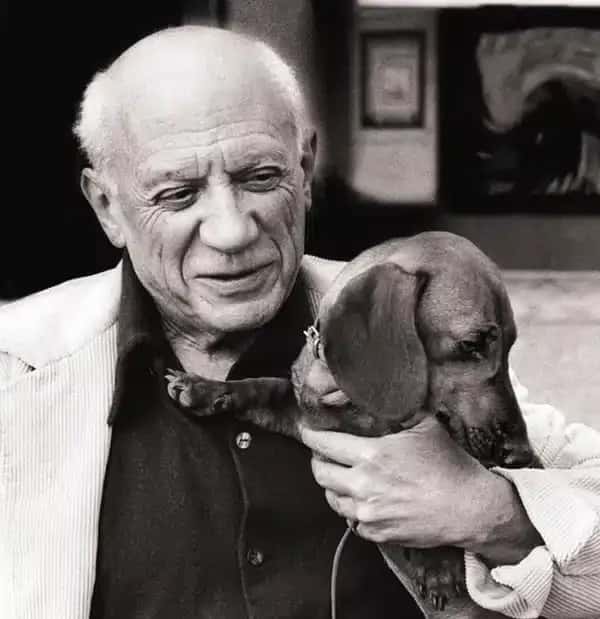
Some breeds pose for portraits. Dachshunds end up in them without asking. Across decades and disciplines, artists have brought dachshunds into their most personal creative spaces — not just as companions, but as extensions of their process. Quiet, constant, unbothered by genius. Just there.
Lump: Picasso’s quietly assertive muse
In 1957, photographer David Douglas Duncan brought his dachshund Lump to visit Pablo Picasso. The visit was supposed to be brief. Lump never left.
He settled in instantly, wandering the studio like he’d been there forever. Picasso, who was known for cycling through companions and animals alike, bonded with Lump in a way that was unusual even for him. The dog appeared in more than 40 artworks, most notably in Picasso’s reimagining of Las Meninas by Velázquez — where Lump replaces the royal dog of the original painting with no explanation and no apology.
The bond between artist and dog was so profound that Duncan later published Picasso & Lump: A Dachshund’s Odyssey, a photographic record of their life together. In it, Lump appears on tables, in doorways, at Picasso’s feet, and in the margins of the creative act itself.
Smithsonian Magazine notes: “Lump wasn’t just a pet — he was a piece of the artist’s emotional furniture.”
Source: Smithsonian – Picasso and Lump
Stanley and Boodgie: Hockney’s visual anchors
British painter David Hockney didn’t just paint his dachshunds. He constructed entire projects around them.
In the 1990s, Hockney released Dog Days, a book and exhibition devoted entirely to his dachshunds Stanley and Boodgie. The paintings are simple and domestic — two dogs curled in the same bed, eating, lounging, watching the day pass. There’s no grandeur. Just stillness. And love.
Hockney once said: “I painted them because I love them. They’re like little people to me. The way they look at you, the way they react, their individuality.”
His works involving the dogs remain some of his most personal — a visual diary of daily intimacy.
Archie and Amos: Warhol’s quiet companions
Andy Warhol, the master of pop and repetition, was rarely seen without a dachshund in the 1970s. His first, Archie, often travelled with him to galleries, openings, and interviews — sometimes even sitting in Warhol’s lap during press events. Later, Warhol added Amos, creating a dachshund duo that mirrored his own dualities: affectionate and private, performative and real.
Photographer Christopher Makos documented Warhol with his dachshunds often, including scenes where the dogs appear more grounded than the artist himself. Some scholars believe Warhol projected elements of himself onto the dogs — and used them as a calming presence in the unpredictable world he helped create.
The Royal & Political Companions — Dachshunds in High Places
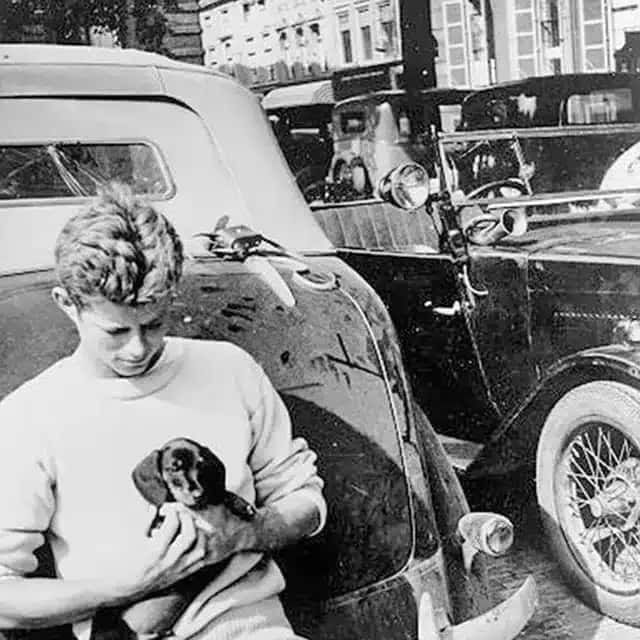
Dachshunds have always been dogs of distinction. They may have been bred to hunt badgers underground, but they somehow found their way into royal chambers, political residences, and even onto military parade grounds. Their bold spirit and distinct silhouette made them a favourite among rulers and statesmen — not as status symbols, but as deeply personal companions.
Queen Victoria: The monarch who made dachshunds fashionable
Queen Victoria’s influence on British dog breeds is well-documented, and dachshunds were no exception. She was first introduced to the breed through Prince Albert, who brought dachshunds over from Germany as a gesture of cultural exchange. She quickly fell in love with their temperament — calling them “clever, devoted, and brave.”
Historical portraits often show her seated beside or with a dachshund at her feet. According to the Royal Collection Trust, she kept several, including a red smooth-haired male named Deckel. Her affinity for the breed helped establish the dachshund in Britain, shifting its image from working-class hunter to loyal companion.
Kaiser Wilhelm II and Erdmann
While Queen Victoria helped introduce dachshunds to polite society in Britain, her grandson, Kaiser Wilhelm II, gave the breed international notoriety in Germany. His dachshund, Erdmann, was known for accompanying the emperor almost everywhere — including political functions and military reviews.
Erdmann was famously opinionated and reportedly bit several foreign dignitaries. Rather than being scandalised, the Kaiser was amused. His indulgence of Erdmann’s bad manners became part of the dachshund’s image: bold, self-important, and unapologetically loyal.
Grover Cleveland: The dachshund at the White House
President Grover Cleveland, the 22nd and 24th president of the United States, reportedly kept a dachshund during his time in the White House. Though not as public-facing as some presidential pets, the dog was noted in early White House logs — and may have been one of the first dachshunds to officially reside in the Executive Mansion.
It was an early signal that the breed had crossed into American cultural life — long before its boom in the mid-20th century.
John F. Kennedy: A dachshund in the Kennedy family
Before his presidency, John F. Kennedy briefly owned a dachshund while living in England. The dog, named Dunker, was reportedly rehomed due to JFK’s worsening allergies — but the fondness remained. Letters between Kennedy and his sister Eunice mention the dog, hinting at a sentimental connection despite the short time they spent together.
Cultural Icons & Mascots — The Dachshund as Emblem
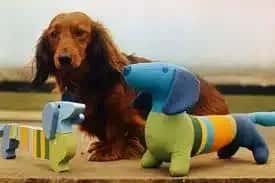
Some dogs become famous for who they belong to. Others, like the dachshund, become famous because of who they are. With their unforgettable shape, dry charisma, and undeniable presence, dachshunds have been used as mascots, brand symbols, and even national emblems. Not because they fit a type — but because they stand out from one.
Waldi: The first official Olympic mascot
In 1972, the Summer Olympics were held in Munich, Germany, and organisers wanted a mascot that would reflect both the athletic ideals of the Games and the cultural identity of the host nation. They chose a dachshund.
His name was Waldi, and he wasn’t just a logo. He was the first official Olympic mascot in history.
Designed by graphic artist Otl Aicher, Waldi was based on a real dachshund and intended to represent resilience, agility, and determination — traits closely associated with both athletes and dachshunds. His colorful design mirrored the layout of the marathon route, which itself was shaped like a dachshund.
The Olympic Museum notes that Waldi was chosen for “his resistance, tenacity and agility” — a reflection of how the breed’s personality was seen as fitting for elite sport.
Source: Olympics.com – The First Olympic Mascot
Before TikTok made it normal for dogs to have millions of followers, there was Crusoe the Celebrity Dachshund.
Crusoe began as a blog in 2011, later turning into a YouTube channel and Instagram account run by his owner, Ryan Beauchesne. Known for his elaborate costumes, miniature cooking shows, and dramatic voiceovers, Crusoe helped set the blueprint for what a pet influencer could be. His charm wasn’t just visual — it was persona-driven.
By 2018, he had published a New York Times bestselling book and appeared on Good Morning America. Crusoe has been credited with helping fuel the modern dachshund resurgence, especially among millennial and Gen Z audiences.
Crusoe continues to reach millions — not just with jokes and outfits, but with honesty. His journey through IVDD surgery and recovery has helped raise awareness of spinal health in dachshunds, an issue covered in our own article on World’s Longest Dachshund, where spinal care plays a leading role.
Modern community mascots
In many cities, particularly in Germany, Austria, and parts of the United States, dachshunds have become informal mascots for neighbourhoods, markets, and even political protests. In Bavaria, you can find bronze dachshund statues. In Melbourne, “Dachshund Day” regularly draws crowds of over 1,000 dogs and owners — many of whom come dressed to reflect the event’s theme.
Even online, the dachshund meme ecosystem has grown to become a culture of its own. Our roundup of Dachshund Meme moments shows just how deeply this breed has embedded itself into digital and social media life.
On Screen & In the Public Eye — The Doxie in Film, TV, and Advertising
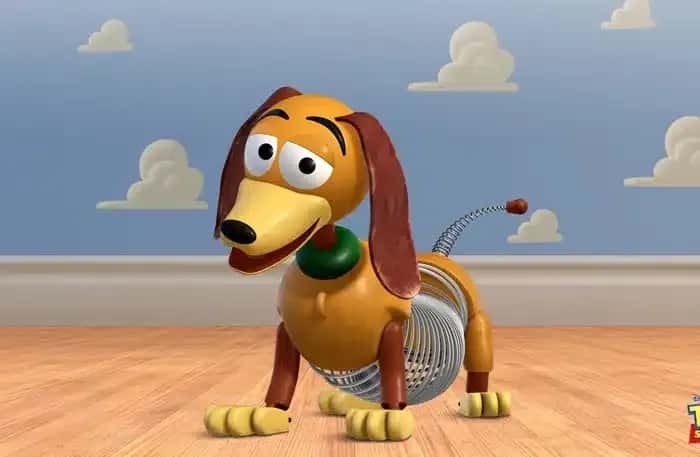
The dachshund isn’t just a scene-stealer — it’s a silhouette people remember. Their unique proportions, expressive faces, and confident stride have made them a favourite of directors, animators, and advertisers for decades. When you want an animal character that reads as bold, specific, and slightly cheeky — you cast a dachshund.
Slinky Dog — Toy Story’s loyal and stretchable sidekick
Perhaps the most iconic animated dachshund of all time, Slinky Dog made his debut in Pixar’s Toy Story in 1995. Based on the real Slinky toy and voiced by Jim Varney (and later Blake Clark), Slinky became a symbol of unwavering loyalty — a character who was quite literally stretched for his friends.
Slinky’s role evolved through the Toy Story series, often grounding emotional moments with humour and heart. His physical design mirrored his personality: flexible, supportive, and always ready to bridge the gap.
Buddy — The Secret Life of Pets
In Illumination’s The Secret Life of Pets, Buddy the dachshund is portrayed as chill, low-energy, and endlessly adaptable. He moves through his apartment using a stand mixer as a back scratcher and lives like someone who figured out how to win at life with the least effort possible.
It’s a portrayal dachshund owners know well — the dog who gives nothing away, but is always exactly where they want to be.
Dachshunds in classic film and European cinema
Long before animation took over, dachshunds appeared in black-and-white comedies, French films, and postwar European television. Their expressive movement translated well on screen — whether in physical comedy or as a symbol of bourgeois eccentricity.
Advertising’s most recognisable shape
Dachshunds appear frequently in advertising for a simple reason: people remember them.
- In Volkswagen ads, they’re often used to signal German heritage and clever design.
- In insurance and pet food commercials, they represent loyalty and intelligence — with just a touch of humour.
- In fashion and lifestyle branding, they’re the dog that doesn’t blend in, which is precisely the point.
Their silhouette is so iconic, many brands don’t even need to name the breed. A single outline is enough.
For a curated list of the best dachshund film appearances — from animated cameos to indie cult favourites — explore our feature on Movies About Dachshunds.
Dachshunds Behind the Velvet Rope — Sport & Pop Icons Who Chose the Long Dog
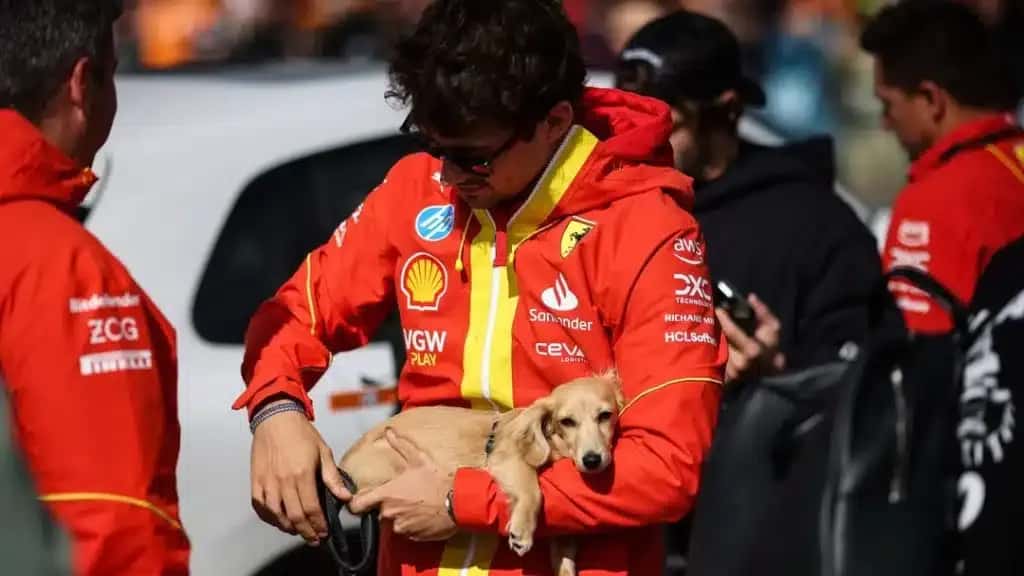
For a breed that tends to avoid fuss, dachshunds have a way of finding their way into very famous laps. Whether it’s backstage, behind the wheel, or between stadium lights, their presence has offered a sense of grounding — a quiet contrast to very public lives.
Charles Leclerc: Ferrari’s golden boy and dachshund dad
Formula One driver Charles Leclerc, known for his precision and calm under pressure, is also known for his dachshund, Leo. The pair have become something of a social media duo, with Leo making regular appearances on Leclerc’s Instagram — often stealing attention from the race cars.
Leclerc has described Leo as “the boss of the house,” and it shows.
Audrey Hepburn: Style, grace, and a dachshund named Famous
In the 1950s, Audrey Hepburn was photographed with her dachshund, aptly named Famous. The dog became a recurring figure in her downtime between film sets. According to Hepburn’s biographical archives, she owned several dogs, but Famous was one of the few pictured consistently beside her — often curled in her lap or trotting quietly at her feet on studio grounds.
Clint Eastwood: A long-time fan of the breed
Actor and director Clint Eastwood has had a lifelong affection for dachshunds, dating back to his early Hollywood years. Though more private about his personal life, he was photographed in the 1960s walking his dachshund outside his Carmel home — an image that later circulated widely as a visual contradiction to his on-screen tough-guy persona. His biography makes mention of his love of animals, including dachshunds, as part of his off-camera lifestyle.
Jack Black: Comic timing and dachshund love
Comedian and actor Jack Black has mentioned his family dachshund in interviews — describing the dog as “both neurotic and noble,” a very on-brand summary. The breed’s natural flair for drama and stubborn humour makes it unsurprising that a performer like Black would find kinship with one.
Dachshunds and the modern celebrity pet culture
With the rise of pet-forward public profiles, dachshunds have reappeared in modern celebrity households:
- Kendall Jenner has been spotted walking a dachshund, though it remains unclear if the dog is hers or a family companion.
- Adele has been rumored to own a dachshund named Louie, mentioned in early interviews though never publicly confirmed.
- Florence Welch (of Florence + the Machine) frequently references dogs in her poetry and visuals — and was once photographed cradling a dachshund in a behind-the-scenes concert shoot.
For a running list of famous people who’ve owned dachshunds — from artists to royalty to pop stars — see the Dachshund Wikipedia page, which documents both historical and modern figures.
FAQs — Famous Dachshunds
More from This Series
Continue exploring the quirks, culture, and charm of dachshunds with the rest of our Fun Facts & Trivia collection:
- World’s Longest Dachshund
Discover the record-breaking dachshunds that made history — and what it says about the breed. - When Is National Dachshund Day?
Why June 21st became the dachshund’s official day, and how people are celebrating worldwide. - Movies About Dachshunds
From cartoons to cult classics, these are the dachshund moments you don’t want to miss. - Funny Dachshund Sayings
Bite-sized expressions that capture the drama, charm, and daily ridiculousness of dachshund life. - Famous Dachshunds
Meet the dachshunds who’ve shared space with royalty, artists, and Olympians. - Dachshund in World War II
Explore the surprising ways dachshunds appeared in wartime propaganda and history. - Dachshund Names
Classic, quirky, or quietly brilliant — the best names for dachshunds, inspired by their personality. - Dachshund Jokes
Clean, clever, and dachshund-approved — a roundup of jokes for owners with a sense of humor. - Fun Facts About Dachshunds
Trivia, history, and odd truths that make you see your dachshund in a whole new light. - Dachshund Meme
From vintage internet gold to today’s viral stars — a look at how doxies dominate meme culture.
Authored by
James
James is the founder of Dachshund Lovers and the proud human of Harvey, a mini dapple with a big personality. He writes to empower and connect the dachshund community, blending founder insights with honest, experience-based stories about life with this incredible and special breed. James brings candid, experience-backed opinions to the community and always focused on fewer, better products and ideas that genuinely improve life for dachshunds and their people.
Read moreJames is the founder of Dachshund Lovers and the proud human of Harvey, a mini dapple with a big personality. He writes to empower and connect the dachshund community, blending founder insights with honest, experience-based stories about life with this incredible and special breed. James brings candid, experience-backed opinions to the community and always focused on fewer, better products and ideas that genuinely improve life for dachshunds and their people.
Read moreDisclaimer
This content is for informational purposes only and should not be considered veterinary advice. Always consult with a licensed veterinarian regarding your dog’s health and wellbeing.
There are no comments yet
Leave a comment