Dachshund Training
Dachshund Training
Training a dachshund can be tough, I've been there. Here’s what actually worked for us, plus tips to avoid common mistakes. Learn more.
James
Posted on November 5, 2025.
Updated on July 20, 2026.
Table of Contents
- 1.Key Takeaways on Dachshund Training
- 2.Understanding the Dachshund Mindset
- 3.How to Train a Dachshund Not to Jump
- 4.Factors That Affect Trainability
- 5.Dachshund Leash Training
- •Start Indoors First
- •Introduce Real-World Distractions Gradually
- •Choose the Right Equipment
- •The Role of Consistency
- •Progress Over Perfection
- 6.Are Male or Female Dachshunds Easier to Train?
- -More from This Series
- -Disclaimer
Share

I still remember the first time I clipped a lead onto Harvey and walked him down our street in Cronulla. He had that bright-eyed curiosity that makes you think, “this will be easy.” Five minutes later, he was sprawled on the pavement, refusing to move unless a passer-by offered a pat. That was my first real lesson in dachshund training these dogs aren’t difficult because they’re stubborn for the sake of it, but because they’re clever enough to weigh up whether something is worth their time.
Dachshund training is less about ticking off commands and more about understanding what motivates a dog bred for independent work. Their history as hunters means they come hard-wired with determination, a sharp nose, and the instinct to make their own calls. According to the American Kennel Club, this independence is one of the most common challenges for owners, especially if they expect instant obedience.
In this guide, we’ll look at practical, breed-specific training strategies from leash training to stopping that signature “doxie jump” while also exploring whether male or female dachshunds are easier to train, and why patience often matters more than treats.
Key Takeaways on Dachshund Training
Fact | Why It Matters |
|---|---|
Dachshunds are independent thinkers with a strong hunting background. | Training requires patience and an understanding of their original working purpose. |
Leash training can take longer than other breeds. | Their scent-driven instincts mean they’re easily distracted on walks. |
Positive reinforcement is more effective than punishment. | Harsh methods can damage trust and make training harder. |
Both male and female dachshunds can be trained successfully. | Personality and individual motivation matter more than gender. |
Stopping a dachshund from jumping requires consistent boundaries from puppyhood. | Jumping can cause back strain, especially in a breed prone to IVDD. |
Understanding the Dachshund Mindset

If you ask ten owners, “Are dachshunds easy to train?” you’ll probably get ten different answers — and most of them will start with a sigh. The truth is, dachshunds are not inherently hard to train, but they are hard to train if you approach them like a blank slate. This is a breed with centuries of instinct and personality baked in.
Originally bred in Germany to hunt badgers, dachshunds worked alone underground, without a handler giving constant commands. That independence wasn’t an accident — it was essential for survival. When you bring a dachshund into your home, you’re inheriting that same problem-solving mind.
Some people mistake this independence for stubbornness. It’s not that your dachshund is ignoring you; it’s that they’re weighing up your request against their own priorities. If you’ve ever stood in your backyard calling their name while they continue sniffing the same patch of grass, you’ve seen this decision-making in action.
A study referenced by the American Kennel Club notes that breeds with high scent-drive, like the dachshund, require training that channels their instincts rather than suppresses them. That means incorporating sniffing into walks, making training sessions feel like a game, and understanding that repetition alone won’t guarantee compliance.
In short, dachshund training is most successful when it respects the breed’s history. The more you work with their instincts instead of against them, the more likely you are to get the consistency you’re hoping for.
How to Train a Dachshund Not to Jump
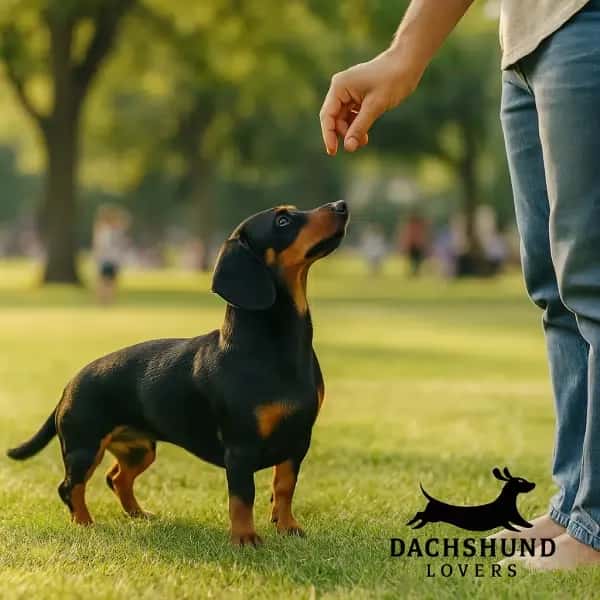
Jumping might look harmless when your dachshund greets you at the door, but over time it can create two problems. The first is behavioural — not every guest appreciates being jumped on, especially by a dog who greets with muddy paws. The second is physical — dachshunds are at higher risk of back injuries, and repeated jumping from a standing position can strain their spine. “Dachshunds are at a 10–12 times higher risk of IVDD than other breeds, and an estimated 19–24 % of Dachshunds show signs of IVDD during their lifetime.” –DachsLife 2015: an investigation of lifestyle associations with the risk of intervertebral disc disease in Dachshunds. So when it comes to training a dachshund not to jump, its crucial for their long term health.
Training a dachshund not to jump is about replacing the behaviour, not simply telling them “no.” If you only give a correction without offering an alternative, they will keep trying the move that has worked for them in the past.
Here is a step-by-step approach:
- Ignore the jump
Dogs jump because it gets them attention. If you give eye contact, speak, or touch them while they are jumping, you are reinforcing the behaviour. Instead, turn away, fold your arms, and wait until they have all four paws on the ground.
- Reward calm greetings
The moment your dachshund stands or sits calmly, reward them with praise or a treat. Consistency is key — everyone in the household needs to follow the same rules.
- Teach a replacement behaviour
“Sit” is the most common alternative. Before greeting your dachshund, ask them to sit, then reward them for staying in place while you give attention. This not only stops the jump but also teaches impulse control.
- Manage the environment
If your dachshund becomes overexcited when people arrive, use a baby gate or playpen to create space until they have settled. You can then bring them out for a calm greeting. Make sure that if its the baby gate or the playpen that it is constant in their environment rather it come out in situations where only people arrive. This worked really well for Harvey our dachshund
This training takes patience, especially if your dachshund has been jumping for years. You may see improvement in a few days, but solid, consistent results can take weeks.
For extra guidance, the American Veterinary Society of Animal Behavior emphasises positive reinforcement as the most effective method for teaching alternative behaviours — especially in intelligent, independent breeds like the dachshund.
Factors That Affect Trainability
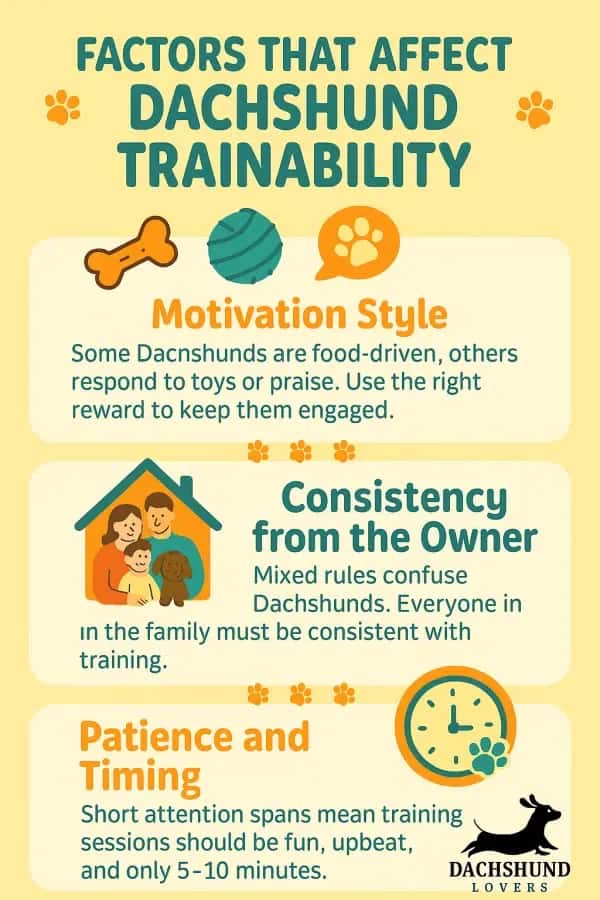
Dachshunds sit in a curious middle ground when it comes to trainability. They are quick learners when the activity makes sense to them, but they can appear “hard to train” if the approach doesn’t suit their temperament. This is why some owners call them stubborn, while others praise them as clever and responsive — it often depends on the trainer as much as the dog.
Their original job as badger hunters meant they worked independently, making decisions without waiting for human direction. This self-reliance is part of their charm but can be a challenge for traditional obedience training. Unlike breeds bred to work closely alongside people, dachshunds will weigh the value of a command before acting on it.
Factors That Affect Trainability
- Motivation style
Some dachshunds are highly food-driven like our Harvey, others are more responsive to toys or verbal praise. Without the right reward, they may simply walk away mid-training session. - Consistency from the owner
Inconsistent cues or rules confuse a dachshund quickly. If one family member allows jumping on the couch and another scolds them for it, training progress will stall. You all have to be super consistent and diligent. - Patience and timing
Their short attention span means training sessions need to be brief and upbeat — usually 5 to 10 minutes at a time. This is so important you don’t over do it here.
Dachshund Leash Training
Leash training a dachshund can feel like a test of wills. Harvey, my own dachshund, treated our first few walks like a choose-your-own-adventure story — one that had nothing to do with the route I had in mind. He’d dart after smells, stop dead at invisible “checkpoints,” and sometimes even reverse his body under the tension of the lead, just to see if I’d give in. It was in those early walks that I learned something essential: dachshund leash training isn’t about forcing compliance, it’s about building a shared rhythm.
Because dachshunds were bred for independent hunting, their natural instinct is to take the lead — literally. They want to control pace, direction, and sniff-time. According to the American Kennel Club, leash manners are one of the first hurdles new owners face, especially when the dog is still a puppy and hasn’t learned self-control. The good news is that with the right mix of patience, consistency, and reward-based reinforcement, leash training can become one of your most rewarding routines.
Start Indoors First
Before you take your dachshund into a busy street or park, start leash training in a calm, distraction-free environment. This could be a hallway, backyard, or even your living room. Clip the lead on and let them walk beside you without the added pressure of passing dogs or noisy traffic.
- Keep sessions short: Five to ten minutes is plenty for young dachshunds.
- Use high-value treats: Save their favourite rewards for leash work so they associate the lead with something positive.
- Reward position, not just progress: Praise them for walking alongside you, not ahead or behind.
Introduce Real-World Distractions Gradually
Once your dachshund is walking comfortably beside you indoors, start introducing low-level distractions — a quiet street, a park during off-peak hours. If your dog pulls ahead, stop walking and wait for them to return to your side. This “be a tree” technique teaches them that pulling gets them nowhere.
For dachshunds prone to reactivity (barking or lunging at other dogs), you might want to read our full guide on Reactive Dachshund Training for strategies that address both pulling and over-excitement.
Choose the Right Equipment
For dachshunds, a harness is generally safer than a collar, particularly because of their long backs and risk of Intervertebral Disc Disease (IVDD). Look for a Y-front harness that allows free shoulder movement without putting strain on their neck or spine.
The Role of Consistency
Consistency isn’t just about training every day — it’s about maintaining the same rules across all walks and handlers. If one family member allows pulling and another doesn’t, the dog learns to test boundaries. Make sure everyone who walks your dachshund understands the same cues, pacing rules, and reward system.
Progress Over Perfection
Some dachshunds will walk neatly on leash in weeks, others in months. The key is not to measure them against other breeds or even other dachshunds. Every dog has its own pace of learning, and every walk is an opportunity to strengthen your communication.
If you’ve already mastered leash manners, you can move on to more advanced cues like “heel” or “look at me” — skills that make every outing smoother and safer. You can explore those techniques in our upcoming guide on How to Train a Dachshund to Lay Down, which builds on the same reward-based principles.
Are Male or Female Dachshunds Easier to Train?
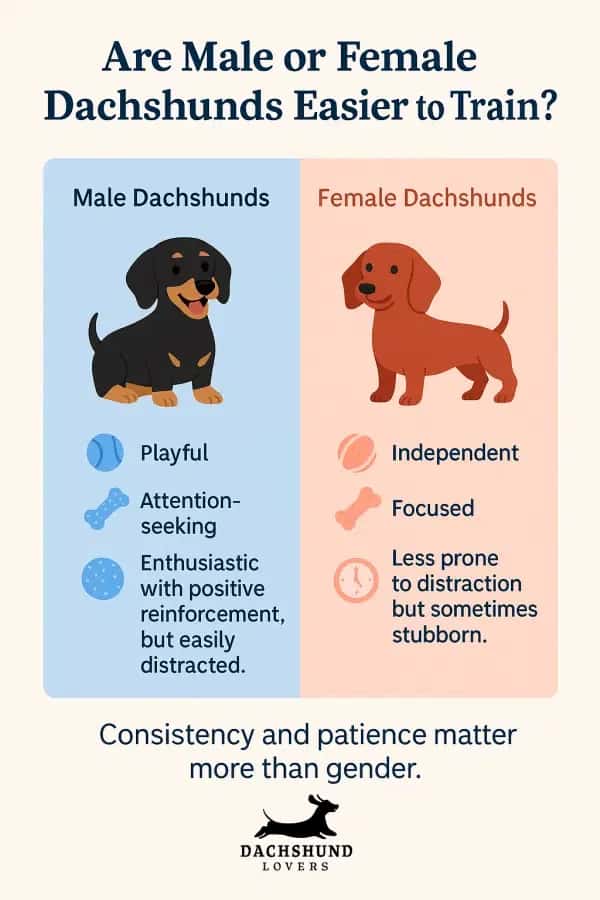
When people ask whether male or female dachshunds are easier to train, they’re often looking for a simple answer — but the truth is more nuanced. In my experience with Harvey and the countless dachshunds I’ve met through friends, events, and the local vet, training outcomes tend to depend more on personality, environment, and consistency than gender alone. That said, there are some general tendencies worth noting.
Male dachshunds are often described as a little more playful and attention-seeking. This can work for or against you in training. On one hand, a male dachshund that craves interaction may respond enthusiastically to positive reinforcement. On the other, his eagerness can make him more easily distracted, especially in busy outdoor settings.
Female dachshunds, in contrast, can sometimes be more independent or reserved. Some owners find them less prone to constant distraction, which can make focused training sessions easier. However, their independence can also tip into stubbornness if they decide they aren’t in the mood to participate.
According to the American Kennel Club, these personality variations are rooted in the breed’s history. Both sexes share the same strong hunting instincts and determination, so your training plan should focus on motivation — finding what your dachshund values most, whether that’s treats, toys, or praise.
For first-time dachshund owners, the decision may come down to matching your own temperament with your dog’s. If you thrive on high-energy interaction, a playful male might be a great fit. If you prefer calmer, more deliberate engagement, a female could feel like a better match. Whichever you choose, consistency and patience matter more than gender.
If you are just starting your training journey, you may want to read our full guide on House Training a Dachshund for essential groundwork before moving onto more complex commands.
FAQs — Dachshund Training
More from This Series
Explore more breed-specific training insights in our Dachshund Obedience & Training collection:
- House Training a Dachshund — Proven methods for building a reliable bathroom routine, whether you live in an apartment or have a backyard.
- Reactive Dachshund Training — Strategies for managing barking, lunging, and overexcitement on walks and at home.
- How to Train a Dachshund to Lay Down — Teach one of the most useful obedience commands for calmness and control.
Authored by
James
James is the founder of Dachshund Lovers and the proud human of Harvey, a mini dapple with a big personality. He writes to empower and connect the dachshund community, blending founder insights with honest, experience-based stories about life with this incredible and special breed. James brings candid, experience-backed opinions to the community and always focused on fewer, better products and ideas that genuinely improve life for dachshunds and their people.
Read moreJames is the founder of Dachshund Lovers and the proud human of Harvey, a mini dapple with a big personality. He writes to empower and connect the dachshund community, blending founder insights with honest, experience-based stories about life with this incredible and special breed. James brings candid, experience-backed opinions to the community and always focused on fewer, better products and ideas that genuinely improve life for dachshunds and their people.
Read moreDisclaimer
This content is for informational purposes only and should not be considered veterinary advice. Always consult with a licensed veterinarian regarding your dog’s health and wellbeing.
There are no comments yet
Leave a comment