How to Crate Train a Dachshund (Without the Drama)
How to Crate Train a Dachshund (Without the Drama)
Learn how to crate train a dachshund without stress. This step-by-step guide covers positive reinforcement techniques & practical tips for all dachshund owners.
James
Posted on July 25, 2025.
Updated on July 21, 2026.
Table of Contents
- 1.The Crate, the Crying, and the Turning Point
- 2.Key Takeaways
- 3.Should You Crate Train a Dachshund?
- •The Benefits at a Glance:
- 4.How to Choose the Right Crate for a Dachshund
- •1. Size Matters (But Bigger Isn’t Always Better)
- •2. Low Entry Point
- •3. Ventilation & Visibility
- •4. Soft Crates for Travel Only
- •5. Make It Feel Like Home
- 5.When to Start Crate Training a Dachshund
- •For Puppies:
- •For Adults or Rescue Dachshunds:
- 6.Crate Training Schedule by Age
- •8–10 Weeks Old
- •10–16 Weeks
- •4–6 Months
- •6+ Months (Young Adults & Adults)
- 7.How to Make the Crate a Positive Space
- •1. Choose the Right Crate
- •2. Make It a Reward Zone
- •3. Add Familiar Scents
- •4. Start with the Door Open
- •5. Create a Cue Word
- 8.Common Mistakes to Avoid in Crate Training a Dachshund
- •1. Using the Crate as Punishment
- •2. Leaving Them Inside for Too Long
- •3. Skipping the Wind-Down Routine
- •4. Expecting Immediate Results
- •5. Inconsistency with Routine
- 9.Should You Crate Train an Older Dachshund?
- •Why It’s Worth It
- •The Adjustment Phase
- 10.When to Start Crate Training a Dachshund Puppy
- •Ideal Starting Age
- •What the First Few Days Look Like
- •Make It Feel Like Home
- •Routine Is Everything
- 11.Should I Cover My Dachshund’s Crate?
- •The Pros of Covering the Crate
- •The Cons (and Cautions)
- •Try a “Half Cover” First
- 12.How Long Should You Crate a Dachshund Puppy?
- •General Rule of Thumb (According to Vets)
- •Key Considerations for Dachshund Puppies
- •What If You Work Full Time?
- 13.Crate Size & Setup for Dachshunds
- •What’s the Right Size Crate for a Dachshund?
- •Crate Type: Wire, Plastic, or Soft?
- •Ideal Crate Location
- •Inside the Crate: What to Include (and What to Avoid)
- 14.Troubleshooting Crate Training: Barking, Whining & Resistance
- •First, Understand Why It’s Happening
- •Common Mistakes That Make Things Worse
- •Tactics That Actually Work
- •When It’s More Than Just Whining
- 15.Crate Training vs. Playpen: What’s Better for Dachshunds?
- •Crate Training: The Pros & Use Cases
- •Playpens: The Pros & When to Use One
- •The Winning Combo: Crate and Playpen
- •Summary: Crate Training a Dachshund Is a Long Game — But Worth Every Step
- •Disclaimer
Share

The Crate, the Crying, and the Turning Point
We picked up Harvey from Tamworth — a long drive inland that felt like the start of something big. He came from Hillhaven Dachshunds, a small, trusted breeder with a reputation for raising confident little personalities. Harvey was 11 weeks old, silver dapple, and small enough to sleep in the crook of my elbow.
The breeder mentioned crate training. Said it helped with toilet training, night routines, and even spinal health in dachshunds. Sounded like a no-brainer. We bought a crate, lined it with a worn jumper that smelled like me, placed it beside the bed — and crossed our fingers.
The first two days were promising. Harvey explored it, curled up for naps, and seemed to take to it. But night three? He howled like a siren in a tunnel. From midnight to 3am, he cried, barked, scratched, and cried again. We sat on the hallway floor, half-delirious, googling “crate training dachshund help” while whispering back and forth: “Should we let him out?”
We didn’t. But we did adapt. We added a blanket over the top to make the crate feel more like a den. Fed him his meals inside it. Rewarded him when he walked in on his own. Moved it a bit closer so he could see us at night. Slowly — and I mean slowly — Harvey stopped fighting it. Within a week, he’d go in willingly and put himself to bed.
That’s when I realized: crate training isn’t one-size-fits-all. Especially not for dachshunds.
These dogs are clever. They’re sensitive. And they like to test limits. But with the right setup and approach, a crate can become their safe zone — not a punishment or prison.
This article breaks down how to make crate training work specifically for dachshunds — with practical tips, real scenarios, and none of the sugarcoating.
Want the science behind it? The American Kennel Club’s guide on crate training explains why it works — and how crates can support emotional stability, security, and independence in puppies.
Key Takeaways
Topic | Summary |
|---|---|
Should You Crate Train? | Yes. Crate training helps with toilet training, injury prevention, and setting boundaries — especially for dachshunds with their long backs and anxious tendencies. |
Ideal Crate Setup | Choose a soft-sided or wire crate with a divider. Use bedding that smells like you. Cover part of the crate with a blanket to mimic a den. |
Crate Training Timeline | Puppies usually adapt in 7–14 days. Older dachshunds may take longer, especially if they’ve never been crated. |
Common Mistakes | Using the crate as punishment, ignoring whining entirely, or leaving them inside too long during the day. |
Best Tip | Think of the crate as their safe retreat, not your tool to “fix” behavior. The more positive associations they have, the faster they’ll settle in. |
Should You Crate Train a Dachshund?
The short answer? Yes — but only if you’re doing it for the right reasons, and with realistic expectations.
Crate training isn’t about locking your dachshund away when they’re too much. It’s about giving them a secure, calm space that belongs to them. A den. A retreat. A place to reset. This is especially important for dachshunds, who are known for being:
- Anxious if overstimulated
- Stubborn but sensitive
- Highly attached to their humans
- Prone to spinal issues (IVDD)
Done right, crate training can help manage separation anxiety, reduce overstimulation, and even protect your pup from risky behavior (like jumping off furniture). It’s also a game-changer for toilet training, especially in the early days.
The Benefits at a Glance:
Benefit | Why It Matters for Dachshunds |
|---|---|
Safe Space | Dachshunds can retreat when anxious or overstimulated |
Toilet Training Support | Encourages bladder control and builds routine |
Travel & Vet Readiness | Prepares them for safe crate travel and overnight stays |
Prevention of IVDD Injury | Reduces risky movement when unsupervised |
Independence & Confidence | Helps them self-soothe and develop healthy boundaries |
That said, not every dachshund will love the crate from day one — and that’s okay. The key is consistency, patience, and never using it as punishment. You’re building trust, not a holding cell.
Perfect — here’s the next section:

How to Choose the Right Crate for a Dachshund
Not all crates are created equal — especially when you’re shopping for a dachshund. With their long backs, short legs, and risk of Intervertebral Disc Disease (IVDD), choosing the right crate isn’t just about comfort — it’s about safety.
Here’s what to look for:
1. Size Matters (But Bigger Isn’t Always Better)
Your dachshund should be able to:
- Stand up fully
- Turn around comfortably
- Lie down and stretch out
But too much space can lead to accidents or anxiety. Aim for a snug, cozy fit — think den, not hotel suite.
Recommended dimensions:
For most minis: around 24”L x 18”W x 19”H
For standards: closer to 30”L x 19”W x 21”H
If you’re crate training a puppy, consider a crate with a divider panel so you can adjust the space as they grow.
2. Low Entry Point
This is crucial for IVDD prevention. Choose a crate with a low threshold or pair it with a non-slip ramp or mat. Jumping in and out of tall crates puts unnecessary strain on their spine.
3. Ventilation & Visibility
Look for crates with good airflow and visibility — especially if your dachshund gets anxious when left alone. Wire crates are breathable and allow for better human contact, while plastic ones can feel more den-like and calming.
4. Soft Crates for Travel Only
While stylish and lightweight, soft-sided crates are best reserved for travel or short-term use. They’re easy to escape from and don’t offer the structure or safety a daily crate should provide.
5. Make It Feel Like Home
Line the crate with soft bedding, a familiar toy, and a blanket that smells like you. This helps build positive associations right from the start.
External resource: Preventing IVDD in Dachshunds – Dachshund IVDD UK Charity
When to Start Crate Training a Dachshund
The best time to start crate training your dachshund? Day one.
Whether you’re bringing home a puppy or rehoming an older doxie, early exposure to the crate sets the foundation for a calm, secure routine — and prevents a lot of stress (for both of you) down the track.
For Puppies:
Start as soon as they come home — ideally 8 to 10 weeks old. At this age, they’re impressionable, learning boundaries, and naturally inclined to seek small, safe spaces. The crate becomes their den — a place of comfort, not confinement.
Short, positive exposures work best:
- Pop them in for 5–10 minutes with the door open while you’re nearby
- Feed them meals inside the crate to build positive associations
- Use a calm voice and reward with praise or a treat when they enter voluntarily
Avoid putting them in the crate as punishment — the goal is for your dachshund to choose the crate, not fear it.
For Adults or Rescue Dachshunds:
It’s never too late — but it may take longer. Older dogs with no prior crate experience (or negative ones) may resist at first. Start slow, with open-door introductions, treats, and lots of patience.
Real-life example: When we brought Harvey home from Hillhaven Dachshunds in Tamworth, I started crate training him that same evening. I placed a fleece blanket from his breeder in the crate — it smelled like his mum — and he curled up within five minutes. That scent, that shape of space… it just clicked.
Crate training is part habit, part environment, and part emotional safety net. The sooner it becomes part of daily life, the more natural it feels for your dachshund.
Crate Training Schedule by Age
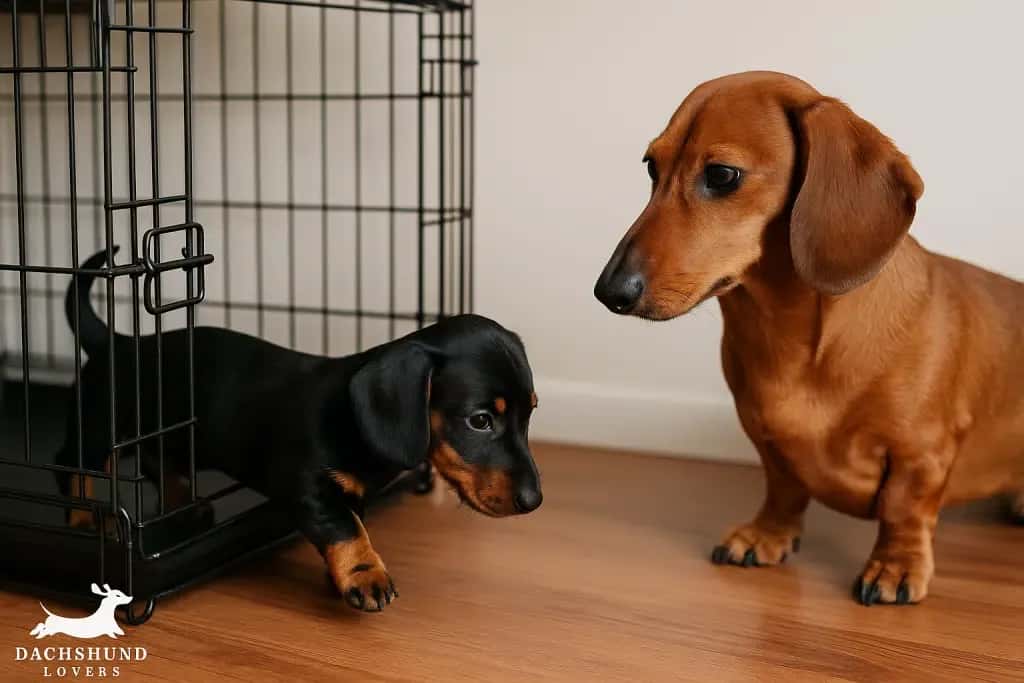
Establishing a consistent schedule is everything when it comes to crate training. Dachshunds, especially puppies, thrive on routine — and having predictable crate time helps reduce accidents, separation anxiety, and excessive barking.
8–10 Weeks Old
At this stage, your puppy’s bladder is tiny and their attention span is even smaller. Crate sessions should be short, frequent, and always positive.
Sample Schedule:
- Morning: Potty break → play → crate (15–30 mins)
- Midday: After lunch and walk → crate for nap (1–2 hours)
- Evening: Potty → dinner → short crate session (30–45 mins)
- Overnight: Sleep in crate with 1–2 potty breaks as needed
James’ Tip: Set a timer if needed. Puppies this age need to go out roughly every 2 hours during the day.
10–16 Weeks
Your doxie is learning bladder control and can stretch crate time a little longer. You can also start creating longer nap sessions and post-mealtime downtime in the crate.
Goal: 2–3 hours max during the day, up to 6 hours overnight (with a potty break).
4–6 Months
You’ll notice a maturity shift here. Your dachshund might start retreating to their crate voluntarily. That’s a great sign — they see it as their “safe zone.”
Max crate time during the day: 4 hours
Overnight: 6–7 hours, ideally without interruption.
Important: Crates should never be used for all-day confinement. If you’re working long hours, consider a playpen extension or a pet sitter to break up the day.
6+ Months (Young Adults & Adults)
By now, your dachshund likely sees the crate as a comfort. Crate use becomes about reinforcing positive habits — for travel, new environments, or quiet time.
Max daytime crate time: 4–5 hours
Overnight: 8 hours (with wind-down routine beforehand)
How to Make the Crate a Positive Space
Crate training should feel like setting up a cozy studio apartment for your dachshund — not like building a doggy jail. Done right, their crate becomes a place of comfort, routine, and self-regulation.
1. Choose the Right Crate
It should be just large enough for your dachshund to stand, turn, and lie down — no bigger. Too much space and they might start using one end as a bathroom.
According to the American Kennel Club, “A good rule of thumb is that the crate should be large enough for your dog to stand up, turn around, and lie down.”
Source: AKC – How to Crate Train a Puppy
Wire crates with adjustable dividers are a solid investment, especially if you’re starting with a puppy.
2. Make It a Reward Zone
Use it for all the best things:
- Serve meals inside the crate
- Leave a safe chew toy or frozen Kong for mental stimulation
- Occasionally sneak in a high-value treat like liver jerky
This creates strong positive associations — your dachshund starts to see the crate as a place where good things happen.
3. Add Familiar Scents
Blankets that smell like you or like home can significantly reduce anxiety. If your pup came from a breeder or foster home, bring a towel that smells like their littermates to ease the transition.
4. Start with the Door Open
Let them walk in and out without pressure. You can toss treats in to make it feel like a treasure hunt. Once they start choosing to linger, gently close the door for short moments — always rewarding calm behavior when you open it again.
5. Create a Cue Word
Use a phrase like “crate time” or “go to bed” every time you guide them in. Dachshunds thrive on routine, and once they link the phrase to the action, they’ll often trot in on command.

Common Mistakes to Avoid in Crate Training a Dachshund
Crate training a dachshund can be smooth sailing… or it can go completely sideways if you’re not careful. These little hounds are smart, sensitive, and notoriously strong-willed — so the way you approach crate training matters.
Here are the biggest missteps to avoid:
1. Using the Crate as Punishment
If you send your dachshund to the crate after they’ve chewed the couch leg or had an accident on the carpet, you’re not teaching them to behave — you’re teaching them to fear the crate.
The crate should never feel like solitary confinement. It’s their den, not detention. Always associate it with calm, positive moments.
2. Leaving Them Inside for Too Long
Even the best crate-trained dog can start resenting it if they’re stuck inside for hours on end. Dachshunds, in particular, are highly social and need interaction throughout the day.
As a rough guide:
- Puppies under 6 months: max 3–4 hours
- Adult dachshunds: up to 5–6 hours (if necessary)
- Overnight: 7–8 hours max, assuming they’ve had ample toilet breaks
If you’re crate training a puppy and need to be away for long stretches, consider a playpen area or asking a friend or pet sitter to help.
The Humane Society of the United States advises: “Puppies under six months shouldn’t stay in a crate more than three or four hours at a time. They can’t control their bladders and bowels for that long.”
Source: Humane Society – Crate Training 101
3. Skipping the Wind-Down Routine
Placing your dachshund in the crate when they’re wound up or mid-play is a recipe for whining and stress. Create a calming routine — a short walk, dim the lights, a bit of quiet cuddle time — to help them transition into rest mode.
4. Expecting Immediate Results
Crate training takes time, especially with a clever breed like dachshunds. You might nail it in a few days — or it could take weeks. Be patient, stay consistent, and avoid giving up at the first sign of protest.
5. Inconsistency with Routine
Dogs thrive on predictability. If crate time is random or inconsistent, your dachshund won’t know what to expect. Stick to regular crate sessions during meals, quiet time, and sleep to reinforce the habit.
Should You Crate Train an Older Dachshund?
Absolutely — but go in knowing it’s a different game than training a puppy.
Older dachshunds come with habits, routines, and sometimes a bit of baggage. They’ve learned how the world works (or how they think it works), and suddenly introducing a crate can feel like flipping their universe upside down.
But that doesn’t mean it can’t be done — in fact, for many adult dachshunds, crate training brings structure, comfort, and calm.
Why It’s Worth It
- Separation anxiety: Many older dachshunds experience this, especially if routines change (new baby, return to office, moving house). A crate can offer a safe, consistent space to retreat to when things feel uncertain.
- Managing overstimulation: For reactive or nervous dachshunds, a crate can act like a “reset zone” during guests, thunderstorms, or noisy kids.
- House safety: If your older dog gets into things when unsupervised — food scraps, furniture chewing, etc. — a crate provides safe boundaries.
The Adjustment Phase
Unlike puppies, older dachshunds will often resist the crate at first — especially if they’ve never used one before.
Here’s how to smooth the transition:
- Start slow: Leave the door open and place treats, toys, or a favorite blanket inside.
- Use meal times: Feeding your dachshund in the crate is a powerful way to build positive association.
- Short sessions first: 5–10 minutes with the door closed, followed by praise and release.
- Stick to a routine: Regular crate time at predictable intervals helps them adjust faster.
According to the American Kennel Club (AKC), “Even senior dogs can learn to love their crate — it may take longer, but patience and consistency are key.”
Source: AKC – Crate Training an Older Dog
When to Start Crate Training a Dachshund Puppy
If you’ve just picked up your new dachshund pup — whether from a reputable breeder like Hillhaven Dachshunds in Tamworth or through a trusted rescue — the best time to start crate training is as early as day one.
Yup, day one.
It might sound harsh, but dachshund puppies thrive on boundaries and routine. Waiting a few weeks “until they settle in” often makes the process harder. The earlier they learn that the crate is their safe little den, the quicker you’ll see calmer naps, fewer toilet accidents, and more relaxed nights (for everyone involved).
Ideal Starting Age
8 weeks is the sweet spot. Most breeders send puppies home around this age, and it’s the perfect window to begin gently shaping positive crate associations.
What the First Few Days Look Like
- First night? Expect protest. Whining, barking, maybe even a full meltdown. It’s normal. You’ve got this.
- Keep the crate in your bedroom at first. This helps reduce anxiety and lets you respond to nighttime toilet needs.
- Daytime use matters too — don’t just rely on overnight crating. Build familiarity by using the crate during naps, quiet time, and after meals.
Make It Feel Like Home
- Use a crate divider if it’s a large crate — they should have just enough room to stand, turn around, and lie down.
- Add a soft blanket that smells like you (or like the breeder’s home, if possible).
- Keep it cozy but breathable — overheating is a real risk for dachshunds.
Routine Is Everything
At this age, structure is your best friend. Feed, toilet, play, crate. Rinse and repeat. Puppies learn fastest when they know what’s coming next.
As VetStreet notes, “Puppies feel secure when they have predictable routines and consistent crate time.”
Source: VetStreet – How to Crate Train Your Puppy

Should I Cover My Dachshund’s Crate?
Short answer? Sometimes — but not always.
Covering your dachshund’s crate can help create a den-like, calming environment, but it depends on your dog’s temperament, the season, and your setup.
The Pros of Covering the Crate
For anxious or highly alert dachshunds, draping a light blanket or a purpose-made crate cover can help them settle faster by:
- Blocking out visual triggers (like people walking past, sudden light changes, or other pets)
- Signaling “quiet time” more clearly
- Helping simulate the feeling of a natural den
In fact, many behaviorists support this. According to the Humane Society, “Covering the crate helps block out distractions, which can reduce barking and whining.”
→ Source: Humane Society – Crate Training Basics
We saw this firsthand with Harvey. He was fine during the day, but at night any flicker of hallway light or distant sound would have him sitting up like a meerkat. A breathable cotton throw changed everything. One week in, he was curling up without protest.
The Cons (and Cautions)
But not every dachshund loves it. Some feel trapped. Some overheat. Some — especially the escape artist types — will dig, chew, or bark more when covered.
Things to consider:
- Temperature: Dachshunds run warm. If it’s summer or you don’t have strong airflow, skip the cover or use a breathable option.
- Visibility: Some dogs prefer being able to see you or the room. Covering it might increase their anxiety.
- Material: Never use heavy blankets or anything flammable. Light, breathable fabrics only — and ensure part of the crate is uncovered for airflow.
Try a “Half Cover” First
Start by covering just the top and one or two sides. Leave the front open so they can see you and still feel in control. Watch how they respond — and adjust from there.
Pro tip: Use crate coverage as a cue. For example, crate cover down = bedtime. Cover off = play or rest time. This helps reinforce routines without yelling across the room.
How Long Should You Crate a Dachshund Puppy?
This is the question that keeps new dachshund owners up at night (sometimes literally). You’ve read mixed opinions. One blog says 2 hours max, another says overnight is fine — so what’s the actual answer?
It depends on age, crate training experience, and how long they’ve gone between toilet breaks.
General Rule of Thumb (According to Vets)
For puppies, the rough guide is:
1 hour per month of age, up to a maximum of about 4–5 hours during the day.
So, an 8-week-old puppy should only be crated for around 2 hours at a time during the day. Overnight is different — as long as you’re giving toilet breaks, most puppies can stretch to 4–6 hours with some training.
Source: American Kennel Club – Crate Training 101
Read more here
Key Considerations for Dachshund Puppies
- Short legs, small bladders — they need more frequent breaks than larger breeds.
- No more than 3–4 hours during the day in a crate, even for older pups.
- Overnight: Use your best judgment based on their routine. 6–7 hours max with a pre-bed and early-morning toilet routine.
What If You Work Full Time?
This is a common concern, and the reality is: crate training only works if your puppy gets enough out-of-crate time. If you’re working 9–5 and they’re locked up the whole time — it’s not going to end well.
Options for working owners:
- Come home at lunch
- Hire a pet sitter or dog walker
- Use a safe, puppy-proofed playpen with the crate open inside
Crating for too long can lead to anxiety, whining, toileting accidents, and in some cases — future crate refusal. Your dachshund needs structure, but they also need connection and space to explore.
Crate Size & Setup for Dachshunds
Not all crates are created equal — and when it comes to dachshunds, size and setup matter more than you might think.
A crate that’s too big? You’ll end up with midnight toilet accidents and a pup who doesn’t feel secure. Too small? You’ve got discomfort and resentment on your hands. You need that Goldilocks zone — just enough room to stand up, turn around, and lie down comfortably.
What’s the Right Size Crate for a Dachshund?
For standard and mini dachshunds, the best crate sizes are usually:
- Mini Dachshund: 24” L x 18” W x 21” H
- Standard Dachshund: 30” L x 19” W x 21” H
We use a 24” crate for Harvey, our mini black dapple, and it’s perfect. Anything larger, and you’ll likely need to use a crate divider during puppyhood.
Pro Tip: Look for crates with removable dividers so you can adjust space as your pup grows. This helps prevent toileting accidents and builds good habits early.
As PetMD explains, “A properly sized crate mimics a den — it creates a calm, enclosed space that satisfies a dog’s natural instinct to feel protected.”
Source: PetMD – Choosing the Right Crate Size
Crate Type: Wire, Plastic, or Soft?
Here’s the breakdown:
- Wire crates – Great airflow, foldable, easy to clean. Best for home use.
- Plastic crates – More enclosed, better for travel or dogs that prefer darkness.
- Soft crates – Lightweight and portable, but not ideal for chewers or untrained pups.
We recommend a double-door wire crate with a divider for most owners. It’s flexible and gives you full visibility — which matters when your dachshund is up to something sneaky.
Ideal Crate Location
This can make or break the experience.
Place the crate:
- Somewhere quiet, but not isolated. Think: living room corner or beside your bed.
- Away from direct sun or draughts. Dachshunds are sensitive to temperature.
- Near where your family spends time. Especially during the early bonding phase.
We started Harvey’s crate near our couch, then transitioned it to our bedroom for overnight use during the first few weeks.
Inside the Crate: What to Include (and What to Avoid)
Do include:
- A washable crate pad or vet bed
- A blanket or t-shirt with your scent
- A safe chew toy or lick mat
- A water bowl that clips to the side (optional for short durations)
Avoid:
- Pee pads — they confuse toilet training
- Too many toys — overstimulation, especially for anxious pups
- Food — unless it’s structured crate-feeding tim
Troubleshooting Crate Training: Barking, Whining & Resistance
Crate training sounds simple — until you’re lying awake at midnight, listening to your dachshund scream like they’ve just been evicted from their penthouse. Been there. Harvey was relentless that first week. But here’s the truth: resistance is normal, and it’s something you can work through with consistency and calm.
First, Understand Why It’s Happening
Dachshunds are smart, dramatic, and deeply attached to their humans. When they bark or whine in the crate, it’s usually for one of three reasons:
- Separation anxiety: Your pup isn’t protesting the crate — they’re panicking about being away from you. Dachshunds bond fast and hard, so being alone can feel threatening, especially early on.
- Lack of crate conditioning: If your dog only ever gets put in the crate when you’re leaving, they’ll associate it with abandonment. That’s a training gap, not a personality flaw.
- Accidental reinforcement: If they barked… and you let them out (even once), they’ve just learned that noise = freedom.
“If you respond to your puppy every time they whine, they learn that whining gets results.”
— American Kennel Club
Source: AKC – Crate Training Basics
Common Mistakes That Make Things Worse
- Inconsistency: Giving in “just this once” resets your progress by days.
- Using the crate as punishment: This breaks the trust. Your dog should associate the crate with rest and safety — not being in trouble.
- Skipping crate time during the day: If you only use the crate when you go out, they’ll see it as a negative space. Use it during calm time, naps, or after meals.
Tactics That Actually Work
- Practice calm crate time with you nearby. Sit next to the crate while they chew a toy inside. No leaving. Just presence. This desensitizes them to the space.
- Try white noise, a ticking clock, or low music. Dachshunds have sensitive ears — ambient sound can dull environmental triggers and calm the nervous system.
- Don’t make a big deal of comings and goings. Quietly crate them and quietly greet them. That helps normalize transitions.
If your dog is losing it every time you step out of the room, you’re not failing — you’re just in the middle of teaching them independence. That’s not easy, especially for velcro dogs like doxies. But it pays off.
When It’s More Than Just Whining
If barking escalates into biting the crate, destructive digging, or uncontrollable shaking, it may signal extreme separation anxiety. In those cases, dial back to basics or seek a behaviorist. And don’t be afraid to temporarily pause crate training if your pup is showing distress.
Perfect — let’s tackle the “Crate Training vs. Playpen” section first in your James Duffy voice. This is designed for readers genuinely trying to figure out what works best — especially first-time dachshund owners overwhelmed by choice and conflicting advice.
Crate Training vs. Playpen: What’s Better for Dachshunds?
This is one of the most common questions I get from new dachshund owners — especially after that first chaotic week of “puppy proofing” the house with makeshift barriers and towel-covered floors.
So, which setup works best: a crate, a playpen, or a mix of both?
Let’s break it down.
Crate Training: The Pros & Use Cases
A crate mimics a den. It’s enclosed, personal, and — when introduced properly — it becomes a safe space where your dachshund can relax and regulate themselves.
Why choose a crate?
- Potty training is faster. Dogs instinctively avoid toileting where they sleep, making crate training one of the most effective toilet training tools.
- Teaches independence. Helps prevent velcro behavior and separation anxiety.
- Safer at night or when you’re out. Keeps them secure and out of trouble (goodbye, chewed charger cables).
Crates are ideal for:
- Puppies in their first 6 months
- Dogs recovering from surgery or needing limited mobility
- Dachshunds prone to anxiety, as crates create a cocoon-like environment
Playpens: The Pros & When to Use One
Playpens offer more freedom and are a great daytime solution when you want your dachshund nearby but not roaming the house.
Why choose a playpen?
- More space to move. Ideal for playtime, toys, and soft beds.
- Good step-down tool. Helps bridge the gap between full crating and full freedom.
- Helps with solo settling. Encourages puppies to play on their own, without constantly being picked up or moved.
Playpens are best for:
- Puppies during the day
- When you’re working from home and need boundaries
- Older dogs who don’t need crate training but still need supervision
The Winning Combo: Crate and Playpen
Here’s the trick I recommend to most new owners — combine them.
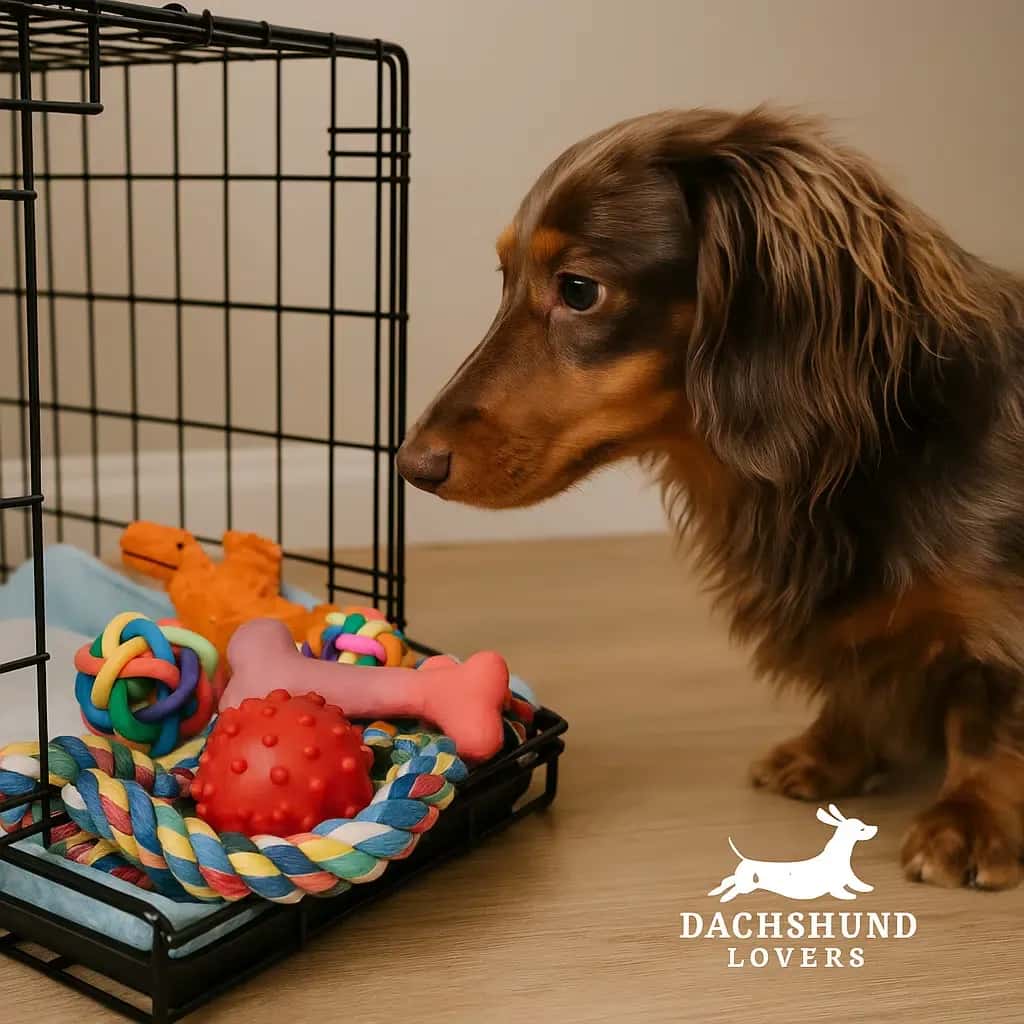
Attach a playpen to the open door of a crate. That way, your dachshund can choose to nap in their crate (and build positive associations) while still having access to a safe play area. It’s the best of both worlds.
Over time, as your pup gets more confident and trustworthy, you can reduce pen size and increase freedom.
Pro tip: For Harvey, we used a crate inside a pen setup until he was 6 months old — crate for overnight, pen during the day. That combo gave us the best behavior outcomes and a way cleaner floor.
Here’s the next section: FAQs About Crate Training Dachshunds — written in your James Duffy tone with clarity, confidence, and SEO relevance. These are the types of questions people Google at midnight when they’re tired, frustrated, or unsure what to do next.
FAQs About Crate Training Dachshunds
Summary: Crate Training a Dachshund Is a Long Game — But Worth Every Step
Crate training a dachshund isn’t about overnight wins or quick fixes. It’s about creating structure, security, and trust — the kind that sets your pup (and you) up for the long haul. From those first tough nights to the “ah-ha” moment when they voluntarily walk into their crate for a nap, every win builds your bond.
The trick? Start early. Stay consistent. And keep reminding yourself: this is a dachshund — not a golden retriever. Their bold little personalities need boundaries, not battles.
Authored by
James
James is the founder of Dachshund Lovers and the proud human of Harvey, a mini dapple with a big personality. He writes to empower and connect the dachshund community, blending founder insights with honest, experience-based stories about life with this incredible and special breed. James brings candid, experience-backed opinions to the community and always focused on fewer, better products and ideas that genuinely improve life for dachshunds and their people.
Read moreJames is the founder of Dachshund Lovers and the proud human of Harvey, a mini dapple with a big personality. He writes to empower and connect the dachshund community, blending founder insights with honest, experience-based stories about life with this incredible and special breed. James brings candid, experience-backed opinions to the community and always focused on fewer, better products and ideas that genuinely improve life for dachshunds and their people.
Read moreDisclaimer
This content is for informational purposes only and should not be considered veterinary advice. Always consult with a licensed veterinarian regarding your dog’s health and wellbeing.
There are no comments yet
Leave a comment