Dorgi for Sale & Adoption: What You Need to Know
Dorgi for Sale & Adoption: What You Need to Know
Before searching “Dorgi for sale,” learn what to expect from this Corgi-Dachshund mix, including costs, care, and tips for finding ethical breeders.
James
Posted on November 10, 2025.
Updated on July 18, 2026.
Table of Contents
- 1.Finding the Right Dorgi
- 2.Key Takeaways
- 3.Buying vs. Adopting: What to Expect
- •Buying from a Breeder
- -Pros:
- -Cons:
- -Typical Prices:
- -Where to Start:
- •Adopting a Dorgi
- -Pros:
- -Cons:
- -Adoption Platforms:
- •Breeder & Rescue Checklist
- •Comparing Costs
- •Extra Considerations
- 4.Dorgi Puppy Prices: What to Expect
- •Average Breeder Prices by Region
- •What’s Included in the Breeder Price?
- •Adoption Fees vs Breeder Costs
- •Factors That Influence Price
- •Where to Search for Fair Pricing
- •Why Paying More Can Save You Money
- 5.How to Identify a Reputable Breeder vs a Puppy Mill
- •What is a Puppy Mill?
- •What Makes a Breeder Reputable?
- •Checklist: Questions to Ask a Breeder
- •Red Flags of Puppy Mills or Backyard Breeders
- •Where to Find Ethical Breeders
- •Why It’s Worth the Effort
- •Adoption vs Breeder — How to Vet Shelters
- •Cost vs Value: Why Ethical Breeding Matters
- •Summary Table: Breeder vs Puppy Mill
- 6.Adoption Resources: Where to Find a Dorgi
- •Why Consider Adoption?
- •Where to Find Dorgis for Adoption – USA
- •Where to Find Dorgis for Adoption – UK
- •Where to Find Dorgis for Adoption – Australia
- •Adoption Fees and What’s Included
- -Cost Comparison Table:
- •Tips for Adopting a Dorgi
- •How to Vet a Rescue Organization
- •Adoption Success Stories
- •Adoption vs Breeder – What’s Right for You?
- •Next Steps
- 7.Questions to Ask Before Adopting or Buying a Dorgi
- •Why Asking Questions Matters
- •Questions for Breeders
- •Checklist for Evaluating Sellers or Rescues
- •The Top 10 Questions Checklist
- •Prepare Your Questions in Advance
- •Resources for Buyer/Adopter Questions
- •Internal Guides to Review Before Purchase or Adoption
- •Next Steps
- 8.Preparing Your Home for a Dorgi
- •Understanding Your Dorgi’s Needs
- •Setting Up a Safe Zone
- •Floor Safety and Stair Management
- •Creating Feeding and Water Stations
- •Potty Training and Outdoor Preparation
- •Essential Supplies for Your Dorgi
- •Puppy-Proofing the Home
- •Introducing Your Dorgi to Other Pets
- •Mental and Physical Stimulation
- •The First 48 Hours
- •Printable Home Prep Checklist
- •Final Tips for a Smooth Transition
- 9.Training Your Dorgi: Early Tips and Long-Term Success
- •Why Training a Dorgi Requires Patience
- •Foundations of Dorgi Training
- •Crate Training Your Dorgi
- •Housebreaking and Potty Training
- •Basic Commands Every Dorgi Should Learn
- •Socialization
- •Leash Training
- •Dealing with Common Behavioral Issues
- •Advanced Training and Enrichment
- •External Training Resources
- •Internal Guides to Read Next
- •Key Takeaways for Dorgi Training
- 10.Dorgi Grooming and First-Year Care
- •Understanding a Dorgi’s Coat
- •Essential Grooming Tools
- •Bathing Guidelines
- •Ear, Teeth, and Nail Care
- •Seasonal Grooming Tips
- •First-Year Veterinary Care
- -Vaccination Schedule (may vary by country):
- -Deworming & Flea Prevention:
- -Spaying/Neutering:
- •Establishing Grooming Routines Early
- •Printable Grooming Checklist
- •Puppy vs. Adult Grooming Needs
- •External Grooming Resources
- 11.Dorgi Health and Vaccination Checklist
- •Common Health Concerns in Dorgis
- •Vaccination Timeline for Puppies
- •Adult Health Maintenance
- •Deworming and Parasite Prevention
- •IVDD Prevention Tips
- •First-Year Vet Checklist
- •Signs to Watch For
- •Home Health Habits
- •Nutritional Health
- •Insurance and Emergency Care
- •Printable Dorgi Health Checklist
- -More From This Series:
- -Disclaimer
Share

Finding the Right Dorgi
Dorgis — a cross between the dachshund and the Pembroke Welsh corgi — have become increasingly sought after due to their affectionate temperament and unique appearance. Whether you’re exploring Dorgi puppies for your first dog or adding a new companion to your family, choosing where and how to find one is just as important as learning how to raise them.
There are two primary options for welcoming a Dorgi into your life:
- Buying from a reputable breeder.
- Adopting through a rescue or shelter.
When searching for “dorgi puppies for sale near me,” it’s crucial to look beyond price and ask the right questions. Ethical breeders will provide health certificates, details on vaccinations, early socialization, and transparent information about parent dogs. In contrast, puppy mills or backyard breeders may offer lower prices but compromise on health, ethics, and care.
Adoption is another excellent path. Many mixed-breed rescues, dachshund clubs, and corgi rescue groups rehome Dorgi-type dogs. Adoption fees are usually lower and often include spay/neuter, vaccinations, and microchipping. For a deeper look at whether the Dorgi’s temperament suits your lifestyle, see our Dorgi Temperament & Personality Traits guide.
Where to Look for Dorgis
- United States:
PuppyFinder and AdoptAPet often list Dorgi puppies or corgi–dachshund crosses. Breed-specific rescue organizations, like those on RescueMe.org, occasionally feature Dorgis for adoption. - United Kingdom:
Verified breeders and litters are commonly listed on Pets4Homes and DachshundOwners.co.uk (some offering corgi crosses). UK-based rescues such as Many Tears Animal Rescue sometimes foster corgi mixes. - Australia:
Platforms like PetRescue frequently have dachshund and corgi mixes available. Smaller rescues in Sydney, Melbourne, and Brisbane occasionally list Dorgis.
Key Takeaways
Topic | Details |
|---|---|
Price Range | Breeder costs range from $800–$1,500 USD; in the UK, £600–£1,200; in Australia, $1,200–$2,000 AUD. |
Adoption Costs | Typically $200–$500 USD (or equivalent), including vaccinations, microchipping, and basic health checks. |
Where To Search | PuppyFinder (USA), Pets4Homes (UK), PetRescue (AUS), plus RescueMe.org for adoption. |
Breeder Checklist | Look for OFA hip and elbow certifications, IVDD health checks, and detailed parent dog information. |
Adoption Benefits | Lower cost, reduced wait times, and giving a home to a dog in need. |
Red Flags | Sellers avoiding in-person visits, offering multiple crossbreeds, or lacking vet records and references. |
Next Step | Learn more about Dorgi Health & Lifespan Guide before committing to a puppy. |
Buying vs. Adopting: What to Expect

Choosing between buying a Dorgi from a breeder or adopting from a rescue involves balancing cost, ethics, availability, and the long-term health of the dog. Each path has its unique considerations, and understanding these will help you make an informed decision that aligns with your values and lifestyle.
Buying from a Breeder
Buying from a breeder appeals to people who want a puppy with a known lineage, predictable traits, and early socialization. Responsible breeders follow ethical breeding practices and prioritize the health of their dogs over profit. However, not every seller meets this standard.
Pros:
- Health-tested parents: Look for breeders who test parent dogs for hip dysplasia, patella issues, and intervertebral disc disease (IVDD) — all common in dachshund and corgi breeds. Certificates from OFA (Orthopedic Foundation for Animals) or similar organizations are strong indicators of responsible breeding.
- Early socialization: Puppies raised in a home environment are usually exposed to household sounds, children, and other pets, making them more adaptable later on.
- Up-to-date medical care: Many breeders include first vaccinations, microchipping, and deworming.
- Meet the parents: A reputable breeder will allow you to meet both parent dogs, giving you insight into temperament and potential health issues.
Cons:
- Higher costs: Prices are significantly higher due to vet care, health checks, and proper breeding practices.
- Vetting breeders: It takes time and effort to avoid backyard breeders and puppy mills, which often prioritize profit over the well-being of the animals.
- Wait times: High demand for Dorgis means waitlists of several months or more for well-bred litters.
Typical Prices:
- USA: $800–$1,500
- UK: £600–£1,200
- Australia: $1,200–$2,000 AUD
Where to Start:
- Good Dog (USA): A trusted breeder directory with health and background checks.
- Pets4Homes (UK): One of the UK’s most popular platforms for vetted breeders.
- DachshundOwners.co.uk: Includes corgi cross litters from reputable sources.
Adopting a Dorgi
Adoption offers a more ethical and budget-friendly route. While puppies are less common in rescues, adult Dorgis and dachshund-corgi mixes frequently appear in breed-specific and mixed-breed shelters.
Pros:
- Lower cost: Adoption fees usually range from $200–$500 and cover core vet expenses, including vaccinations and microchipping.
- Pre-vetted dogs: Many rescues perform thorough medical exams and behavioral assessments.
- Ethical choice: Adopting a rescue Dorgi helps reduce overbreeding and gives a dog a second chance at life.
Cons:
- Limited history: You may have less information about the dog’s early life or parentage.
- Fewer puppies: Most rescues list young adults or seniors rather than 8–12-week-old puppies.
- Potential training needs: Some rescue dogs require extra time to adjust or unlearn old habits.
Adoption Platforms:
- USA: AdoptAPet and RescueMe.org.
- UK: Many Tears Animal Rescue and DachshundOwners.co.uk.
- AUS: PetRescue and RSPCA branches.
Breeder & Rescue Checklist
Before committing to either option, ask the following questions:
- Breeder Checks:
- Do they provide OFA/hip certifications and IVDD screenings?
- Are puppies raised in a home environment with early socialization?
- Are there clear contracts and written health guarantees?
- Can you visit the premises and meet the parents?
- Do they provide OFA/hip certifications and IVDD screenings?
- Rescue Checks:
- Is the dog vaccinated, microchipped, and desexed?
- Has the dog undergone temperament testing or foster evaluation?
- Are they open about behavioral or health challenges?
- Is the dog vaccinated, microchipped, and desexed?
Tip: See our Dorgi Health & Lifespan Guide for a checklist of common health concerns to discuss with breeders or shelters.
Comparing Costs
Option | USA | UK | Australia |
|---|---|---|---|
Breeder Price | $800–$1,500 | £600–£1,200 | $1,200–$2,000 |
Adoption Fee | $200–$500 | £150–£350 | $250–$600 |
Included Services | Health checks, first vaccinations, microchip, early socialization (varies). | Similar inclusions; UK often includes KC papers for breeder dogs. | Vet checks, microchipping, first-year vaccinations. |
Extra Considerations
- Travel Costs: If your breeder or rescue is far away, factor in transport or pickup fees.
- Insurance: Pet insurance is highly recommended, especially for breeds prone to spinal issues like Dorgis. Providers like Trupanion (USA) or Petplan (UK) offer breed-specific coverage.
Waitlists: Ethical breeders often require deposits and can have 6–12 month waiting periods due to limited litter sizes.
Dorgi Puppy Prices: What to Expect

The price of a Dorgi puppy can vary greatly depending on your location, the breeder’s reputation, and whether the parents are health-tested. Understanding these price ranges and what’s included in the purchase or adoption fee can help you make a more informed decision.
Average Breeder Prices by Region
United States:
- $800–$1,500 USD is the typical range for a Dorgi from a reputable breeder.
- Prices can rise to $2,000 or more if the parents are from champion lines or have extensive health testing.
- Trusted directories like Good Dog and AKC Marketplace list breeders who adhere to ethical breeding standards.
United Kingdom:
- Dorgi puppies usually cost £600–£1,200 GBP.
- Sites such as Pets4Homes and DachshundOwners.co.uk offer breeder listings with health certifications and reviews.
Australia:
- Expect to pay $1,200–$2,000 AUD for a Dorgi puppy from a responsible breeder.
- Platforms like Pet Rescue and Gumtree Pets may list breeders, but cross-checking reviews and health guarantees is crucial.
What’s Included in the Breeder Price?
When you purchase from a reputable breeder, the price often includes:
- Health checks for both the puppy and parent dogs.
- Vaccinations appropriate for the puppy’s age.
- Microchipping for identification.
- Deworming and flea treatments.
- Starter packs (puppy food, care guides, or blankets with the mother’s scent).
- Health guarantees covering genetic conditions like IVDD or hip dysplasia.
Adoption Fees vs Breeder Costs
Adoption fees are generally lower but include similar services. Here’s a quick comparison:
Service | Breeder | Adoption |
|---|---|---|
Price Range | $800–$2,000 (USA) / £600–£1,200 / $1,200–$2,000 AUD | $200–$500 (USA) / £150–£350 / $250–$600 AUD |
Vaccinations | Yes (first set included) | Yes |
Microchipping | Usually included | Almost always included |
Spay/Neuter | Not always included | Often included |
Health Guarantees | Written guarantee from breeder | Vet checks and shelter records |
Factors That Influence Price
- Parent Breed Quality: Puppies from health-tested corgi and dachshund parents often cost more.
- Coat Type: Unique coat patterns (e.g., dapple) or rare colors may increase the price.
- Breeder Reputation: Ethical breeders who limit litters, provide early socialization, and conduct health tests generally charge more.
- Demand & Location: In urban areas or high-demand states (like California or New York), prices tend to be higher.
Where to Search for Fair Pricing
USA:
- Good Dog – Trusted breeder directory with transparent health records.
- AdoptAPet – For rescue Dorgis and dachshund/corgi mixes.
UK:
- Pets4Homes – Lists both breeders and private litters.
- Many Tears Animal Rescue – Specializes in corgi-type mixes for adoption.
Australia:
- PetRescue – Nationwide adoption platform.
- Gumtree Pets – Check reviews to avoid backyard breeders.
Tips for Negotiating Price Ethically
- Ask for a breakdown: Understand what the breeder’s price covers (vaccinations, microchip, vet care).
- Avoid bargain hunting: Extremely low prices can indicate puppy mills or poor health care.
- Verify health certificates: Look for OFA hip scores or IVDD screening results.
For more details on Dorgi health concerns that breeders should test for, see our Dorgi Health & Lifespan Guide.
Why Paying More Can Save You Money
A healthy Dorgi from a reputable breeder can reduce future vet bills. Poor breeding practices may result in health issues like IVDD, hip dysplasia, or chronic dental problems. Paying for quality upfront is often less costly than dealing with long-term medical expenses
How to Identify a Reputable Breeder vs a Puppy Mill
Finding the right Dorgi puppy isn’t just about price — it’s about ensuring your dog comes from a healthy, ethical environment. Unfortunately, the rise in demand for designer breeds like the Dorgi has led to a surge in puppy mills and backyard breeders that prioritize profit over animal welfare. Puppies from these sources often suffer from health problems, poor socialization, and high vet costs later in life.
This section will help you differentiate between responsible breeders and unethical sellers, so you can invest in a puppy that’s been bred with care and integrity.
What is a Puppy Mill?
A puppy mill is a large-scale commercial breeding operation that focuses on volume rather than quality. Dogs are often housed in overcrowded conditions, with little to no attention given to health testing or socialization. According to the Humane Society of the United States, these facilities frequently fail to provide proper veterinary care, leading to preventable illnesses in both the parent dogs and puppies.
Common traits of puppy mills include:
- Multiple litters and breeds available at all times.
- Lack of transparency (no visits allowed).
- No records of vaccinations, microchipping, or genetic health checks.
- Puppies shipped to pet stores or sold online with little buyer screening.
What Makes a Breeder Reputable?
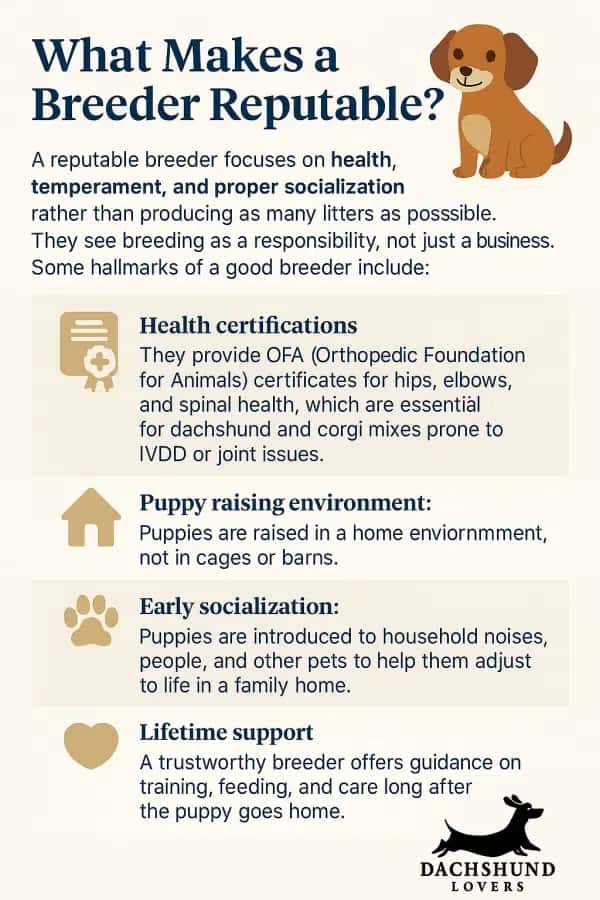
A reputable breeder focuses on health, temperament, and proper socialization rather than producing as many litters as possible. They see breeding as a responsibility, not just a business. Some hallmarks of a good breeder include:
- Health certifications: They provide OFA (Orthopedic Foundation for Animals) certificates for hips, elbows, and spinal health, which are essential for dachshund and corgi mixes prone to IVDD or joint issues.
- Puppy raising environment: Puppies are raised in a home environment, not in cages or barns.
- Early socialization: Puppies are introduced to household noises, people, and other pets to help them adjust to life in a family home.
- Lifetime support: A trustworthy breeder offers guidance on training, feeding, and care long after the puppy goes home.
For more on Dorgi health and what breeders should be screening for, read our Dorgi Health & Lifespan Guide.
Checklist: Questions to Ask a Breeder
Before committing to a purchase, ask these essential questions:
- Can I see the health certificates for both parent dogs?
- Look for OFA scores, IVDD screenings, and DNA tests for hereditary diseases.
- Look for OFA scores, IVDD screenings, and DNA tests for hereditary diseases.
- Can I meet the puppy’s parents?
- Observing the parents helps you gauge temperament and size.
- Observing the parents helps you gauge temperament and size.
- Where are the puppies raised?
- Puppies should be raised indoors, not in kennels or outdoor cages.
- Puppies should be raised indoors, not in kennels or outdoor cages.
- What socialization has been done?
- Have they been exposed to children, other pets, or common household environments?
- Have they been exposed to children, other pets, or common household environments?
- What is included in the price?
- Reputable breeders typically include vaccinations, microchipping, and initial deworming.
- Reputable breeders typically include vaccinations, microchipping, and initial deworming.
- Do you provide a written health guarantee?
- Good breeders stand behind their puppies with contracts and return policies.
- Good breeders stand behind their puppies with contracts and return policies.
Red Flags of Puppy Mills or Backyard Breeders
- No visitation allowed: If a breeder refuses to let you see where the puppies are raised, this is a major red flag.
- Multiple crossbreeds listed for sale: Puppy mills often breed several designer mixes at once.
- Unrealistically low prices: Dorgi puppies priced far below the average ($300–$500 USD) may signal unethical practices.
- Vague answers about parent dogs or health testing: A reputable breeder should answer confidently and provide documentation.
- Selling through third-party sites or pet stores: Ethical breeders typically match puppies directly with owners, not via mass-market outlets.
Where to Find Ethical Breeders
- USA:
- Good Dog – Breeders are screened for health standards.
- AKC Marketplace – While Dorgis are not AKC-recognized, you can find corgi and dachshund breeders with strong reputations.
- Good Dog – Breeders are screened for health standards.
- UK:
- Pets4Homes – Lists breeders with verified health checks and KC paperwork.
- DachshundOwners.co.uk – Offers corgi-cross listings.
- Pets4Homes – Lists breeders with verified health checks and KC paperwork.
- Australia:
- Dogzonline – Features breeders for both dachshunds and corgis.
- Dogzonline – Features breeders for both dachshunds and corgis.
Why It’s Worth the Effort
Paying a little more for a healthy, well-bred puppy from a reputable source often saves money and heartache in the long run. Puppies from mills or poorly managed backyard breeders are prone to:
- Genetic disorders (IVDD, hip dysplasia).
- Behavioral issues (fearfulness, poor socialization).
- Higher vet bills due to untreated illnesses.
Choosing a good breeder also means supporting ethical breeding practices, where the welfare of the dogs comes first.
Adoption vs Breeder — How to Vet Shelters
While rescues are generally more transparent, not all adoption groups are equal. Ask:
- Do they provide a full medical record and vaccination proof?
- Have they performed temperament evaluations?
- Do they offer a trial period or return policy if the dog isn’t a good fit?
To see available Dorgis for adoption, visit:
- AdoptAPet – Nationwide listings in the USA.
- Many Tears Animal Rescue – Known for rehoming corgi and dachshund mixes in the UK.
- PetRescue – The go-to for Australian mixed-breed rescues.
Cost vs Value: Why Ethical Breeding Matters
While paying $800–$1,500 USD (USA) or £600–£1,200 (UK) might seem high, it includes:
- Health testing for genetic issues.
- Initial vet care, vaccinations, and microchipping.
- Support and advice from the breeder for the dog’s lifetime.
Compare this with potentially spending thousands on vet bills due to conditions like IVDD, which are common in poorly bred dachshund mixes.
Summary Table: Breeder vs Puppy Mill
Feature | Reputable Breeder | Puppy Mill |
|---|---|---|
Health Certificates | Yes, OFA, IVDD tests | Rarely, if ever provided |
Living Conditions | Home-raised, clean, socialized | Overcrowded, unsanitary, minimal interaction |
Buyer Screening | Interviews buyers for a good match | Sells to anyone with cash |
Post-Purchase Support | Lifetime guidance, written health guarantees | No follow-up support |
Puppy Pricing | $800–$2,000 (with inclusions) | Often low-priced but with hidden health issues |
Adoption Resources: Where to Find a Dorgi
Adopting a Dorgi is often a more affordable and ethical choice compared to buying from a breeder. While Dorgis aren’t as common as purebred corgis or dachshunds, they do appear in breed-specific rescues, shelters, and online adoption platforms across the USA, UK, and Australia. This section will guide you through where to look, what to expect, and how to ensure a smooth adoption process.
Why Consider Adoption?
- Lower Costs: Adoption fees are typically $200–$500 USD, £150–£350 UK, or $250–$600 AUD, which usually includes vaccinations, microchipping, and desexing.
- Ethical Impact: Adopting a Dorgi helps reduce demand for puppy mills and supports animal welfare organizations.
- Ready for Home Life: Many rescue dogs are already house-trained and socialized, saving you time and effort.
Second Chances: Adoption provides a loving home for dogs that may have been surrendered due to changes in their owners’ circumstances, not because of behavioral issues
Where to Find Dorgis for Adoption – USA
- AdoptAPet
A leading platform for nationwide adoption listings. Simply search for “corgi mix” or “dachshund mix” to find Dorgi-like dogs. - Petfinder
Features thousands of adoptable pets, including designer hybrids. You can filter by breed mix and location. - RescueMe – Corgi Section
A dedicated rescue network for corgis and corgi mixes, with regular listings of corgi–dachshund hybrids. - Dachshund Rescue of North America
While primarily dachshund-focused, they occasionally foster corgi-dachshund mixes.
Where to Find Dorgis for Adoption – UK
- Many Tears Animal Rescue
Known for rehoming corgis and corgi mixes, this rescue often lists hybrids like the Dorgi. - Blue Cross
A trusted UK charity that frequently lists corgi-type breeds and small mixed dogs. - Dogs Trust
The UK’s largest dog welfare charity with adoption centers nationwide. - DachshundOwners.co.uk
Primarily a breeder platform but includes occasional rescue/adoption listings.
Where to Find Dorgis for Adoption – Australia
- PetRescue
Australia’s largest adoption site, with a searchable database for corgi/dachshund mixes. - RSPCA Adopt a Pet
State branches often list small crossbreeds, including Dorgis. - Dachshund Rescue Australia
While focused on dachshunds, they sometimes have corgi mixes available. - Local Corgi Rescues:
Smaller rescue organizations in Melbourne, Sydney, and Brisbane occasionally list Dorgis.
Adoption Fees and What’s Included
Adoption fees usually include:
- Veterinary health check.
- Vaccinations and booster shots.
- Microchipping and registration.
- Flea and tick prevention.
- Spay or neuter surgery.
Cost Comparison Table:
Region | Adopting Fee Range | Typical Inclusions |
|---|---|---|
USA | $200–$500 USD | Vaccinations, microchip, spay/neuter, health check |
UK | £150–£350 | Vaccinations, microchip, initial medical care |
Australia | $250–$600 AUD | Vet check, microchip, desexing, vaccinations |
Post-Purchase Support | Lifetime guidance, written health guarantees | No follow-up support |
Puppy Pricing | $800–$2,000 (with inclusions) | Often low-priced but with hidden health issues |
Tips for Adopting a Dorgi
- Be Flexible: Dorgi puppies are less common; you may find more young adults or seniors available.
- Act Quickly: Hybrids like the Dorgi tend to get adopted fast once listed.
- Ask Questions: Inquire about the dog’s history, behavior, and health status.
- Meet-and-Greet: Arrange to meet the dog in person (or virtually) to see if the temperament fits your lifestyle.
- Prepare Your Home: Review our Dorgi Puppies: Buying, Raising & Care Tips to get your home ready, even for older rescue dogs.
How to Vet a Rescue Organization
Not all rescues operate with the same level of transparency. To ensure you’re adopting from a reputable group, check:
- References and Reviews: Look for testimonials or ratings online.
- Medical Documentation: Ask for vaccination records and vet reports.
- Adoption Policies: Reputable rescues often conduct home checks or interviews to ensure a good match.
- Return Policy: Ethical rescues allow returns if the adoption isn’t a good fit.
Adoption Success Stories
Many owners find that adopting a Dorgi results in a loyal, grateful, and well-adjusted companion. Rescued dogs often bond quickly with their new families, especially when given consistent routines, positive reinforcement, and time to settle in.
Adoption vs Breeder – What’s Right for You?
- Choose adoption if you’re open to an adult dog, want to support animal welfare, and prefer a lower cost.
- Choose a breeder if you’re committed to raising a puppy from scratch and want predictable health records from day one.
Both paths require preparation. We recommend reading our Dorgi Health & Lifespan Guide to understand long-term care before making your decision.
Next Steps
Start your search by setting alerts on:
- AdoptAPet (USA).
- Many Tears Animal Rescue (UK).
- PetRescue (Australia).
If you’re still deciding whether to adopt or buy, our Dorgi Temperament & Personality Traits guide will help you determine if this hybrid is the right fit for your home.
Questions to Ask Before Adopting or Buying a Dorgi
Whether you’re adopting from a rescue or buying from a breeder, asking the right questions is the most important step in ensuring that your future Dorgi is healthy, well-socialized, and ethically sourced. This section provides a comprehensive list of questions to guide your conversations, helping you avoid hidden health issues, poor breeding practices, or mismatched temperaments.
Why Asking Questions Matters
The Dorgi, being a hybrid of dachshunds and Pembroke Welsh corgis, can inherit health risks from both parent breeds. Conditions like intervertebral disc disease (IVDD), hip dysplasia, and obesity are common concerns. By asking key questions, you can:
- Verify that proper health screenings have been performed.
- Understand the dog’s history, diet, and temperament.
- Ensure that you are supporting responsible breeding or ethical rescue practices.
For a deeper understanding of health considerations, see our Dorgi Health & Lifespan Guide.
Questions for Breeders
If you’re considering buying from a breeder, start by confirming their credentials and practices. A reputable breeder will welcome questions and provide detailed answers without hesitation.
Key Questions:
- Can I see the health certificates for both parent dogs?
- Look for OFA hip and elbow scores, eye exams, and genetic screening for IVDD and PRA (Progressive Retinal Atrophy).
- Look for OFA hip and elbow scores, eye exams, and genetic screening for IVDD and PRA (Progressive Retinal Atrophy).
- How many litters do you breed per year?
- Reputable breeders focus on quality, not quantity, typically having no more than 1–2 litters annually.
- Reputable breeders focus on quality, not quantity, typically having no more than 1–2 litters annually.
- Can I visit your home or facility?
- Responsible breeders are transparent about where their puppies are raised.
- Responsible breeders are transparent about where their puppies are raised.
- What early socialization has the puppy experienced?
- Exposure to children, other pets, and normal household sounds is critical for a well-adjusted adult Dorgi.
- Exposure to children, other pets, and normal household sounds is critical for a well-adjusted adult Dorgi.
- What’s included in the price?
- Ask if the puppy comes with vaccinations, microchipping, deworming, and a starter kit.
- Ask if the puppy comes with vaccinations, microchipping, deworming, and a starter kit.
- Do you offer a health guarantee or return policy?
- Most ethical breeders provide a written contract covering genetic health conditions.
- Most ethical breeders provide a written contract covering genetic health conditions.
Questions for Rescues or Shelters
Adoption processes can vary depending on the organization. Some rescues provide a wealth of background information, while others may have limited records. Here’s what to ask:
- What’s the dog’s history?
- Was it surrendered, found as a stray, or rescued from a puppy mill?
- Was it surrendered, found as a stray, or rescued from a puppy mill?
- Has the dog been health-checked by a vet?
- Ask for vaccination records, microchip information, and any known medical issues.
- Ask for vaccination records, microchip information, and any known medical issues.
- What’s the dog’s temperament like?
- Are there any behavioral challenges, such as anxiety, barking, or fear of strangers?
- Are there any behavioral challenges, such as anxiety, barking, or fear of strangers?
- Is the dog house-trained or crate-trained?
- This will help you prepare for training at home.
- This will help you prepare for training at home.
- Does the adoption fee include spay/neuter surgery?
- Many rescues include this in the fee, but it’s always best to confirm.
- Many rescues include this in the fee, but it’s always best to confirm.
- What support is offered after adoption?
- Some rescues provide trial periods or post-adoption advice.
- Some rescues provide trial periods or post-adoption advice.
Checklist for Evaluating Sellers or Rescues
A trustworthy breeder or rescue will:
- Provide clear health documentation (e.g., OFA or vet records).
- Allow home visits or virtual tours.
- Have positive reviews or references from previous buyers/adopters.
- Offer lifetime support, advice, and willingness to take the dog back if needed.
Red Flags to Watch Out For:
- Refusal to answer questions or provide health records.
- Puppies available year-round in large numbers (a puppy mill sign).
- Lack of transparency about the puppy’s parentage or living conditions.
- Selling through third-party outlets (pet stores or mass online ads).
The Top 10 Questions Checklist
Here’s a quick downloadable-style checklist you can save:
Question | Why It Matters |
|---|---|
Can I meet the parents or see their records? | Confirms temperament and health background. |
What health screenings have been done? | Prevents genetic health issues. |
How are puppies socialized? | Ensures adaptability and good behavior. |
What’s included in the fee? | Clarifies vaccinations, microchipping, and starter kits. |
What is the return policy? | Ethical breeders allow returns for health or compatibility issues. |
Has the dog been spayed/neutered? | Reduces medical costs and prevents overbreeding |
Is the dog house-trained? | Helps prepare for home life. |
What’s the dog’s diet and feeding schedule? | Maintains consistency to prevent stomach issues. |
Are there any behavioral notes? | Helps you plan training or adjustments. |
What ongoing support is provided? | Indicates commitment to the dog’s lifelong welfare. |
Prepare Your Questions in Advance
Before you call or visit a breeder/rescue:
- Write your top 5 questions and have them ready to ask.
- Research common breed health problems (IVDD, obesity, dental issues).
- Compare answers across multiple breeders or rescues before making a decision.
Resources for Buyer/Adopter Questions
- Good Dog – Buying Guide (USA): Tips for finding ethical breeders.
- Blue Cross – Adopting a Dog (UK): Key questions for shelters.
- PetRescue – Adoption Guide (AUS): Information about local rescues and adoption protocols.
Internal Guides to Review Before Purchase or Adoption
- Dorgi Puppies: Buying, Raising & Care Tips: Everything you need for preparing a home for a puppy.
- Dorgi Temperament & Personality Traits: Understanding the personality of this hybrid breed.
- Dorgi Health & Lifespan Guide: Key preventive measures to discuss with sellers or rescues.
Next Steps
Once you have answers to these questions and are confident in your choice of breeder or rescue, you’ll be ready to commit. Remember:
- Do not rush. Take the time to compare and verify information.
- Trust your instincts. If something feels off (e.g., lack of transparency), walk away.
- Prepare your home. Use our Dorgi Puppies Guide for tips on safe setups, essential supplies, and early training.
Preparing Your Home for a Dorgi
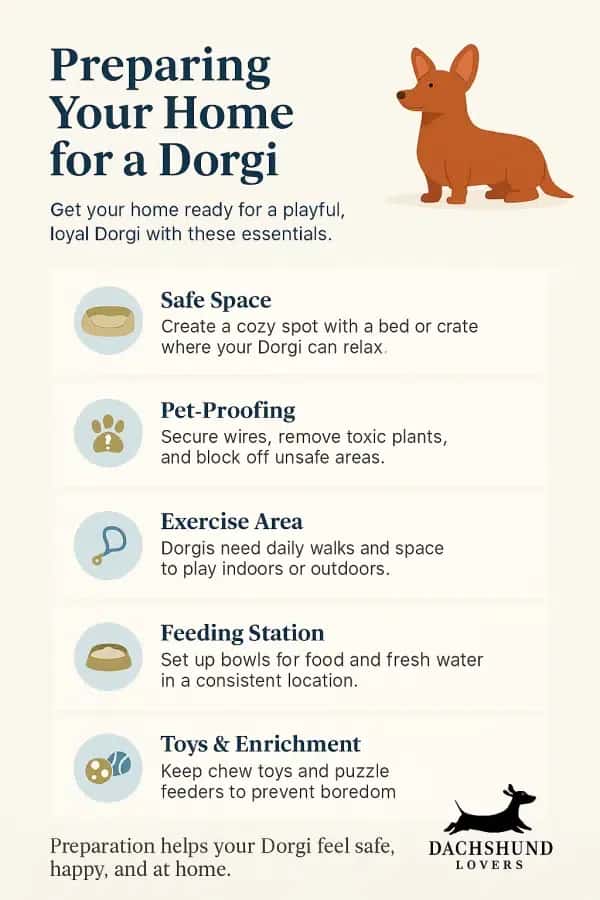
Bringing a Dorgi into your home is both exciting and life-changing. Whether you’re welcoming a playful puppy or a rescue adult, preparation ensures your new companion feels safe, secure, and part of the family from day one. Dorgis are known for their curious nature and sharp intelligence — traits inherited from their Pembroke Welsh corgi and dachshund lineage. A well-prepared home not only supports their physical comfort but also helps avoid common behavioral challenges.
Understanding Your Dorgi’s Needs
Dorgis are not high-maintenance dogs, but they do require structure and thoughtful planning. Their long backs make them prone to injuries if they jump excessively or navigate steep stairs. Their alertness and energy levels also mean they need mental stimulation and physical outlets to prevent boredom. Preparing your home for a Dorgi isn’t just about purchasing supplies — it’s about designing an environment that encourages healthy habits, minimizes risks, and builds a strong bond from the start.
Setting Up a Safe Zone
Creating a dedicated space for your Dorgi is essential, especially during the adjustment period.
- Choose a quiet area in your home that’s away from heavy foot traffic, loud TVs, or busy entrances.
- Use a crate or playpen to provide a sense of security. When introduced correctly, a crate becomes a safe, den-like retreat rather than a place of confinement.
- Add soft blankets and chew-safe toys to make the area inviting. For puppies, include a blanket with the scent of their mother or littermates to help reduce separation anxiety.
Having a safe zone also makes house training easier. Puppies learn faster when they have a consistent sleeping and resting area, while adult rescues feel less overwhelmed when they have a single spot to decompress.
Floor Safety and Stair Management
Dorgis are prone to intervertebral disc disease (IVDD) due to their elongated spines. Jumping from furniture or climbing stairs regularly can strain their back and joints.
- Install baby gates to block access to staircases.
- Use dog ramps or pet stairs near couches and beds to allow easy, safe climbing.
- Add non-slip rugs to hardwood or tile floors to prevent accidental slips, which can injure their spine or legs.
These small adjustments can dramatically reduce the risk of injuries, especially as your Dorgi ages. For more health-focused tips, see our Dorgi Health & Lifespan Guide.
Creating Feeding and Water Stations
Food and water areas should be thoughtfully planned.
- Choose a low-traffic, quiet location for food and water bowls to avoid distractions or stress during mealtime.
- Invest in stainless steel or ceramic bowls — they’re hygienic and less likely to harbor bacteria.
- Place bowls on a non-slip feeding mat to keep everything tidy and prevent spills.
For puppies, schedule feeding times consistently (3–4 meals per day) to support digestion and house training. Adults typically thrive on two balanced meals per day. For specific dietary recommendations, refer to What Should I Feed a Dorgi Puppy?.
Potty Training and Outdoor Preparation
If you have a yard, ensure it’s securely fenced before your Dorgi arrives. Dorgis are curious explorers, and their dachshund genes give them a talent for digging. For apartment living or urban settings:
- Create an indoor potty station with pee pads or artificial grass mats.
- Keep a consistent potty schedule — especially for puppies, who typically need a bathroom break every 2–3 hours.
- Reward successful potty breaks with treats and praise to build positive associations.
Essential Supplies for Your Dorgi
In addition to basic necessities like food and bowls, these items are crucial for a smooth transition:
- Training gear: Harness (preferred over collars), durable leash, and clicker (optional).
- Comfortable bedding: An orthopedic bed with memory foam supports the back and joints.
- Toys: A mix of chew toys, interactive puzzle toys, and plush options to reduce boredom.
- Health items: Nail clippers, dog-safe toothpaste, and a grooming brush for coat maintenance.
- Crate or playpen: Ideal for safe confinement during training or when you’re away.
Puppy-Proofing the Home
Puppy-proofing prevents accidents and discourages destructive chewing.
- Store hazardous items: Cleaning supplies, medications, and small objects should be kept out of reach.
- Secure wires and cords: Puppies love to chew, so consider cord covers or cable management solutions.
- Remove toxic plants: Common houseplants like lilies, aloe vera, and philodendrons are harmful to dogs.
- Use child locks on low cabinets to keep curious noses out.
For more safety guidance, the AKC Puppy-Proofing Guide is an excellent resource.
Introducing Your Dorgi to Other Pets
If you already have pets at home, introductions should be calm and gradual.
- Start with short, supervised sessions where both animals are separated by a gate or leash.
- Reward calm behavior with treats and verbal praise.
- Avoid overwhelming your new Dorgi by limiting the number of interactions in the first few days.
Mental and Physical Stimulation
Dorgis are intelligent dogs that require mental engagement just as much as physical exercise. Without adequate stimulation, they can develop habits like excessive barking or chewing.
- Daily short walks (10–15 minutes, 2–3 times per day) are perfect for their short legs and backs.
- Use interactive toys such as treat-dispensing puzzles to keep them engaged indoors.
- Incorporate basic training sessions (sit, stay, recall) for 5–10 minutes each day.
The First 48 Hours
The first two days are about building trust and setting routines.
- Keep your schedule predictable: consistent feeding, potty breaks, and nap times help your Dorgi settle quickly.
- Keep noise and chaos to a minimum. Avoid hosting guests or taking them on busy outings.
- Offer plenty of positive reinforcement for good behavior, especially during early training sessions.
Printable Home Prep Checklist
Sleeping Area:
- Crate or playpen
- Orthopedic dog bed
- Soft blankets
Feeding:
- High-quality food (puppy or adult)
- Stainless steel bowls
- Non-slip feeding mat
Safety:
- Baby gates
- Non-slip rugs
- Dog ramps for furniture
Training Essentials:
- Harness and leash
- Puppy pads
- Treat pouch
Grooming:
- Dog brush
- Nail clippers
- Dog-safe shampoo
Final Tips for a Smooth Transition
- Establish house rules early: Decide where your Dorgi can sleep, which furniture is off-limits, and stick to these boundaries.
- Invest in quality time: Short, positive play sessions and gentle handling build trust.
- Plan for vet care: Book an initial check-up within the first week to discuss vaccinations, microchipping, and a wellness plan
Training Your Dorgi: Early Tips and Long-Term Success
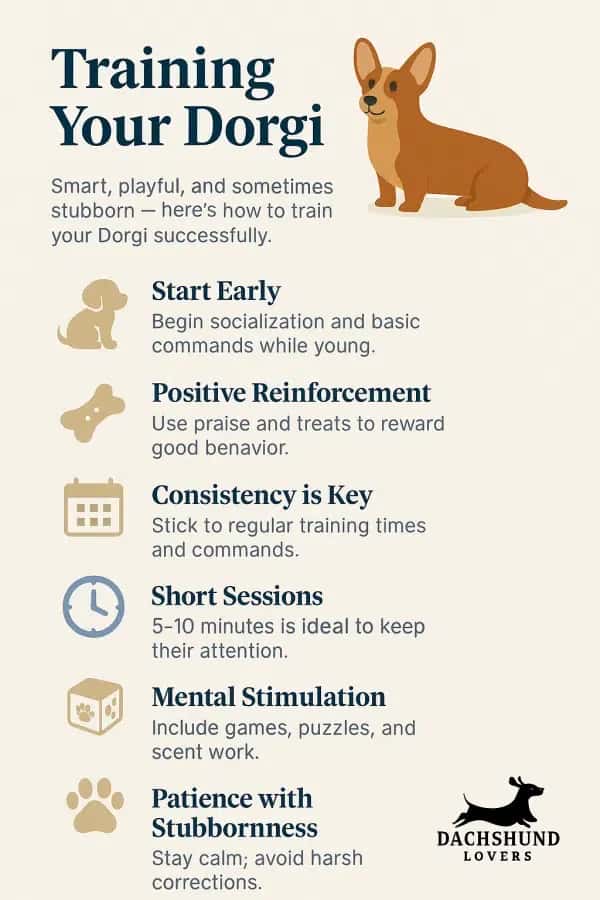
Training is one of the most rewarding parts of owning a Dorgi. This hybrid breed inherits the intelligence and alertness of the corgi along with the stubborn streak of the dachshund. To set your dog up for success, it’s vital to establish consistent routines, start early, and use positive reinforcement techniques recommended by credible organizations like the American Kennel Club (AKC) and the RSPCA.
Why Training a Dorgi Requires Patience
Dorgis are quick learners, but they are also independent thinkers. Their dachshund heritage gives them a streak of determination — which can sometimes feel like stubbornness — while their corgi side makes them eager to please. Training works best when you are consistent, firm, and reward-based. Harsh corrections or punishment-based methods are strongly discouraged by the RSPCA, as they can cause fear and anxiety, making behavioral problems worse.
Foundations of Dorgi Training
- Start Early
Training should begin the day your Dorgi arrives home. Even an 8-week-old puppy can learn basic cues like “sit” or “come” through short, fun sessions. - Use Positive Reinforcement
Reward good behavior with treats, praise, or play. The AKC highlights that reward-based training builds trust and confidence in dogs. - Keep Sessions Short and Fun
Puppies have short attention spans. Limit training sessions to 5–10 minutes, multiple times per day, rather than long, overwhelming lessons. - Be Consistent
Always use the same cues and signals. If “off” means get off furniture, don’t switch between “off” and “down” — consistency prevents confusion.
Crate Training Your Dorgi
Crate training helps with housebreaking, travel, and creating a safe space for your dog. According to the AKC, a crate should be viewed as a “den” — a positive place where your dog feels comfortable.
Steps for Crate Training:
- Introduce Gradually: Place the crate in a quiet, family area with the door open. Use treats or toys to encourage exploration.
- Create Positive Associations: Feed meals inside the crate and provide a comfortable bed or blanket.
- Short Stays: Begin with 5-minute crate periods, gradually increasing duration.
- Never Use as Punishment: The crate should be associated with rest, not isolation.
For a deeper look at creating a calm home environment, review Preparing Your Home for a Dorgi.
Housebreaking and Potty Training
Dorgis can be house-trained relatively quickly if you stick to a consistent schedule. Puppies typically need bathroom breaks:
- First thing in the morning.
- After meals or playtime.
- Before bed.
Housebreaking Tips:
- Take them to the same spot each time. Scent markers help them learn faster.
- Praise and reward immediately after they eliminate outside.
- Supervise indoors. If you can’t supervise, use a crate or a gated play area.
For urban living or apartments, puppy pads can be used temporarily, but transitioning to outdoor potty breaks is encouraged for better long-term habits.
Basic Commands Every Dorgi Should Learn
Teaching basic obedience improves safety and strengthens the bond between you and your dog. Start with:
- Sit: Easiest command, forms the foundation for others.
- Stay: Helps prevent bolting or accidents.
- Come: Critical for recall during outdoor walks or play.
- Leave It: Prevents them from grabbing harmful objects or food.
- Heel: Useful for leash manners.
Socialization is one of the most important steps in raising a well-rounded Dorgi. The critical window for puppies is between 8–16 weeks, but older dogs benefit too. Introduce your Dorgi to:
- Different environments: Parks, car rides, pet-friendly stores.
- People: Adults, children, and visitors.
- Other dogs: Arrange safe playdates or attend puppy classes.
- Sounds: Vacuum cleaners, traffic, and doorbells.
The RSPCA emphasizes that early socialization prevents fear-based behaviors and aggression later in life.
Leash Training
Because of their hunting and herding instincts, Dorgis can be prone to pulling on walks.
- Use a front-clip harness to discourage pulling (safer for their neck and spine).
- Practice the “stop and wait” method: If they pull, stop walking until they return to your side.
- Reward good leash manners with treats and verbal praise.
Dealing with Common Behavioral Issues
- Barking: Dorgis are vocal, especially if bored. Provide puzzle toys, exercise, and mental stimulation to reduce barking.
- Chewing: Puppies explore the world through their mouths. Offer chew-safe toys and redirect inappropriate chewing to approved options.
- Separation Anxiety: Start with short departures and build up gradually. Leave calming music or a shirt with your scent in their crate.
Advanced Training and Enrichment
Once your Dorgi masters basic commands, consider introducing advanced tricks or dog sports like agility or rally obedience. These activities engage their sharp minds and keep them physically active, which is essential for preventing obesity and back issues.
External Training Resources
- American Kennel Club (AKC) Training Library – Free articles and video tutorials.
- RSPCA Dog Training Advice – Welfare-first training methods.
- Victoria Stilwell’s Positive Training – Practical guides for reward-based training.
Internal Guides to Read Next
- Dorgi Puppies: Buying, Raising & – A full step-by-step guide to raising a puppy.
- Care Tips
- Dorgi Temperament & Personality Traits – Understand why Dorgis act the way they do.
- Dorgi Health & Lifespan Guide – Preventive care to support healthy training and exercise.
Key Takeaways for Dorgi Training
Training Focus | Tips |
|---|---|
Positive Reinforcement | Reward with treats, praise, or play immediately after good behavior. |
Consistency | Use the same commands and schedule daily. |
Socialization | Expose them to new people, places, and pets early on. |
Short Sessions | Keep lessons brief (5–10 mins) to avoid frustration. |
Patience | Avoid punishment; focus on rewards and redirection. |
Dorgi Grooming and First-Year Care
Dorgis, with their unique mix of corgi’s double coat and dachshund’s smooth or long-haired coat types, require regular grooming to stay clean, healthy, and comfortable. In addition to coat care, the first year of a Dorgi’s life is crucial for vet check-ups, vaccinations, and developing good grooming habits. With the right approach, grooming can become a bonding experience that keeps your dog’s skin, coat, and overall health in top condition.
Understanding a Dorgi’s Coat
The type of coat your Dorgi has will dictate the grooming frequency:
- Short coat (smooth): Minimal shedding year-round. Weekly brushing is usually sufficient.
- Medium coat: Slightly thicker with light feathering on ears or chest. Brush 2–3 times a week.
- Double coat (corgi-like): Seasonal shedding twice a year (spring and autumn). Requires brushing 3–4 times weekly during heavy shed periods.
If your Dorgi has inherited a double coat, expect seasonal “blowouts,” where large amounts of undercoat shed in clumps. Using a de-shedding tool during these times helps control hair around the home.
Essential Grooming Tools
Investing in the right grooming tools will make upkeep easier and more enjoyable:
- Slicker brush: Ideal for removing tangles and loose fur in medium or double coats.
- Rubber grooming mitt: Great for massaging the skin and loosening short hair.
- Deshedding rake: Useful during shedding seasons to remove undercoat.
- Nail clippers or grinder: Dorgis have fast-growing nails that need trimming every 2–3 weeks.
- Dog-safe shampoo: Look for gentle, pH-balanced formulas that prevent skin dryness.
- Ear cleaning solution: Helps prevent infections in floppy-eared Dorgis.
- Dog toothbrush and toothpaste: Dental hygiene reduces the risk of gum disease and tartar build-up.
For a complete care plan, see our Dorgi Health & Lifespan Guide.
Bathing Guidelines
- Frequency: Every 6–8 weeks, unless they get dirty in between.
- Use lukewarm water: Avoid hot water which can dry out their skin.
- Dog-safe shampoos only: Human products can irritate a dog’s skin barrier.
- Rinse thoroughly: Residual shampoo can cause itching or dryness.
For dogs with a double coat, ensure the undercoat is fully dry to prevent mildew or skin infections. A pet dryer on a cool setting can help.
Ear, Teeth, and Nail Care
- Ears:
Dorgis with corgi-like ears may accumulate wax and dirt. Clean once every 2–3 weeks using a vet-recommended solution. - Teeth:
Brush teeth 2–3 times per week with dog-safe toothpaste. Dental chews or water additives can help prevent tartar. - Nails:
Long nails can cause discomfort and affect gait. Trim every 2–3 weeks or when you hear them clicking on the floor.
Seasonal Grooming Tips
- Spring/Summer:
Use a de-shedding tool weekly to manage increased shedding. Apply dog-safe sunscreen on exposed skin (like the nose) if spending long hours outside. - Autumn/Winter:
Keep coat longer to maintain warmth. Consider paw balm to prevent cracking from cold surfaces.
First-Year Veterinary Care
The first 12 months are critical for establishing a strong health foundation.
Vaccination Schedule (may vary by country):
- 6–8 weeks: Distemper, parvovirus, adenovirus (core vaccines).
- 10–12 weeks: Second round of core vaccines.
- 14–16 weeks: Rabies (where required) and boosters.
- Annual: Booster shots as recommended by your vet.
Deworming & Flea Prevention:
- Puppies need deworming every 2–3 weeks until 12 weeks of age, then monthly.
- Use vet-approved flea/tick prevention year-round.
Spaying/Neutering:
- Most vets recommend between 6–12 months, depending on the dog’s size and health.
Establishing Grooming Routines Early
Introducing grooming in the first year helps your Dorgi become comfortable with the process:
- Start slow: Brush your puppy for just 2–3 minutes and reward with treats.
- Handle paws and ears: Regular gentle handling builds trust and reduces fear of nail trims or ear cleaning.
- Positive associations: Keep sessions short and enjoyable.
Printable Grooming Checklist
Task | Frequency |
|---|---|
Brushing | Weekly (short coats); 2–3 times per week (medium/double). |
Bathing | Every 6–8 weeks. |
Nail Trimming | Every 2–3 weeks. |
Teeth Brushing | 2–3 times per week. |
Ear Cleaning | Every 2–3 weeks |
Deshedding | As needed during spring/autumn shedding seasons. |
Puppy vs. Adult Grooming Needs
- Puppies: Softer, less dense coats require gentler brushing but more frequent acclimation to grooming tools. Start nail trims and dental care early.
- Adults: Grooming frequency depends on coat type, but regular maintenance prevents matting and keeps the skin healthy.
External Grooming Resources
- American Kennel Club Grooming Guide – Detailed coat and nail care advice.
- RSPCA Dog Grooming Advice – Welfare-first grooming recommendations.
Dorgi Health and Vaccination Checklist
A healthy Dorgi begins with a strong foundation of preventive care, regular vet visits, and awareness of breed-specific health risks. Because the Dorgi is a mix of the dachshund and Pembroke Welsh corgi, it inherits certain predispositions, such as intervertebral disc disease (IVDD) and joint problems. This guide provides a comprehensive health and vaccination checklist to help you keep your Dorgi thriving well into adulthood.
Common Health Concerns in Dorgis
Dorgis are generally healthy, but hybrid vigor doesn’t eliminate risks. According to the VCA Animal Hospitals and American KAmerican Kennel Club (AKC), the following conditions are worth monitoring:
- Intervertebral Disc Disease (IVDD):
Due to their long spines, Dorgis are prone to spinal disc herniation, which can cause pain, nerve damage, or even paralysis. Limiting jumping, maintaining a healthy weight, and providing ramp access to furniture are key prevention strategies. - Hip Dysplasia:
More common in corgis, this condition affects hip joint formation and can cause arthritis. Breeders should screen parent dogs for this issue using OFA (Orthopedic Foundation for Animals) certifications. - Patella Luxation:
A common small-breed issue where the kneecap slips out of place, affecting mobility. - Obesity:
Dorgis are food-motivated. Obesity not only increases the risk of diabetes but also exacerbates IVDD and joint stress. - Dental Issues:
Smaller mouths can lead to overcrowding and tartar build-up. Regular brushing and dental chews are essential. - Eye Conditions:
Progressive Retinal Atrophy (PRA) and cataracts are seen in both parent breeds, so regular eye exams are beneficial.
For a more detailed breakdown, refer to our Dorgi Health & Lifespan Guide.
Vaccination Timeline for Puppies
Following a vet-approved vaccination schedule is crucial during your Dorgi’s first year to protect against life-threatening illnesses such as parvovirus and distemper.
Age | Core Vaccinations | Optional Vaccinations |
|---|---|---|
6–8 weeks | Distemper, Parvovirus, Adenovirus (DHPP combo). | Bordetella (kennel cough), if needed. |
10-12 weeks | Second DHPP shot. | Leptospirosis (if at risk). |
14–16 weeks | DHPP booster + Rabies (where required by law). | Lyme disease (for tick-prone regions). |
12 months | DHPP booster and Rabies booster. | Bordetella annual booster. |
After the first year, boosters are typically given every 1–3 years depending on your vet’s advice and regional regulations.
Adult Health Maintenance
- Annual Vet Check-ups:
Even healthy Dorgis should have at least one comprehensive vet visit per year. This includes:
- Physical exam (spine, joints, teeth, eyes).
- Heart and lung check.
- Vaccination boosters.
- Parasite prevention review.
- Weight Monitoring:
Keeping your Dorgi lean is crucial for spine and joint health. The AKC recommends maintaining a visible waist and being able to feel (but not see) the ribs. - Dental Care:
Brush teeth 2–3 times per week with dog-safe toothpaste. Annual dental cleanings may be recommended by your vet.
Deworming and Parasite Prevention
Puppies are especially vulnerable to intestinal parasites like roundworms and hookworms.
- Deworming Schedule: Every 2–3 weeks from 2 weeks old until 12 weeks, then monthly up to 6 months.
- Flea/Tick Control: Use vet-approved treatments like NexGard or Frontline.
- Heartworm Prevention: Monthly preventives are essential in mosquito-prone areas.
IVDD Prevention Tips
The VCA Animal Hospitals emphasize that IVDD prevention involves proactive care:
- Use ramps: Avoid stairs and furniture jumps.
- Keep weight in check: Overweight dogs are at significantly higher risk.
- Limit strenuous exercise: Avoid long runs or rough play.
- Support when lifting: Always lift with two hands — one supporting the chest, the other the hindquarters.
First-Year Vet Checklist
Milestone | What's Needed |
|---|---|
8 weeks | First vaccinations, microchipping, deworming. |
12 weeks | Booster shots, flea/tick prevention |
16 weeks | Final core vaccines, rabies shot (if required |
6 Months | Spay/neuter consultation, dental check. |
12 Months | Booster vaccines, annual wellness exam. |
Signs to Watch For
Early detection of health issues can save lives. Contact your vet if you notice:
- Limping, reluctance to jump, or back sensitivity (possible IVDD).
- Persistent coughing, lethargy, or breathing difficulties.
- Sudden changes in appetite or weight.
- Cloudy eyes, excessive tearing, or squinting.
Home Health Habits
Beyond vet visits, daily and weekly habits play a huge role in long-term health:
- Daily:
- Brushing teeth or offering dental chews.
- Checking ears for dirt or odor.
- Observing gait and energy levels.
- Brushing teeth or offering dental chews.
- Weekly:
- Brushing coat to remove loose hair.
- Inspecting nails and trimming if needed.
- Brushing coat to remove loose hair.
Nutritional Health
Feeding high-quality food tailored to small to medium breeds supports joint and bone development. Brands like Hill’s Science Diet Small Bites or Royal Canin Small Breed Puppy are excellent starting points. For adult dogs, focus on lean proteins, omega-3s for joint support, and controlled calories.
For portion guides and feeding schedules, see What Should I Feed a Dorgi Puppy?
Insurance and Emergency Care
Due to the risk of spinal issues, pet insurance can be a worthwhile investment. Providers like Trupanion (USA), Petplan (UK), or Bow Wow Meow (AUS) offer plans covering IVDD and hereditary conditions.
Have a list of emergency vets nearby — Dorgis prone to back injuries may require urgent care if symptoms appear suddenly.
Printable Dorgi Health Checklist
Daily:
- Monitor weight and appetite.
- Clean water and balanced meals.
- Quick health scan (coat, ears, teeth).
Monthly:
- Flea/tick and heartworm prevention.
- Nail trimming and ear cleaning.
Quarterly:
- Deworming (for younger dogs or if recommended).
- Full grooming session.
Annually:
- Vet exam and vaccination updates.
- Dental cleaning (if required).
Frequently Asked Questions (FAQs)
More From This Series:
Continue exploring our full Dorgi series for a 360° view of the breed:
- About Dorgi: History, traits, and hybrid facts.
- Dorgi Puppies: Buying, Raising & Care Tips: Your complete puppy guide.
- Full-Grown Dorgi: Size, Weight & Temperament: What to expect in adulthood.
- Dorgi Temperament & Personality Traits: Behavioral insights.
- Dorgi Health & Lifespan Guide: Health risks and prevention.
Authored by
James
James is the founder of Dachshund Lovers and the proud human of Harvey, a mini dapple with a big personality. He writes to empower and connect the dachshund community, blending founder insights with honest, experience-based stories about life with this incredible and special breed. James brings candid, experience-backed opinions to the community and always focused on fewer, better products and ideas that genuinely improve life for dachshunds and their people.
Read moreJames is the founder of Dachshund Lovers and the proud human of Harvey, a mini dapple with a big personality. He writes to empower and connect the dachshund community, blending founder insights with honest, experience-based stories about life with this incredible and special breed. James brings candid, experience-backed opinions to the community and always focused on fewer, better products and ideas that genuinely improve life for dachshunds and their people.
Read moreDisclaimer
This content is for informational purposes only and should not be considered veterinary advice. Always consult with a licensed veterinarian regarding your dog’s health and wellbeing.
There are no comments yet
Leave a comment